


Kinetic punishment is the ultimate filter for autonomous bipedal hardware. In the hyper-agile development landscape of 2026, engineers design humanoid robots that not only walk but jump, land, and carry heavy payloads. While magnesium provides exceptional weight reduction for the upper torso, it lacks the fracture toughness to survive the violent, repetitive impact forces experienced at the distal extremities—specifically the ankles, footplates, and lower knee linkages. When a 100-kilogram robot lands a jump, the dynamic load concentrated on the ankle joint can exceed several thousand Newtons. A standard aluminum or magnesium part will shatter or permanently deform under this stress. Navigating this demand for extreme impact resistance and low inertial mass requires the strategic deployment of 3D printed titanium robot parts. This advanced additive discipline defies the geometric constraints of traditional subtractive machining, allowing engineers to "grow" complex, hollow, shock-absorbing bionic structures from raw titanium powder. Jucheng Precision operates as a high-fidelity metallurgical sanctuary in the Shenzhen precision manufacturing hub, providing the Direct Metal Laser Sintering (DMLS) capacity and thermal post-processing rigor needed to deliver these exotic components. As the peak structural element within our humanoid robot parts portfolio, we turn raw titanium powder into indestructible mechanical lifelines, ensuring your robot lands every step with unyielding sovereignty.
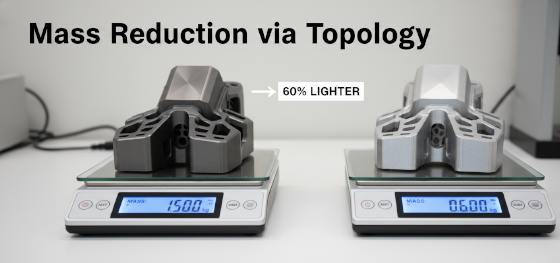
Establishing a resilient bionic anatomy demands the absolute rejection of "Solid-Billet" logic. Amateurs often attempt to machine complex titanium joints from a solid block, resulting in parts that are either too heavy (killing battery life) or astronomically expensive due to the massive tool wear and material waste associated with cutting Grade 5 Titanium. Jucheng Precision eliminates this "Machining Ransom" by utilizing DMLS to achieve near-net-shape geometries featuring internal lattice webs that are physically impossible to reach with a CNC spinning cutter. This guide deconstructs the unique metallurgical advantages of Ti-6Al-4V, the physics of powder-bed fusion, and why our "Print-then-Machine" hybrid protocol is the mandatory foundation for anyone developing high-impact robotic structures for global deployment.
Ti-6Al-4V (Grade 5): Why is Titanium the undisputed king of the strength-to-weight ratio?
DMLS Technology: How does Direct Metal Laser Sintering create hollow bionic bones?
Cost-Benefit Analysis: When does printing titanium make more financial sense than machining?
The JUCHENG Angle: Guaranteeing stress-free titanium parts through hybrid manufacturing.
Frequently Asked Questions: 3D Printed Titanium
Ti-6Al-4V (Grade 5): Why is Titanium the undisputed king of the strength-to-weight ratio?
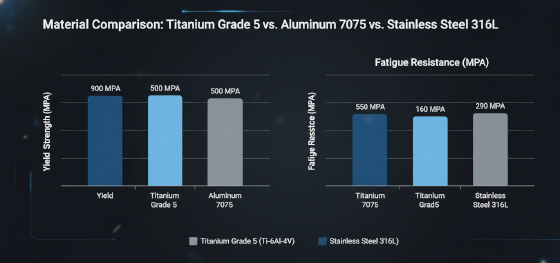
Fatigue resistance separates titanium from every other industrial metal. While 7075 Aluminum is light, it suffers from a finite "Fatigue Limit"; after a certain number of stress cycles, it will inevitably crack, regardless of how low the load is. Ti-6Al-4V (Titanium Grade 5) possesses an infinite fatigue life below its stress threshold, meaning a robotic footplate can strike the ground a million times without accumulating micro-fractures. It offers a yield strength (880-950 MPa) that rivals hardened steel, but at only 55% of the weight (density of 4.43 g/cm³). Furthermore, titanium has a relatively low "Young's Modulus" compared to steel, making it slightly more "springy." This inherent elasticity allows the titanium ankle joint to actively absorb and dissipate the kinetic shock of a footstep, protecting the delicate harmonic drives and sensors housed above it. By utilizing 3D printed titanium, engineers secure the strength of a tank tread with the weight profile of an aerospace chassis.
DMLS Technology: How does Direct Metal Laser Sintering create hollow bionic bones?
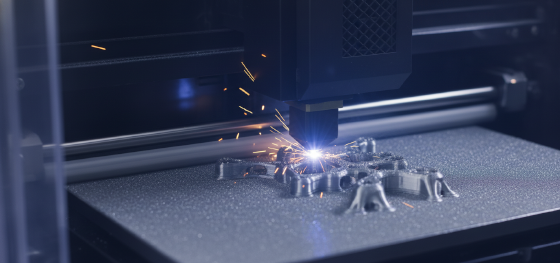
Generative complexity is realized through the physics of powder bed fusion. DMLS operates by spreading a microscopic layer of spherical titanium powder (often 20-40 microns thick) across a build platform. A high-power fiber laser (typically 400W to 1000W) fires into the chamber, precisely melting the powder according to the digital slices of the CAD file. The platform lowers, more powder is spread, and the laser fires again, fusing the new layer to the solid metal below. This "Bottom-Up" growth allows Jucheng Precision to manufacture parts that are entirely hollow or filled with complex, mathematically optimized "Gyroid" or "Lattice" structures. Because the laser can reach anywhere on the 2D plane, we can design internal reinforcement ribs that mimic the trabecular (spongy) bone found in human joints. These bionic structures maximize stiffness exactly where the load vectors demand it, while removing mass from low-stress areas. We don't just "shape" the metal; we engineer its internal density.
Cost-Benefit Analysis: When does printing titanium make more financial sense than machining?
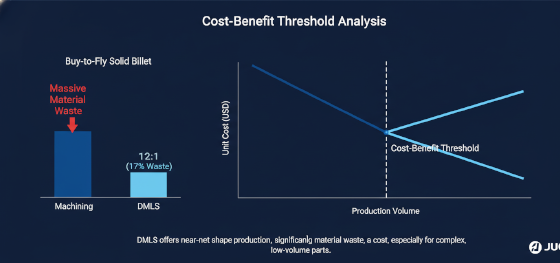
Procurement logic for titanium hinges entirely on the "Buy-to-Fly" ratio. This aerospace metric calculates the weight of the raw material purchased versus the weight of the final part. Because Titanium Grade 5 is incredibly expensive and notoriously difficult to cut, turning a 10kg solid billet into a 1kg complex bionic joint means you are paying to grind 9kg of expensive alloy into worthless chips (a 10:1 ratio). Furthermore, machining titanium requires slow spindle speeds and consumes expensive carbide cutters rapidly, driving up the CNC machine-hour costs. DMLS 3D printing operates near a 1:1 "Buy-to-Fly" ratio; you only melt the powder you actually need for the part, and the unfused powder is recycled for the next build. If your robotic joint features high organic complexity, internal cooling channels, or hollow sections, printing the near-net shape in titanium is dramatically cheaper and faster than attempting to subtractively mill it from a solid block. The more complex the geometry, the more the financial pendulum swings toward DMLS.
The JUCHENG Angle: Guaranteeing stress-free titanium parts through hybrid manufacturing.
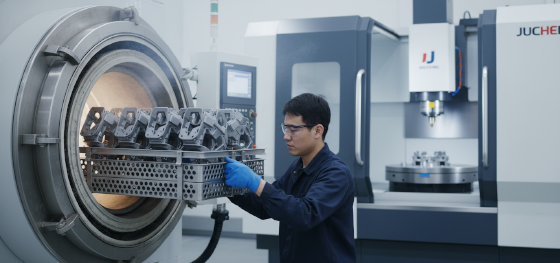
Manufacturing excellence at Jucheng Precision is built on the foundation of the "Hybrid Protocol." We recognize that while DMLS can grow impossible shapes, it cannot produce the +/- 0.005mm tolerances required for cross-roller bearing seats and actuator flanges. Furthermore, the rapid heating and cooling of the laser process traps massive residual thermal stresses inside the printed titanium. We eliminate these "Geometric Ghosts" by immediately transferring the printed plates to a high-temperature vacuum furnace for a rigorous "Stress-Relief Annealing" cycle. Once the molecular tension is neutralized, we move the parts to our 5-axis Haas CNC centers. We utilize custom, vibration-damping fixtures to securely hold the complex organic shapes while we precision-mill the final mounting bores and joint interfaces. We combine the "Infinite Complexity" of additive lasers with the "Absolute Accuracy" of subtractive aerospace machining. Stop compromising your robot's agility with heavy aluminum or weak plastics. Leverage our decade of titanium mastery to validate rapidly and launch bionic hardware that survives the harshest impacts. Contact our technical team today for a free DFM review.
Frequently Asked Questions: 3D Printed Titanium
Question: Is DMLS 3D printed titanium as strong as forged or machined titanium billet?
Answer: Yes. Because the metal powder is fully melted (not just sintered), DMLS parts achieve 99.9% density. After our mandatory thermal annealing and Hot Isostatic Pressing (HIP) protocols, the mechanical properties equal or exceed those of cast or forged Ti-6Al-4V.
Question: What is the surface finish like on a raw 3D printed titanium part?
Answer: The "as-printed" surface is relatively rough, resembling a fine cast metal or a heavy sandblast finish (Ra 5 - 10 µm). For robotic applications, we typically bead-blast the exterior for a uniform matte look, and CNC machine any critical mating surfaces to a smooth finish.
Question: Can JUCHENG print hollow titanium parts with trapped powder inside?
Answer: Our engineers perform a strict DFM review to design "Escape Holes" (powder removal ports) into any hollow or lattice structure. This ensures all unfused powder is evacuated using compressed air and vibration before heat treatment, preventing internal mass accumulation.

