


Kinetic efficiency dictates the survival of untethered autonomous systems. In the hyper-agile environment of 2026, when engineering teams design the structural chassis of a bipedal walker or a high-speed quadruped, the physical mass of the skeleton determines battery life, actuator size, and ultimate payload capacity. While aerospace-grade aluminum has long been the default choice for lightweight rigidity, the relentless pursuit of energy optimization requires pushing the periodic table to its absolute limit. Navigating this demand for extreme mass reduction requires the strategic deployment of Magnesium CNC machining for robots. This specialized subtractive discipline utilizes alloys like AZ31B and AZ91D, which offer the highest strength-to-weight ratio of any structural metal, effectively acting as the ultimate "Diet" for heavy bionic hardware. Jucheng Precision operates as an elite metallurgical sanctuary in the Shenzhen precision manufacturing hub, providing the specialized, fire-safe infrastructure needed to conquer this highly combustible element. As a critical pillar within our humanoid robot parts development portfolio, we transform raw, volatile magnesium billets into vibration-damping, sub-micron skeletal linkages, ensuring your bionic hardware moves with unprecedented, lightweight agility.
Establishing a resilient magnesium supply chain demands the absolute rejection of "general-purpose" machine shops. Amateurs often refuse to process magnesium—or worse, attempt to machine it on standard equipment—unaware that a single spark from a dull cutter can ignite the magnesium chips, resulting in an inextinguishable Class D metal fire that burns at 3,000°C. Jucheng Precision eliminates these "Catastrophic Risks" by enforcing a strict, purpose-built "Wet Machining" protocol across dedicated, isolated CNC cells. We recognize that machining magnesium is not just a metal-cutting operation; it is an exercise in hazardous materials management. This guide deconstructs the structural superiority of magnesium over aluminum, the violent thermodynamics of chip ignition, and why our immediate surface-passivation protocol is the mandatory foundation for anyone developing lightweight, corrosion-resistant robotic architectures.
Magnesium vs. Aluminum: Why sacrifice 33% of your robot's weight?
The Safety Challenge: How do you prevent catastrophic magnesium fires?
Surface Protection: Why must magnesium frames be coated immediately?
The JUCHENG Angle: Dedicated Safety Cells for Magnesium Machining
Frequently Asked Questions: Magnesium Skeletons
Magnesium vs. Aluminum: Why sacrifice 33% of your robot's weight?

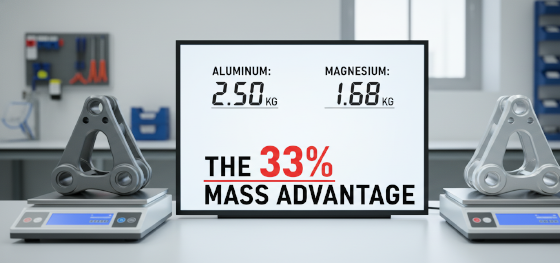
Mass reduction is the most expensive variable in mobile robotics, and magnesium is the undisputed king of structural lightweighting. When comparing materials for a robotic torso, pelvis, or heavy femoral link, the density difference is stark: Aluminum (such as 6061 or 7075) sits at roughly 2.7 g/cm³, while Magnesium (AZ31B) sits at a mere 1.74 g/cm³. This represents a staggering 33% reduction in weight for a part of identical volume. If an aluminum leg assembly weighs 10 kilograms, switching to magnesium drops it to 6.7 kilograms. This 3.3-kilogram saving per leg drastically lowers the "Moment of Inertia," allowing the knee and hip actuators to accelerate faster, draw significantly less current from the battery, and utilize smaller, cooler-running harmonic drives. Furthermore, magnesium possesses a "Specific Damping Capacity" that is nearly 100 times greater than aluminum. This means when a bipedal robot's foot strikes the ground, the magnesium bone structure actively absorbs and dissipates the shockwave, preventing high-frequency harmonic vibrations from traveling up the leg and destroying delicate LiDAR sensors or disrupting the IMU (Inertial Measurement Unit). We don't just "cut weight"; we engineer a naturally shock-absorbing bionic skeleton.
The Safety Challenge: How do you prevent catastrophic magnesium fires?
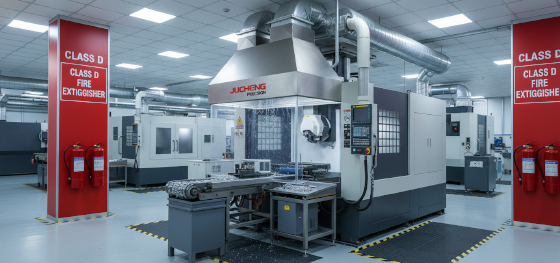
Combustion risk is the primary reason the vast majority of machine shops refuse to quote magnesium projects. In its solid billet form, magnesium is perfectly safe. However, during the CNC milling process, the cutter produces fine chips, ribbons, and highly flammable metallic dust. If the cutting tool becomes dull or if the spindle speed creates excessive friction, the localized heat can instantly ignite this dust. A magnesium fire cannot be extinguished with water or CO2; applying water actually triggers a violent hydrogen explosion. Jucheng Precision eliminates this "Thermal Catastrophe" by deploying dedicated, isolated CNC cells designed exclusively for magnesium. We enforce a strict "Wet Machining" protocol, flooding the cutting zone with specialized, high-volume mineral-oil-based coolants that prevent the chips from ever reaching their ignition temperature. Furthermore, our machines are equipped with automated chip conveyors that immediately evacuate the flammable debris into sealed, fire-proof underwater collection bins. We treat magnesium machining not as a standard operation, but as a high-security hazardous material process, ensuring your parts are cut safely and efficiently without risking our facility or your supply chain.
Surface Protection: Why must magnesium frames be coated immediately?

Galvanic corrosion is the silent executioner of raw magnesium hardware. Magnesium is highly anodic (active) on the galvanic scale. If a raw magnesium robot joint comes into contact with moisture and a dissimilar metal—such as a steel bearing or a titanium screw—it will act as a sacrificial anode, corroding rapidly and turning into a powdery white oxide. A beautifully machined pelvic frame can literally dissolve at the mounting points within weeks if left unprotected. Jucheng Precision prevents this "Chemical Decay" by enforcing an "Immediate Passivation" mandate. The moment a magnesium part finishes its final CNC cycle and passes CMM inspection, it is immediately transferred to our in-house surface treatment laboratory. We apply a chemical conversion coating (such as a Chromate or non-chromate Alodine equivalent) that chemically alters the outer microns of the metal, creating an inert, protective skin. For maximum durability, we frequently follow this with a specialized epoxy primer or a high-performance Micro-Arc Oxidation (MAO) coating. This ensures that your lightweight skeletal frames remain structurally sovereign, immune to the sweat of assembly technicians and the humidity of coastal operating environments.
The JUCHENG Angle: Dedicated Safety Cells for Magnesium Machining
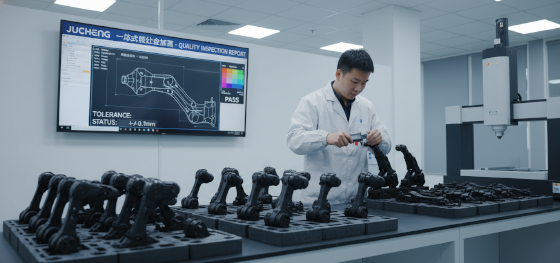
Manufacturing excellence at Jucheng Precision is built on the foundation of specialized infrastructure. We don't try to force magnesium through a standard aluminum workflow; we respect the chemistry. Many hardware startups struggle to find a reliable vendor for AZ31B or AZ91D because traditional shops fear the liability. JUCHENG operates purpose-built, safety-controlled 5-axis CNC cells dedicated entirely to magnesium machining. This specialization allows us to run aggressive feed rates with razor-sharp carbide tooling, delivering complex bionic geometries with +/- 0.01mm tolerances. We provide full material lot traceability, CMM inspection reports, and certified surface treatments for every batch, ensuring your project meets the strict requirements of the aerospace and robotics industries. Stop compromising your robot's battery life with heavy aluminum frames because you can't find a capable vendor. Leverage our decade of exotic alloy mastery to validate rapidly and launch the lightest, most agile machine possible. Contact our technical team today for a free DFM review.
Frequently Asked Questions: Magnesium Skeletons
Question: Is magnesium strong enough to replace 7075 aluminum in robotic joints?
Answer: While Magnesium AZ31B has a lower absolute yield strength than 7075-T6, its "Specific Strength" (strength divided by density) is excellent. By slightly thickening critical ribs—which still results in a lighter overall part—magnesium easily replaces aluminum in non-impact, load-bearing torso and arm links.
Question: How does JUCHENG handle the threaded holes in a magnesium part?
Answer: Because magnesium threads can strip under high torque, we routinely CNC machine precision bores and install stainless steel or brass "Helicoils" or threaded inserts. This provides strong, reusable threads while maintaining the overall lightweight structure of the magnesium frame.
Question: Can magnesium parts be painted for cosmetic robotic enclosures?
Answer: Yes. Once the magnesium has received its anti-corrosion conversion coating, it serves as an excellent substrate for automotive-grade 2K wet paints or specialized powder coats, delivering a premium, retail-ready finish.

