


Kinetic inefficiency is the primary assassin of autonomous mobility. In the hyper-agile landscape of 2026, when engineering teams transition a bipedal robot from a tethered laboratory experiment to an untethered factory worker, the physical mass of the chassis dictates the entire system's viability. If the structural limbs and torso are over-engineered blocks of solid aluminum, the actuators must draw excessive current just to lift the robot's own weight. This massive thermal output drains the onboard battery within minutes and drastically reduces the available payload capacity for the hands to carry actual goods. Navigating this requirement for extreme "Strength-to-Mass" optimization requires the strategic deployment of Lightweight humanoid robot frames. This advanced discipline replaces traditional rectilinear beams with organic, web-like architectures that mimic the cellular structure of human bone. Jucheng Precision operates as a high-fidelity bionic sanctuary in the Shenzhen precision manufacturing hub, providing the exotic hybrid manufacturing depth needed to construct these complex skeletons. As a critical pillar within our humanoid robot parts portfolio, we don't just "reduce weight"; we engineer the aerodynamic and structural sovereignty required for your robot to walk, run, and balance with unprecedented energy efficiency.
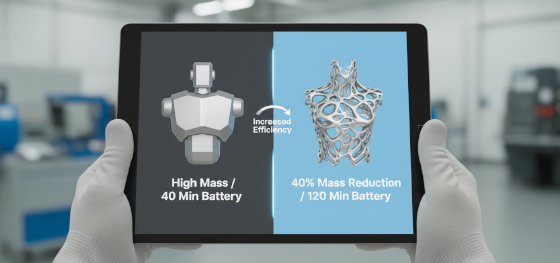
Establishing a resilient bionic supply chain demands the absolute rejection of "subtractive-only" thinking. Amateurs often attempt to lighten a heavy robot arm by simply drilling "Swiss-cheese" holes into a solid billet of metal, unaware that this creates dangerous stress risers that will fracture under the dynamic load of a footstep. Jucheng Precision eliminates these "Structural Compromises" by embracing the physics of additive growth followed by subtractive refinement. This guide deconstructs the necessity of generative AI design, the thermodynamics of metal 3D printing, and why our integrated DMLS and CNC protocol is the mandatory foundation for anyone developing scalable humanoid architectures that defy gravity.
The Weight Penalty: Why Every Gram Matters in a Bipedal Robot
Generative Design & Topology Optimization: The Rise of Organic Bones
Hybrid Manufacturing: Merging DMLS with 5-Axis CNC Precision
The JUCHENG Angle: Seamless Print-to-Machine Execution
Frequently Asked Questions: Bionic Skeletons
The Weight Penalty: Why Every Gram Matters in a Bipedal Robot
Dynamic balancing in a two-legged machine requires the instantaneous redistribution of momentum. Unlike a wheeled AGV whose weight is fully supported by the floor, a bipedal robot constantly fights gravity, often balancing its entire mass on a single ankle joint during mid-stride. Every unnecessary gram located in the upper torso or the distal limbs (forearms) acts as a pendulum weight, exponentially increasing the "Moment of Inertia." The heavier the pendulum, the harder the harmonic drives and frameless motors must work to stop the swinging motion and re-center the robot. This "Weight Penalty" leads to overheated actuators, sluggish response times, and a severely degraded battery life. By transitioning to bionic lattice structures, engineers can slash the mass of a thoracic spine or a pelvic cradle by 40% to 60%. This massive reduction in "Dead Weight" directly increases the robot's functional payload, allowing it to carry heavier tools or packages without requiring larger, more expensive motors. We turn a sluggish mechanical prototype into an agile, highly responsive athlete.
Generative Design & Topology Optimization: The Rise of Organic Bones
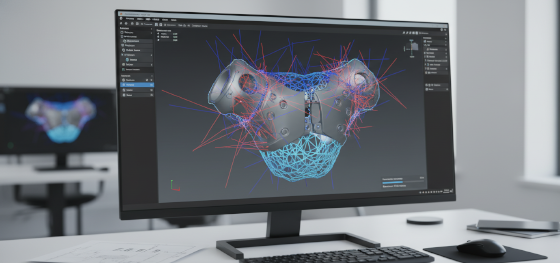
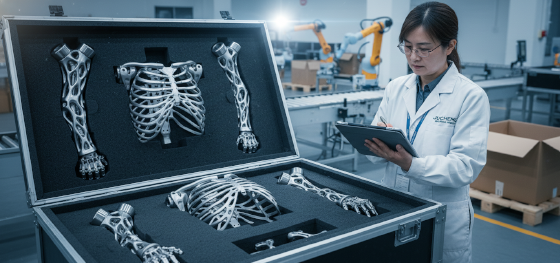
Material placement must be dictated by stress vectors, not human aesthetics. The blocky, square metal frames of early robotics were a symptom of manufacturing limitations—engineers designed parts that were easy to cut on a standard mill. The modern bionic skeleton is born in the digital space through Generative Design and Topology Optimization. In this software environment, the engineer inputs the required mounting points (e.g., motor A to bearing B) and the expected load forces (e.g., 500 Newtons of shear stress). The AI algorithm then iteratively removes every cubic millimeter of metal that does not actively contribute to supporting that load. The result is a highly complex, organic-looking structure that resembles a bird's bone or a tree root. These parts feature hollow internal cavities, sweeping arches, and dense lattice webs. While visually stunning, these optimized geometries are physically impossible to manufacture using traditional CNC machining alone, as a spinning cutter cannot reach inside a closed, web-like cavity to remove material.
Hybrid Manufacturing: Merging DMLS with 5-Axis CNC Precision
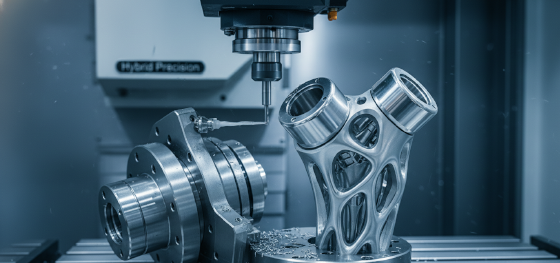
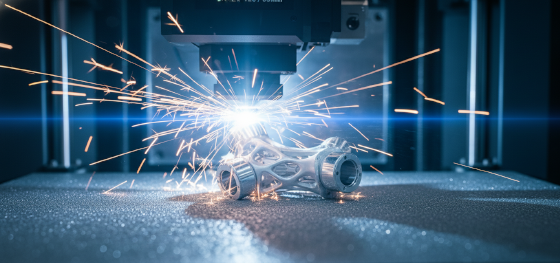
Physical realization of organic geometry requires a two-stage thermodynamic and subtractive dance. Jucheng Precision resolves the manufacturing paradox of generative design by deploying Direct Metal Laser Sintering (DMLS). In our additive manufacturing bay, high-power fiber lasers fuse microscopic layers of aluminum (AlSi10Mg) or titanium powder to "grow" the complex, hollow bone structures from the ground up. This process allows for infinite geometric freedom, creating the lightweight lattice cores that make the bionic shape possible. However, DMLS parts possess a relatively rough, matte surface finish (typically Ra 5-10 µm) and cannot achieve the +/- 0.005mm dimensional tolerances required for seating precision harmonic drives and cross-roller bearings. The "Hybrid" solution mandates a secondary operation. Once the bionic bone is printed and thermally stress-relieved, we transfer it to our 5-Axis CNC machining centers. We use custom, vibration-damping fixtures to hold the delicate lattice structure securely while the CNC spindle performs a surgical finishing pass on all critical mounting flanges and bearing bores. We combine the "Impossible Shape" of 3D printing with the "Absolute Precision" of aerospace machining.
The JUCHENG Angle: Seamless Print-to-Machine Execution
Manufacturing excellence in the robotics sector is built on the foundation of single-source accountability. Managing a complex generative part across fragmented suppliers—printing the part at a rapid prototyping house and shipping it to a traditional machine shop to cut the bearing seats—is a recipe for "Tolerance Stack-up" and disastrous alignment errors. The machinist will not know where the "Zero Point" of the printed part is, resulting in misaligned joints. Jucheng Precision is one of the few facilities globally offering seamless "Print-to-Machine" hybrid manufacturing under one ISO 9001 certified roof. Because our 3D printing technicians and our 5-axis CNC programmers share the same digital CAD files and the same metrology lab, we design precision "Sacrificial Locating Tabs" into the 3D print. These tabs ensure the CNC machine knows exactly where the bionic bone is in 3D space, guaranteeing perfect concentricity for every joint. Stop gambling your robot's agility on fragmented supply chains. Leverage our decade of high-performance replication mastery to validate rapidly and launch profitably. Contact our technical team today for a free DFM review.
Frequently Asked Questions: Bionic Skeletons
Question: What materials can JUCHENG use for DMLS robotic bones?
Answer: For optimal strength-to-weight ratios, we predominantly utilize Aluminum AlSi10Mg for lightweight torso and arm frames, and Titanium Ti-6Al-4V (Grade 5) for high-stress distal joints like ankles and feet that endure severe impact forces.
Question: How do you ensure the internal hollow structures of a 3D printed part are strong enough?
Answer: Before printing, our engineers run Finite Element Analysis (FEA) to verify the internal lattice density against your specified payload parameters. The DMLS process creates 100% dense metallurgical bonds, ensuring the printed metal behaves like forged billet.
Question: Can these bionic frames be painted or finished?
Answer: Yes. We routinely perform media-blasting to smooth the raw DMLS surface, followed by hard-anodizing (for aluminum) or specialized powder coating to provide a premium, retail-ready cosmetic finish.

