Walking through a high-speed automotive assembly line reveals a fundamental truth about industrial robot parts: precision is born at the floor. While the sensors and software capture the headlines, the mechanical foundation dictates whether a six-axis arm maintains its micron-level repeatability over millions of cycles. In environments where robots move multi-hundred-kilogram payloads at high velocities, the base must act as an immovable anchor. Engineering for these high-torque conditions requires specialized Industrial robot base manufacturing to eliminate the microscopic vibrations that ruin kinematic accuracy.
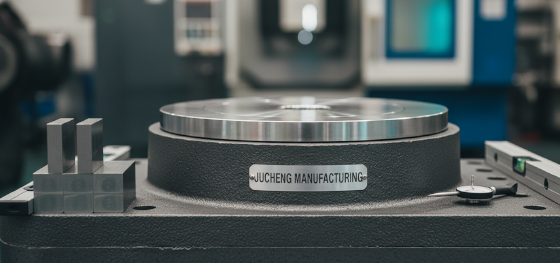
Robotic J1 axis stability is a direct function of base rigidity. If the base plate flexes by even 0.05mm under the momentum of a fully extended arm, the resulting error at the end-effector can exceed several millimeters due to the lever-arm effect. This mechanical amplification of error is the primary enemy of precision assembly and high-speed welding. Jucheng Precision addresses these structural demands by utilizing heavy-duty casting and large-scale gantry milling designed for the [2026] industrial cycle.
Operating out of the Shenzhen precision manufacturing hub, JUCHENG provides the heavy-duty infrastructure required for autonomous factory OEMs. We transform raw forged or cast blocks into stabilized foundations that ensure a zero-vibration mission profile. This guide explores the essential material science, large-scale machining challenges, and parallelism requirements necessary for manufacturing robot bases that never yield to the forces of high-speed motion.
content:
Foundation of Precision: Why Rigid Bases Rule Accuracy
Comparative Data: Cast Iron vs Welded Steel Bases
Large-Scale Machining: Gantry Milling and Flatness
Parallelism Standards: The J1 Axis Interface
JUCHENG: The Foundation for High-Payload Robotics
FAQ: Structural Stability for Industrial Robotics
Foundation of Precision: Why Rigid Bases Rule Accuracy
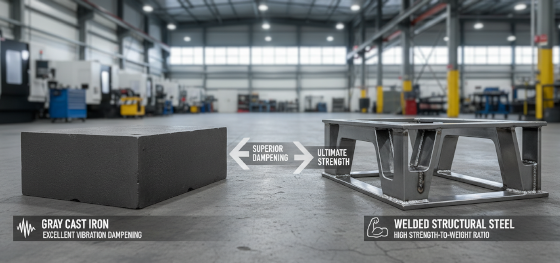
Structural rigidity in robot bases is not just about withstanding weight; it is about resisting the dynamic energy of sudden accelerations. Every time a robot arm stops or starts, the inertial forces translate directly into the J1 axis mounting plate. In Industrial robot base manufacturing, if the base possesses a low natural frequency, it will resonate after every movement, causing a "settling time" delay that reduces overall factory throughput. JUCHENG engineers these bases to be "over-built," ensuring the natural frequency remains far outside the robot's operating range.
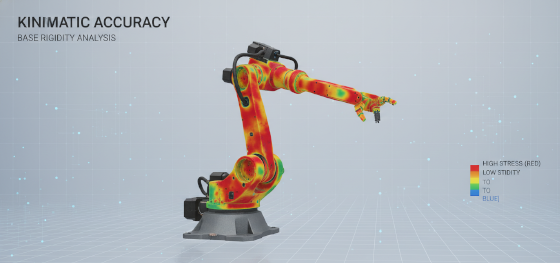
Kinematic chains amplify the smallest base errors. Imagine a 3-meter reach robot; a tiny 0.01-degree tilt at the base results in a 0.52mm deviation at the gripper. This is why "stiffness" is the primary metric we use when evaluating a robot base design. By utilizing Finite Element Analysis (FEA), we identify high-stress nodes where the base might experience elastic deformation. We then reinforce these areas with internal webbing or increased wall thickness, ensuring the foundation remains a true "geometric constant" throughout the robot’s lifecycle.
Vibration dampening is the secondary mission of a well-manufactured base. Industrial floors are noisy environments with constant harmonic interference from nearby machinery. A poorly designed base acts as an amplifier for these floor vibrations, leading to "jitter" in delicate operations like laser cutting or micro-soldering. JUCHENG’s manufacturing approach prioritizes materials and geometries that naturally dissipate this kinetic energy, protecting the internal bearings and gearboxes from premature wear caused by harmonic fatigue.
Mounting interface integrity is another critical detail. The base must provide a perfectly stable platform for the high-precision slew bearings that drive the first axis. If the mounting surface is not machined to extreme flatness standards, the bearing race will distort when the bolts are torqued, leading to uneven friction and early failure. JUCHENG’s Industrial robot base manufacturing process involves multiple stress-relief cycles between machining steps to ensure that the metal does not "move" after it leaves our facility, maintaining its flatness for years of service.
Comparative Data: Cast Iron vs Welded Steel Bases
Selecting the right substrate is the first critical decision in Industrial robot base manufacturing. While welded steel offers incredible design flexibility, cast iron remains the king of vibration dampening. Jucheng Precision provides technical consultations to help you balance structural strength, weight, and vibration characteristics. The following table compares the most common materials used for high-stability robot foundations in the [2026] market.
| Material Property | Gray Cast Iron (HT300) | Structural Steel (A36) | Aluminum 6061-T6 |
| Vibration Dampening | Exceptional (High Carbon) | Low | Moderate |
| Yield Strength (MPa) | 300 | 250 | 240 - 270 |
| Design Flexibility | Low (Requires Pattern) | Maximum (Welded) | Moderate |
| Thermal Expansion | Stable | High | Very High |
Gray Cast Iron (HT300) is the preferred choice for heavy-payload robots because the graphite flakes in its microstructure act as internal shock absorbers. This material effectively "soaks up" the harmonic energy generated by high-speed axis reversals. JUCHENG utilizes specialized heat treatment to normalize these castings, ensuring that they remain dimensionally stable even in non-climate-controlled factory environments where thermal expansion could otherwise misalign the robot’s origin point.
Welded Steel (A36) is utilized for custom robot bases where rapid lead times and complex, oversized shapes are required. To compensate for steel's lower dampening properties, JUCHENG utilizes sand-filled hollow sections or specialized dampening plates to achieve the necessary stability. This allows us to manufacture bespoke bases for large-scale aerospace or shipbuilding robots where a traditional casting would be prohibitively expensive and slow to produce.
Large-Scale Machining: Gantry Milling and Flatness
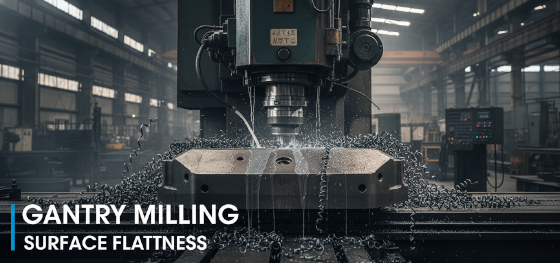
Machining a part that weighs several tons while holding tolerances of +/- 0.02mm requires massive, stable equipment. JUCHENG utilizes heavy-duty Gantry Milling machines to surface the top and bottom of robot bases. The challenge in Industrial robot base manufacturing is ensuring that the part does not flex under its own weight or the pressure of the cutting tools. We use multi-point leveling and specialized clamping jigs to ensure the base is in a "relaxed" state during the final finishing pass, guaranteeing absolute flatness across large surface areas.
Surface flatness on the mounting interface is critical for "Bolt-on Precision." If the base surface has any "crown" or "dish," the torque from the J1 axis bolts will create internal tension in the robot's main slew bearing. JUCHENG machines these surfaces to a flatness of 0.01mm per meter, ensuring a perfect "metal-to-metal" contact that prevents loosening or misalignment during the robot's service life. This level of precision is achieved through slow, high-precision finishing cuts and real-time laser measurement on the machine bed.
Internal stress relief is the secret to long-term stability. Large cast or welded parts want to "spring" back to their original shape after machining. JUCHENG utilizes vibrational stress relief (VSR) or thermal aging to "relax" the molecular structure of the base. This ensures that the flatness we achieve on day one in our Shenzhen hub is the same flatness the customer sees on day 1000 on their assembly line. Without these critical steps, a robot base can slowly warp over time, leading to mysterious accuracy drift that is impossible to solve via software.
Thread integrity on the mounting pattern is another focus area. Industrial robots are subjected to constant vibration that can work bolts loose. JUCHENG utilizes precision-tapped holes with high-tolerance Class 3B threads and provides specialized "counter-bore" features to ensure the mounting bolts are seated perfectly. For heavy-duty applications, we often integrate hardened steel thread inserts into cast iron bases, combining the vibration-dampening of the iron with the extreme pull-out strength of alloy steel.
Parallelism Standards: The J1 Axis Interface
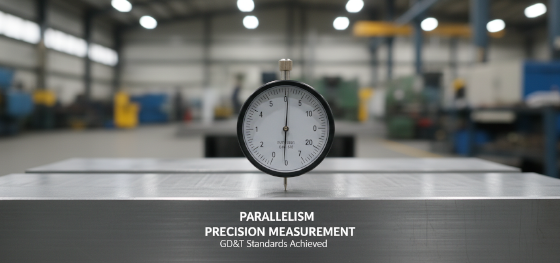
Parallelism between the bottom floor-mounting surface and the top robot-mounting surface is the most vital GD&T (Geometric Dimensioning and Tolerancing) metric in Industrial robot base manufacturing. If these two planes are not perfectly parallel, the entire robot will stand at a slight tilt. While a 0.1mm error might seem small, at the end of a fully extended arm, it creates a massive "spatial offset" that forces the software to compensate constantly. JUCHENG’s gantry milling process ensures these surfaces are parallel within 0.03mm across the entire span.
Concentricity between the J1 axis bearing seat and the base’s registration features is equally vital. Most high-end robots utilize a "pilot diameter" or dowel pins to locate the arm on the base. JUCHENG machines these features in a single setup with the main mounting face to eliminate "stacking errors." This ensures that when the robot is bolted down, its center of rotation is exactly where the CAD model says it should be, allowing for "copy-paste" deployment of robotic programs across multiple factory cells.
Surface roughness (Ra) on the interface is controlled to prevent "micro-fretting." If the mounting surface is too rough, the microscopic peaks will flatten over time under the vibration of the robot, causing the bolts to lose their preload. JUCHENG delivers a Ra 0.8 finish on all robot-base interfaces, providing a stable, high-friction contact area that prevents any lateral movement of the arm, even during emergency-stop scenarios where the forces are at their highest.
Corrosion protection for the interface is handled via precision-applied chemical conversion coatings or thin-film oils. While the rest of the base is typically powder-coated for durability, the mounting face must remain bare metal for maximum accuracy. JUCHENG ensures these bare-metal surfaces are protected during shipping and installation, ensuring that no rust blossoms can compromise the flatness of the interface before the robot is mounted. This attention to detail is what makes JUCHENG a preferred partner for global robot manufacturers.
JUCHENG: The Foundation for High-Payload Robotics
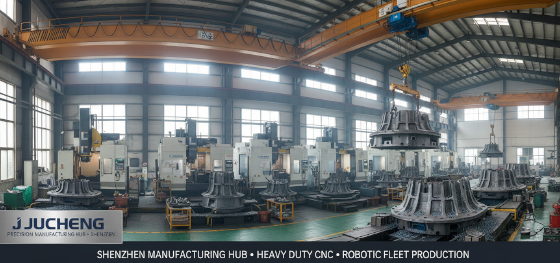
Dominating the [2026] industrial hardware market requires a partner that can scale from prototype to massive fleet production without losing precision. Jucheng Precision operates with a 24/7 manufacturing mindset in our Shenzhen precision manufacturing hub, delivering high-stability robot bases and heavy structural components with lead times as fast as 20 business days. We provide a "Bridge to Production" that allows you to move from a single cast prototype to a commercial deployment of 1,000 bases with consistent metallurgical and dimensional quality.
Integrating your structural design with JUCHENG’s expertise ensures that your robot survives the "First-Year Fatigue" and moves into long-term adoption. We offer comprehensive DFM reviews within 24 hours, identifying potential vibration bottlenecks or machining risks in your base design before they become field failures. Whether you are building an automotive welding robot or a heavy-duty palletizer, Jucheng Precision provides the rigid foundations that keep your innovation standing tall through the high-speed cycles and the years of hard labor.
Our facility is equipped with oversized Gantry CNC units and 5-axis machining centers, allowing us to manage the entire base lifecycle from raw casting to finished, measured assembly. We manage the complexity of large-scale machining so your engineering team can focus on the kinematics and the AI. By combining Shenzhen's speed with industrial-grade material verification, JUCHENG remains the preferred partner for the world's most aggressive industrial robot parts challenges. Contact us today to start your next project.
FAQ: Structural Stability for Industrial Robotics
Why is cast iron better than steel for robot bases?
Cast iron possesses internal graphite flakes that dissipate vibration much more effectively than structural steel.
What is the maximum weight JUCHENG can machine?
Our gantry milling centers handle robot bases and structural components weighing up to 10 tons.
How do you ensure long-term flatness on a base?
We utilize multi-stage stress relief (thermal or VSR) to prevent the part from warping after machining.
Can JUCHENG integrate coolant or cable paths into the base?
Yes. We use deep-hole drilling and CNC milling to create internal routing for high-pressure lines and electrical cables.
What are typical lead times for a custom robot base?
Depending on casting availability, fully machined bases are typically delivered in 4 to 6 weeks.
Structural vibration in industrial automation is an absolute hardware killer. Partnering with Jucheng Precision ensures that your foundations are built with the heavy-duty cast iron and specialized gantry-milling techniques the industry demands. Reach out to our Shenzhen manufacturing hub today for a complete DFM review and build the rigid foundation your autonomous fleet requires.


