

Sheet Metal Fabrication: From Process and Materials to Final Cost
Views: 3 Author: Allen Xiao Publish Time: 2025-12-04


At its core, Sheet Metal Fabrication is a kind of magic. It is the art and science of taking a flat, lifeless sheet of metal and transforming it into a complex, strong, and functional three-dimensional object. It is a process that builds the world around us.
This process is the backbone of modern industry. From the server racks in a data center to the chassis of your car, from medical devices to aerospace components, sheet metal parts are everywhere. They offer an unmatched combination of strength, light weight, and cost-effectiveness.
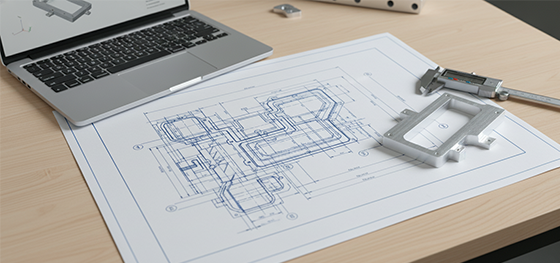
But how does this transformation truly happen? What are the critical stages, the material choices, and the design rules that separate a successful project from a costly failure? Understanding this entire workflow is not just for engineers. It is a strategic necessity for any innovator. This complete guide will serve as your map, navigating you through the entire fabrication journey from start to finish.
The Sheet Metal Fabrication Process (Overview)
Common Sheet Metal Materials
Design for Manufacturability (DFM) Basics
Understanding Sheet Metal Fabrication Cost
Options for Sheet Metal Surface Treatment
Quality Control and Sheet Metal Tolerances
From Parts to Products: Sheet Metal Assembly
Choosing Your Fabrication Partner
The Sheet Metal Fabrication Process (Overview)

Every sheet metal part, no matter how complex, begins its life the same way: as a flat sheet. The journey from that sheet to a 3D part follows three fundamental stages: Cutting, Forming, and Joining.
Cutting is the first step. This is where the 2D "flat pattern" of your part is cut from a larger sheet. For prototypes and modern production, the primary tool is a high-power laser cutter. It is incredibly fast and precise, capable of cutting almost any shape you can draw.
Forming is where the magic happens. The flat, cut-out part is then taken to a machine called a press brake. Here, immense force is applied along specific lines to create clean, accurate bends. This is the stage that gives the part its three-dimensional structure and strength.
Joining is the final stage for products made from multiple components. This can involve welding to permanently fuse parts, or using mechanical fasteners like rivets and screws. The specific sheet metal fabrication process used is a careful choice based on the part's final application. Understanding this sequence is key to designing a part that can be manufactured efficiently.
Common Sheet Metal Materials

The material you choose is the very soul of your part. It dictates its final weight, strength, longevity, and cost. Each sheet metal material has a unique personality and purpose.
Aluminum is the lightweight champion. It offers excellent corrosion resistance and a beautiful natural finish, making it a favorite for electronics and aerospace. Steel is the powerful workhorse. Carbon steel is incredibly strong and low-cost, forming the backbone of machinery and enclosures, but it needs a protective coating to prevent rust. Stainless Steel is the durable hero, providing both high strength and natural corrosion resistance, which is essential for medical, marine, and food-grade applications. Making the right material choice early is a critical step that impacts every other stage of the project.
Design for Manufacturability (DFM) Basics

A great part is born from a great design. But in sheet metal, a great design is not just about aesthetics. It is about understanding the process. A smart Sheet metal design is one that is optimized for manufacturing. This philosophy is called Design for Manufacturability (DFM).
There are a few golden rules that every designer must follow. The most important is to maintain a uniform wall thickness across the entire part. You must also design with a proper bend radius to prevent the metal from cracking under stress. And you need to keep holes and other features a safe distance from bends to prevent them from deforming. Following these basic rules is the single biggest lever you have to reduce cost and improve the quality of your final part.
Understanding Sheet Metal Fabrication Cost

What are the factors that determine the Sheet metal fabrication cost? A transparent quote is typically a combination of three main drivers: material, machine time, and skilled labor.
Material cost is influenced by the type of metal chosen and the "nesting" efficiency—how tightly your parts can be arranged on a large sheet to minimize waste. Machine time is a direct function of your design's complexity. A part with hundreds of small cuts and a dozen bends will take longer to process than a simple bracket. Finally, labor cost is driven by manual secondary operations. Tasks like welding, grinding down the weld seams, and final assembly require the hands of a skilled technician, and this is often a significant component of the total cost.
Options for Sheet Metal Surface Treatment
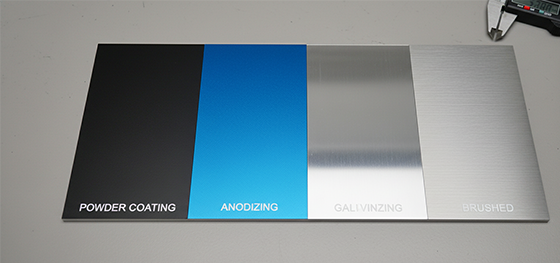
A raw metal part is rarely the end of the story. It needs a finish. This is the job of Sheet metal surface treatment, a critical step that provides both long-term protection and the final aesthetic of your product.
Powder coating is a popular and extremely durable choice, creating a thick, hard shell in a huge range of colors and textures. Anodizing is a premium finish for aluminum parts, creating a very hard, ceramic-like surface that is integral to the metal. Plating with materials like zinc or nickel is a common way to give cost-effective steel excellent corrosion resistance. And for applying logos and labels, processes like silkscreening add that final professional touch. The finish you choose is your customer's first impression of your product's quality.
Quality Control and Sheet Metal Tolerances
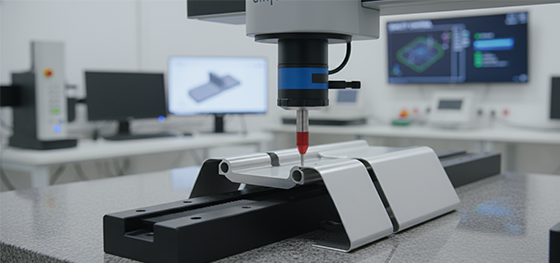
How accurate is sheet metal fabrication? While it's not a microscopic process like some forms of CNC machining, it still operates to very high and predictable standards of accuracy. Understanding Sheet metal tolerances is key to a successful assembly.
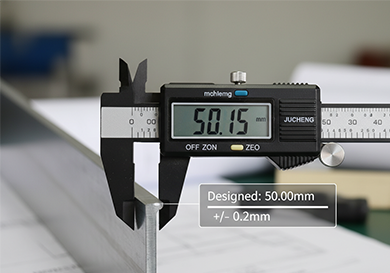
Globally recognized standards, like ISO 2768, provide a framework for these tolerances. A feature cut by a laser might be accurate to +/- 0.1mm, while a dimension across a bend might be accurate to +/- 0.3mm due to the nature of metal springback. A professional manufacturer uses advanced inspection equipment, like a Coordinate Measuring Machine (CMM), to verify that your parts meet these standards. This data-driven approach is your guarantee of consistency.
From Parts to Products: Sheet Metal Assembly
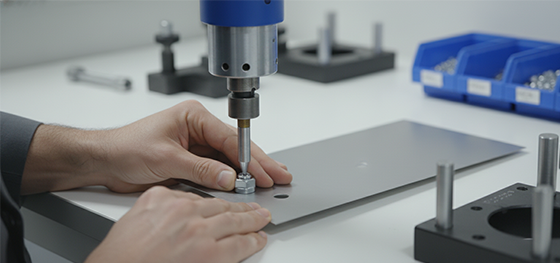
A truly valuable partner sees beyond the individual component. They see the final product. The process of Sheet metal assembly is what bridges the gap from a collection of parts to a fully integrated solution.
This involves critical services that add immense value. The most common is hardware insertion, using a press to install PEM nuts and threaded standoffs that are essential for mounting circuit boards and other components. It can also include welding separate pieces into a rigid frame, or riveting panels together. A full-service partner who manages the entire assembly process simplifies your supply chain and ensures a perfect final product.
Choosing Your Fabrication Partner

Navigating this entire journey requires expertise at every step. This is why choosing your manufacturing partner is your most important decision. You are not just buying a part; you are sourcing a capability.
A true partner, like JUCHENG, offers a one-stop solution. We provide expert DFM feedback at the design stage. We have a full suite of modern equipment for cutting, bending, and welding. Our in-house finishing and assembly departments ensure quality control from start to finish. Our ISO 9001 certification and advanced CMM inspection are your guarantee of quality.
This integrated, end-to-end approach is the core of modern Sheet Metal Fabrication. It is a partnership designed to reduce your risks, simplify your supply chain, and help you bring a better product to market, faster.


ㆍPrivacy: We respect your privacy. Here you can find an example of a non-disclosure agreement. By submitting this form, you agree to our terms & conditions and privacy policy.
