


Your prototype arrives. You designed it to have perfect 90-degree angles. You check it with a square. It is 91 degrees. You designed a round hole near a bend. On the part, the hole is a slight oval. Why?

This is not necessarily a manufacturing defect. This is the ghost in the machine. It is the hidden physics of the sheet metal fabrication process. Metal is a living material. It has memory. It fights back.
Understanding this fight is the key to designing great parts. This guide will take you deep inside the process. It will reveal the forces at play and how a professional manufacturer controls them.
content:
Anatomy of an Imperfect Part
Birthing the Blank with Light and Precision
Inside the Violent Art of Bending
Fighting the Metal's Memory: Springback
Building the Whole from its Parts
Anatomy of an Imperfect Part

In the world of Sheet Metal Fabrication, the material itself has a voice. It pushes and pulls. It remembers its flat state. A designer who does not listen to the material will always be surprised by the final result.
When your precise CAD model becomes a slightly different physical object, it is because of these forces. The metal stretched where you did not expect. It bent back when you wanted it to stay put.
A professional fabrication process is not about forcing the metal into shape. It is about understanding these forces and using them to your advantage. It is a dance between the machine and the material's memory.
Birthing the Blank with Light and Precision
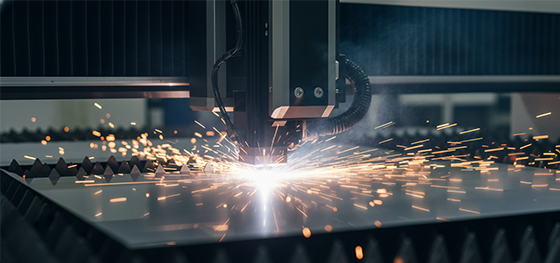
Every great part starts with a perfect "blank." The blank is the 2D flat pattern of your part, cut from a large sheet. The accuracy of this first step is critical.
The primary tool for this is a fiber laser cutter. This is the "cutting" part of the process. A high-intensity beam of light instantly melts and vaporizes the metal. A jet of gas blows the molten metal away, leaving a perfectly clean edge.
The laser is controlled by a computer that reads your design file directly. It can cut any shape, no matter how complex, with a tolerance of about +/- 0.1mm. This digital precision at the very beginning is the foundation for an accurate final part. Other cutting processes, like CNC punching, are used for parts with many repeating holes.
Inside the Violent Art of Bending

Bending is where the part comes to life. But it is a violent and complex event at the microscopic level.
When a sheet of metal is forced into a bend, the atoms on the outside of the bend are pulled apart. They are in tension. The atoms on the inside of the bend are squeezed together. They are in compression.
This stretching and squeezing is what causes the deformation around your holes. If a hole is too close to the bend line, it will be pulled into the stretching zone and become distorted. This is not a mistake. It is physics. A good designer must account for this.
This internal stress is the source of all the challenges in forming metal.
Fighting the Metal's Memory: Springback
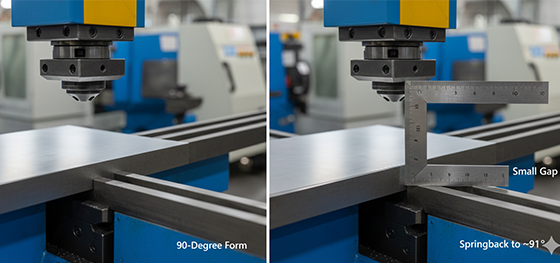
Once the bending tool is removed, the internal stresses in the metal want to relax. This causes the metal to "spring back" slightly.
This is why your 90-degree angle becomes a 91-degree angle. The metal is trying to return to its original flat state.
A professional manufacturer knows how to defeat this enemy. Their press brake machines are equipped with advanced sensors. They can predict how much a certain material will spring back.
To create a perfect 90-degree angle, they will actually bend the metal slightly further, for example, to 89 degrees. They let it spring back, and it settles at exactly 90 degrees. This is a science called "air bending," and it requires a huge amount of process knowledge and a very precise machine.
Building the Whole from its Parts
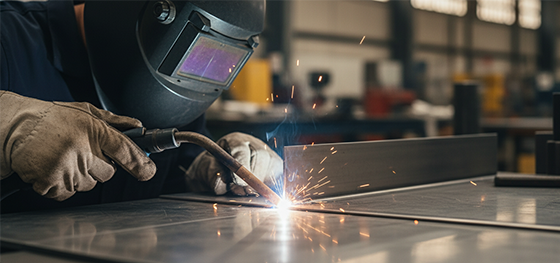
The final part of the sheet metal fabrication process is putting it all together.
If the product is an assembly of multiple parts, they are joined together. This is the "joining" stage. Welding is a common method for creating strong, permanent joints. For a clean, precise weld on aluminum or stainless steel, TIG welding is the preferred choice.
Other joining methods include inserting rivets or hardware. Once assembled, the part then goes on to the final finishing steps, like powder coating.
Understanding this entire chain of events, from the hidden physics of bending to the final weld, is what separates a designer from a master of the craft. It is a partnership with the material, not a fight against it.

