Designing for Fit: How Much Tolerance to Add for 3D Printing Assemblies
Views: 8 Author: Allen Xiao Publish Time: 2026-02-19 Origin: Site
Nothing kills an engineering prototype faster than a high-precision assembly that refuses to assemble. In the frictionless vacuum of CAD software, a 10.00mm pin fits perfectly into a 10.00mm hole. However, the moment that design enters the physical build chamber, the laws of thermal expansion and material behavior take over. If you haven't calculated how much tolerance to add for 3d printing, you are essentially gambling with your production budget. Most engineers assume that if the machine is accurate to ±0.1mm, the parts will automatically fit. The reality is that "Accuracy" and "Fit" are two different languages. Achieving a functional sliding mechanism or a secure press-fit requires a deliberate engineering gap—an intentional clearance designed to survive the inherent noise of the 3D printing tolerances cycle.
JUCHENG operates as a strategic technical sanctuary for hardware teams who cannot afford the delays of a "trial and error" prototyping cycle. We have seen thousands of projects where "line-to-line" designs resulted in parts that were effectively welded together by layer-line friction. We don't just "print your file"; we act as a design-for-manufacturing (DFM) filter. By understanding the specific rheology of the resins and the cooling rates of the powders we use, we provide our clients with a verified roadmap for assembly. This guide moves beyond the generic charts to explore the physics of mechanical clearance, the impact of surface texture on fitment, and why JUCHENG’s integrated audit process is the only way to ensure your complex multi-part designs work the moment they come off the build plate.
Profitability in hardware innovation is won by those who eliminate the assembly rework loop. You aren't just buying a plastic component; you are buying the verified relationship between two mating surfaces. Whether you are building an intricate surgical robot hinge or a high-durability automotive fastener, the logic of the gap is your primary manufacturing governor. Let us break down the physical laws of clearance and see how technical foresight can lock the integrity of your next assembly into physical reality.
The Critical Distinction: Clearance vs. Machine Tolerance
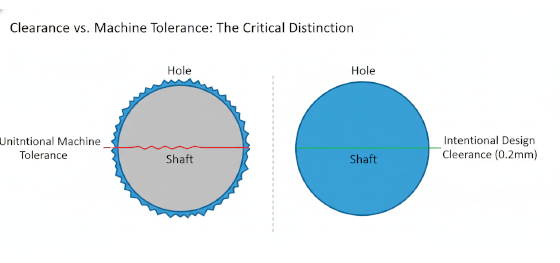
To understand how much tolerance to add for 3d printing, you must first separate the machine's behavior from your design intent. Tolerance is the unintentional error. It is the ±0.1mm deviation caused by the laser’s focal point or the thermal shrinkage of the nylon. You cannot control this; you can only account for it. Clearance is the intentional gap. It is the space you purposely build into your CAD model to ensure that a shaft can rotate or a lid can snap into place.
The biggest trap for engineers is designing "Nominal-to-Nominal." If you design a 10mm hole and a 10mm pin, and the machine has a tolerance of ±0.1mm, you could end up with a 9.9mm hole and a 10.1mm pin. That 0.2mm interference will make assembly impossible without heavy sanding. At Jucheng Precision, we explain this as a "Confidence Offset." Your design clearance must be large enough to absorb the worst-case tolerance deviation of the machine. If the machine's 3D printing tolerances are ±0.15mm, your intentional clearance should ideally be at least 0.3mm to ensure a loose, functional fit. By decoupling these two concepts in your mind, you move from "hoping it fits" to "engineering the assembly." We treat these gaps as functional specifications, ensuring that the friction of the real world matches the intent of your digital simulation.
General Clearance Rules: Mapping the Assembly Spectrum
Successful 3D printing design requires a tiered approach to clearances. There is no universal number that fits every part. Instead, we categorize fits based on the required mechanical movement. During our technical reviews at Jucheng Precision, we use the following industrial baselines for parts with a surface area under 100mm.
1. Loose Fit (0.3mm - 0.5mm Clearance): This is the "Safe Zone" for parts that must move freely or have high-build complexity. We recommend this for sliding lids, non-precision hinges, or interlocking toy components. It allows for significant thermal warping and layer artifacts without the parts seizing. 2. Standard Fit (0.15mm - 0.2mm Clearance): This is the gold standard for functional prototypes. It provides a "Precise Sliding" feel, perfect for pivoting robotic joints or guided mounts. It requires an industrial-grade printer (SLA or MJF) to maintain the consistency needed to hit this window. 3. Tight Fit (0.05mm - 0.1mm Clearance): This is the "Danger Zone" where how much tolerance to add for 3d printing reaches its physical limit. This is intended for parts that should stay together through friction once assembled but can still be pulled apart. 4. Press Fit (0.0mm or Interference): For parts that must be hammered or pressed together permanently. This requires a specific design strategy involving "Crush Ribs," which we will explore in subsequent technical articles. By applying these tiered rules to your CAD model, you ensure that JUCHENG can deliver a part that functions exactly as your assembly logic intended.
Material Influence: How Polymers Dictate the Design Gap
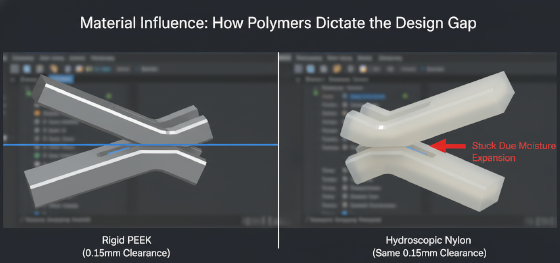
The chemistry of the material is the invisible hand that shifts your tolerances. A 0.2mm clearance in a rigid, stable resin (like Somos Next) feels completely different than the same clearance in a hygroscopic Nylon 12. At Jucheng Precision, we analyze the "Material Personality" before we approve a fitment design. Rigid materials allow for tighter clearances because they don't deform under the pressure of assembly. However, they are also less forgiving of errors—if the clearance is too small, they will crack rather than yield.
Nylons (SLS/MJF) present a unique challenge. While they are tough and can "yield" into a fit, they also absorb moisture from the air and swell in volume. If you design a precision hinge in Nylon with a 0.1mm clearance, it may work perfectly in our climate-controlled lab but seize up after a week in a humid shipping container. We often recommend adding an extra 0.05mm of clearance to Nylon parts specifically to account for this environmental "thirst." For high-performance polymers like PEEK 3D Printing, the challenge is thermal shrinkage. The material contracts aggressively as it cools. We help our clients navigate these chemical trade-offs, ensuring that how much tolerance to add for 3d printing is calculated based on the material's real-world behavior, not just its theoretical datasheet. We bridge the gap between polymer science and mechanical fit.
Layer-Line Friction: The Surface Texture Tax
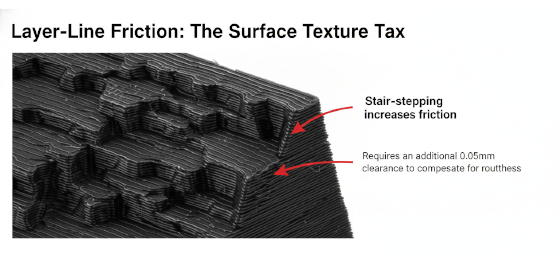
A 3D printed surface is not flat; it is a landscape of microscopic ridges and valleys. In 3D printing tolerances, these layer lines act like a series of tiny mechanical teeth. When two 3D printed surfaces slide against each other, these teeth interlock, creating a "Texture Tax"—an artificial increase in friction that can make a correctly sized clearance feel "tight" or "gritty." This is especially prevalent in FDM and MJF technologies where the surface roughness (Ra) is higher.
To achieve a smooth "User Experience" (UX) in your prototypes, JUCHENG suggests a "Texture Offset." We advise adding an additional 0.05mm of clearance beyond the machine's tolerance just to compensate for the "peak-to-peak" contact of the layer lines. Alternatively, we utilize Vapor Smoothing to melt these peaks, effectively turning a "gritty" SLS part into a "silky" injection-molded surrogate. By sealing the surface, we reduce the coefficient of friction, allowing you to use tighter clearances for a more professional mechanical feel. We treat surface integrity as a functional variable, ensuring that the "tactile honesty" of your part is not ruined by the unintended physics of the build process. We don't just print layers; we manage the interface where those layers meet.
JUCHENG’s DFM Protocol: Validating the Assembly Logic
The final hallmark of a professional manufacturing partner is the move away from guesswork. At Jucheng Precision, we have codified the how much tolerance to add for 3d printing query into a rigorous DFM protocol. We don't just "hope" your assembly fits; we validate it. When you upload an assembly file to our system, our engineers perform a "Virtual Fitment Check." We look for "Zero-Gap" zones and flag them immediately. We know that for a surgical instrument prototype or a high-speed robotics mount, a seized assembly is a lost week of R&D.
We also offer "Tolerance Testing Kits" for our long-term partners. Before a massive production run, we can print a small coupon featuring a series of pins and holes with varying clearances (0.1mm to 0.5mm). This allows you to physically test the fitment with your chosen material and technology, identifying the exact "feel" your end-user requires. This empirical approach eliminates the uncertainty of digital modeling, providing you with the data needed to lock in your final dimensions with 100% confidence. When you receive a shipment from JUCHENG, you receive components that are visually identical to your vision and mechanically ready for work. Contact Jucheng Precision today for a technical DFM review and see how our assembly protocols can clarify and secure your next 3D manufacturing breakthrough.
ㆍFill in your requirements and upload your 2D&3D file, we will feedback your project quotation and DFM within 24 hours.
ㆍFile types: STEP, STP, IGES, IGS, SLDPRT, 3DM, SAT or X_T files File size: < 128 MB Part size: < 1500*1500*1500 mm ㆍPrivacy: We respect your privacy. Here you can find an example of a non-disclosure agreement. By submitting this form, you agree to our terms & conditions and privacy policy.