


Smashing a plastic prototype with a heavy hammer because the internal mounting pegs refuse to slide into the designated chassis holes is an agonizing engineering rite of passage. Delivering physical components that violently fail to mate perfectly on the final assembly line destroys tight corporate launch schedules instantly. Procurement executives constantly interrogate our engineering team regarding exact fdm 3d printing tolerances, desperately searching for mathematical guarantees before issuing purchase orders.
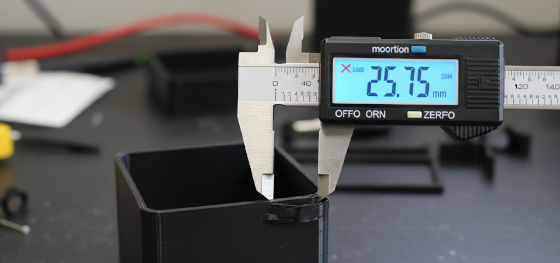
Answering this critical manufacturing question requires brutally stripping away the inflated marketing statistics published by desktop machine vendors. Expecting single-digit micron accuracy straight off a heated glass build plate completely ignores the violent thermodynamic realities of melting industrial polymers. Extruding molten ABS or rigid Polycarbonate inherently introduces massive physical shrinkage as the material violently returns to room temperature.
Executing flawless mechanical assemblies forces hardware teams to master advanced thermal shrinkage compensation algorithms long before firing the heated nozzle. Designers must aggressively oversize critical internal holes or deliberately thicken load-bearing external walls to heavily combat this unavoidable chemical contraction. Failing to respect this fundamental physical metallurgy guarantees catastrophic misalignments during your expensive beta testing phase.
Operating out of the aggressive Shenzhen precision manufacturing hub teaches seasoned veterans that pure additive manufacturing often falls short for aerospace-grade requirements. Achieving absolute mechanical perfection frequently dictates deploying heavy hybrid manufacturing tolerances to cross the finish line. We must ruthlessly break down exactly where layered extrusion succeeds and where subtractive secondary operations become absolutely mandatory for project survival.
content:
Conquering Severe Thermal Shrinkage Limitations
Defeating Z-Axis Compression and Elephant Foot
Surviving the Oval Hole Bearing Nightmare
JUCHENG Hub: Dominating Hybrid Capabilities
Frequently Asked Questions: Dimensional Reality
Conquering Severe Thermal Shrinkage Limitations

Do all industrial polymer filaments shrink exactly the same amount after leaving the heated nozzle?
Absolutely not. High-temperature engineering materials suffer from massive thermal contraction compared to standard entry-level plastics, requiring entirely different scaling multipliers to hit targeted fdm 3d printing tolerances properly.
Dealing with thick geometric walls inherently traps massive amounts of thermal heat deep inside the plastic core. While the exterior printed skin cools and hardens rapidly against the ambient factory air, the molten center continues to shrink slowly over several hours. This severe internal temperature differential physically pulls the external walls inward, creating ugly concave surfaces that violently ruin flat mating joints.
Intelligent CAM software attempts to counteract this violent physics by deliberately executing thermal shrinkage compensation before slicing the file. However, applying a blanket global scaling factor rarely works for highly complex organic geometries. Thick structural ribs will always contract significantly harder than thin cosmetic fins, causing severe geometric twisting across the entire chassis.
Switching to highly controlled, fully enclosed heated build chambers mitigates this nightmare significantly. Basting the entire part in a constant bath of high-temperature air prevents the lower layers from freezing prematurely. Allowing the entire block of plastic to cool down uniformly over twenty-four hours delivers drastically tighter dimensional stability across massive automotive enclosures.
Defeating Z-Axis Compression and Elephant Foot

Why does the very bottom of my printed prototype always flare outwards, ruining the mechanical fit?
Pushing molten plastic heavily into a rigid glass bed forces the material to squish outward horizontally, creating a permanent dimensional defect commonly known in the industry as an elephant foot.
Managing devastating Z-axis compression requires absolute mastery of your initial layer height parameters. Factory technicians deliberately squash the first layer of plastic to ensure the entire model bonds violently to the build plate, preventing catastrophic mid-print detachments. Unfortunately, this necessary adhesion strategy permanently destroys the exact dimensional accuracy of the bottom-facing surface.
Engineering tight sliding mechanisms completely fails when the bottom flange prints a half-millimeter too wide. Designers must proactively implement aggressive digital chamfers along the bottom edges of their CAD models. Slanting the bottom wall inward mathematically neutralizes the outward physical squish, ensuring the final cured dimension closely matches the intended engineering blueprint.
Evaluating the physical layer stack reveals further vertical inaccuracies. Because standard FDM technology relies entirely on mechanical lead screws to move the heavy gantry, slight microscopic wobbles introduce vertical banding. Designers absolutely cannot rely on vertical Z-axis dimensions to hold the same extreme precision found across the horizontal X and Y planes.
| Geometric Feature Type | Expected Additive Deviation | Primary Physical Failure Mode | Shop Floor Mitigation Strategy |
|---|---|---|---|
| Vertical Z-Axis Height | ± 0.200 mm to ± 0.500 mm | Base layer compression (Elephant foot) | Design 45-degree base chamfers |
| Horizontal X/Y Outer Walls | ± 0.150 mm to ± 0.300 mm | Thermal shrinking and corner warping | Utilize heated enclosures and brims |
| Internal Circular Holes | Consistently Undersized (-0.4 mm) | Polygon dragging creates oval distortion | Print deliberately small, manual reaming |
| Overhanging Bridged Gaps | Severe Sagging | Gravity pulls molten plastic downward | Deploy dense breakaway support structures |
Surviving the Oval Hole Bearing Nightmare
Will a digitally perfect circular CAD hole actually print perfectly round in reality?
Never. Thermoplastic extrusion naturally drags the molten plastic slightly inward as the toolhead forces a circular direction change, almost always resulting in an undersized, microscopic oval shape.
Executing a flawless heavy bearing press-fit demands ruthless physical iteration. If an engineer models a ten-millimeter hole for a steel bearing, the printed hole inevitably shrinks to roughly nine-point-six millimeters. Attempting to forcefully smash the heavy metal bearing into this severely undersized cavity will violently split the brittle plastic layers completely apart.
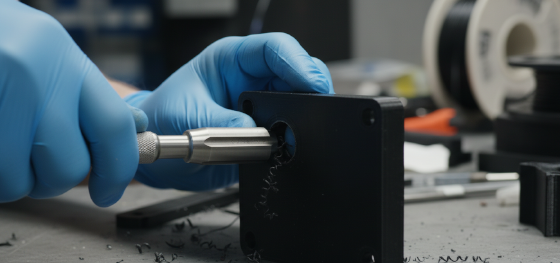
Factory veterans utilize a highly reliable mechanical workaround called undersizing and reaming. Smart designers deliberately draw the CAD hole significantly smaller than required. Once the physical plastic completely cools, hardens, and shrinks, technicians utilize a razor-sharp mechanical hand reamer to slowly shave away the excess interior material, creating a perfectly round, flawless internal diameter.
Transitioning complex fluid manifolds to SLA (Stereolithography) resin processes offers vastly superior hole concentricity compared to traditional filament dragging. The laser traces the absolute perimeter mathematically without physically pulling molten material. However, prolonged exposure to ambient ultraviolet sunlight post-curing causes the resin to continue shrinking slightly over several weeks.
JUCHENG Hub: Dominating Hybrid Capabilities

Can purely additive technologies realistically hit single-digit micron accuracy for aerospace hardware?
Never. Pushing extreme physical limits strictly requires taking the oversized printed component and subtractively milling the critical mating surfaces completely flat on a rigid machine center.
Executing highly advanced hybrid manufacturing tolerances separates elite hardware programs from amateur maker projects. Engineers routinely print massive, complex drone chassis out of lightweight polymers to save expensive material costs. However, they deliberately add two extra millimeters of raw sacrificial material strictly to the engine mounting pads.
Once the plastic completely cures, Jucheng technicians aggressively clamp the polymer part into a heavy 5-axis CNC Machining center. The spinning carbide endmill violently shears away the excess plastic, leaving an absolutely flawless, perfectly flat mounting face. We deliver absolute perfection by combining the ultimate geometry of printing with the brutal precision of milling.
Frequently Asked Questions: Dimensional Reality

Does slowing down the extrusion print speed actually improve dimensional accuracy?
Yes. Running the heavy mechanical gantry at extreme speeds induces violent vibrations that ghost perfectly straight edges. Slowing the machine down allows the molten plastic to cool and bond more consistently, drastically reducing unwanted corner bulging.
Why does requesting extreme tight tolerances increase the manufacturing estimate so aggressively?
Demanding single-digit micron accuracy practically guarantees the part must be transferred to a secondary milling center. This introduces highly expensive fixture setups, specialized tooling, and additional labor hours to perfectly machine the printed faces.
Is massive dimensional shrinkage a problem when scaling into global mass production?
Absolutely. Transitioning a printed design directly into hardened Injection Molding steel requires massive shrinkage recalculation. Highly crystalline polymers like Nylon shrink violently inside a pressurized steel mold, forcing tooling engineers to heavily oversize the physical metal cavity.

