


Friction is a permanent structural bond that requires zero fasteners. When two components must stay together through the raw power of interference, the digital dimensions of the CAD model face their most brutal reality check. In the high-stakes arena of 3D printing tolerances, the "press fit" is where engineering logic meets the volatile physics of polymer memory. A press fit 3d printing tolerance is not a static number; it is a calculated bet on the material's ability to yield without shattering. If you design for a 10.00mm pin to go into a 10.00mm hole, you haven't designed a fit—you've designed a failure. Achieving a functional, reliable press-fit requires an intentional overlap of material that exploits the elasticity of the plastic to create a constant, outward clamping force.
JUCHENG operates as a unified hub for complex mechanical assemblies where high-speed rotation and vibration are constant threats. We understand that for a robotics pivot or a pump housing, a loose fit leads to rattle, while a too-tight fit leads to a crack. By integrating high-resolution MJF nylon and "Tough" SLA resins with our industrial 5-axis CNC finishing, we provide a technical roadmap for interference success. We recognize that every micron of interference adds "Hoop Stress" to the geometry. This guide moves beyond the basic visual mockups to explore the mathematics of the 0.08mm overlap, the strategic necessity of lead-in chamfers, and why JUCHENG’s empirical "Force Validation" is the only way to ensure your press-fit designs survive the transition from the laboratory to the field.
Efficiency in assembly is won by those who can control the deformation. You aren't just pushing a pin; you are managing a microscopic collision of layer lines and crystalline chains. Whether you are building a custom drone chassis or a high-durability surgical handle, the logic of the interference zone is your primary manufacturing governor. Let us break down the physical pillars of permanent fits and see how technical foresight can lock the integrity of your next assembly into physical reality.
Mathematics of Interference: Defining the 0.08mm Oversize
Material Modulus: Why Ductility Prevents Catastrophic Fracture
Geometric Sacrifices: The Strategic Role of Crush Ribs
Environmental Drift: How Moisture Swells the Interference Zone
JUCHENG’s Functional Standard: Validating the Hold-Force
Mathematics of Interference: Defining the 0.08mm Oversize
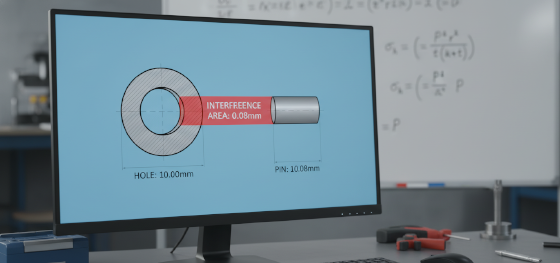
A press-fit is a controlled mechanical conflict. Unlike a sliding fit where clearance is the goal, press fit 3d printing tolerance requires the male part to be intentionally oversized. The core challenge is the "Tolerance Buffer." Most industrial 3D printers have an inherent accuracy of ±0.1mm. If you design a 0.05mm interference, the machine's own noise could easily turn that into a 0.15mm interference (which will crack the part) or a 0.05mm clearance (which will lead to the pin falling out).
At Jucheng Precision, we advocate for a "Staged Interference" model. For a 10mm pin in MJF Nylon 12, we typically suggest a nominal interference of 0.08mm to 0.12mm. This value is large enough to ensure that even with the machine's ±0.1mm tolerance, the parts will always remain in an "interference state." However, this requires the hole to be extremely circular. In the 3D printing process, holes printed in the X-Y plane are much truer than those printed vertically. We utilize our high-resolution CMM probes to verify these bores, ensuring that the "Average Interference" is consistent across the entire depth of the hole. By managing the math of the overlap, we eliminate the "Guesswork fitting" that ruins assembly lines, providing you with parts that have the exact holding force your FEA simulations required.
Material Modulus: Why Ductility Prevents Catastrophic Fracture
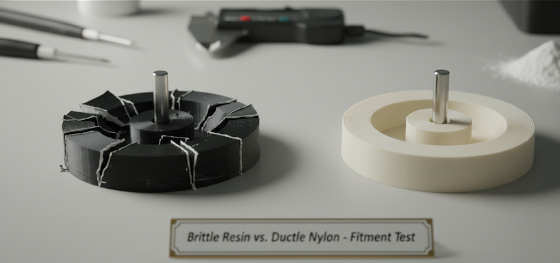
Success in press fit 3d printing tolerance is dictated by the material's "Yield Point." When you force a metal pin into a plastic hole, the plastic must expand. This expansion creates "Hoop Stress"—a tensile force that tries to pull the circumference of the hole apart. Brittle materials, like standard SLA resins, have very low elongation-at-break values (often<5%). If the interference exceeds a few microns, the resin simply snaps like glass.
At JUCHENG, we prioritize "Resilient Polymers" for all press-fit assemblies. Nylon 12 (MJF/SLS) is the industrial favorite because it possesses high ductility and a balanced flexural modulus. It has the ability to yield slightly under the pressure of the pin and then "grip" the surface through elastic recovery. For parts that must remain rigid, we utilize "Tough" resins that offer a compromise between hardness and elongation. We help our clients perform a "Material Sensitivity Audit"—if we see a high-interference fit specified in a brittle clear resin, we will flag it during the DFM review. By selecting a material with the correct molecular "give," we ensure your assembly survives the initial press-force and remains secure across years of vibration and thermal cycling. We don't just print the part; we audit the material's structural soul.
Geometric Sacrifices: The Strategic Role of Crush Ribs
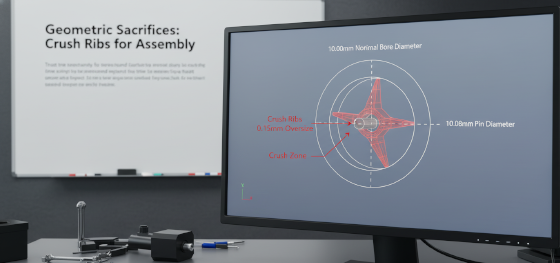
Sometimes, the smartest way to achieve press fit 3d printing tolerance is to reduce the contact area. Trying to press a smooth pin into a smooth hole requires immense force and perfect alignment. If the pin enters at a one-degree angle, it will act as a wedge and split the part. JUCHENG’s engineers advocate for "Geometric Sacrifices"—specifically, the use of **Crush Ribs**. Instead of making the entire bore tight, we design a series of three or four small triangular ridges inside the hole.
When the pin is inserted, it only makes contact with these tiny ribs. The metal pin "crushes" the plastic peaks of the ribs, creating a secure friction lock with significantly less total force than a full-bore press-fit. This strategy is a life-saver for large-format parts where the cumulative error of a large hole makes a smooth press-fit impossible to manage. Crush ribs allow for a wider "Machine Tolerance" (±0.2mm) while still delivering a "Tight Fit" (±0.02mm) at the contact points. We also mandate the use of a "Lead-In Chamfer" on both the pin and the hole. This self-centering guide ensures the parts are aligned before the interference pressure begins. By engineering the failure of the ribs, we protect the integrity of the part, delivering an assembly that is easy to produce but impossible to pull apart.
Environmental Drift: How Moisture Swells the Interference Zone
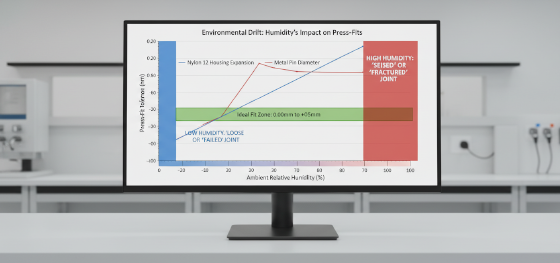
A press-fit that works in our climate-controlled lab in Shenzhen may not work in a humid factory in Singapore. Polyamides like Nylon 12 are hygroscopic; they drink water from the air and expand. In a 10mm bore, moisture absorption can cause the hole to shrink by 0.05mm or the wall to swell by the same amount. This dimensional shift turns a "Tight Fit" into a "Breaking Fit." Understanding the environmental lifecycle is essential for press fit 3d printing tolerance success.
JUCHENG mitigates this through "Saturation Mapping." We calculate the expected moisture expansion of the material based on your part's final destination. For high-precision robotics mounts, we may suggest a "Post-Machining Stabilize" cycle, where the 3D printed parts are annealed and then conditioned to a specific humidity before being measured. This locks the dimensions into an equilibrium state. If your assembly cannot tolerate environmental drift, we may recommend a switch to a more stable material like Machined Delrin for the interference features. We provide the technical transparency needed to manage these "living" dimensions, ensuring your hardware doesn't fail three weeks after delivery because of a rainstorm. We bridge the gap between digital theory and the visceral reality of global logistics.
JUCHENG’s Functional Standard: Validating the Hold-Force
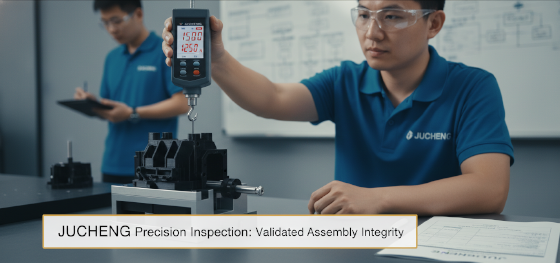
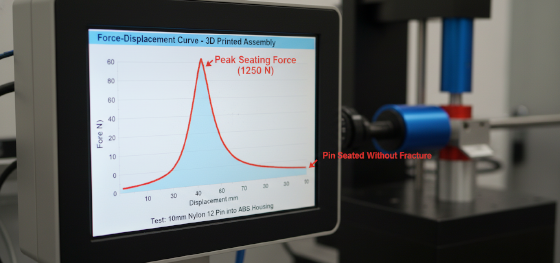
The final hallmark of a professional manufacturing partner is the move beyond "it feels tight" to "here is the data." Jucheng Precision operates a functional validation lab where we don't just inspect dimensions; we inspect performance. For critical press fit 3d printing tolerance orders, we perform standardized "Pull-Out Tests." We use digital force gauges to measure exactly how many Newtons of force are required to separate the components.
This empirical data allows our clients to verify their engineering safety factors with real-world parts. Our facility is equipped with high-resolution CMMs to audit the circularity of every interference bore, ensuring that the "grip" is uniform around the entire circumference. We provide full documentation, including material lot certificates and inspection heatmaps, ensuring your 3D printing tolerances are backed by the same rigor as our 5-axis CNC production. Whether you are building an innovative medical valve or a high-torque automotive linkage, our expertise ensures your vision is delivered with absolute visual and structural integrity. Contact Jucheng Precision today for a comprehensive technical DFM review and let our interference protocols clarify and armor your next manufacturing breakthrough.

