

Die casting for humanoid robot parts: The Mass Production Pivot
Views: 4 Author: Allen Xiao Publish Time: 2026-04-07


Subtractive manufacturing becomes a financial anchor when a hardware program transitions from a successful pilot to global mass market adoption. In the hyper-agile ecosystem of 2026, when a robotics company secures a massive logistics contract or consumer retail order, attempting to CNC mill 10,000 bipedal skeletons from solid billets of aluminum is an exercise in operational suicide. The "Machine-Hour Tax" and the astronomical raw material waste (often a 10:1 Buy-to-Fly ratio) will consume all profit margins and cripple the supply chain's delivery velocity. Navigating this critical volume threshold requires the strategic deployment of Die casting for humanoid robot parts. This high-pressure formative discipline transforms molten metal alloys into near-net-shape structural components in mere seconds. Jucheng Precision operates as a high-fidelity metallurgical sanctuary in the Shenzhen precision manufacturing hub, providing the heavy-duty foundry capacity needed to eradicate the CNC bottleneck. As the ultimate scaling mechanism within our humanoid robot parts portfolio, we engineer H13 steel dies that deliver lightweight, high-modulus aluminum and zinc frames by the thousands. We turn "expensive bespoke linkages" into "affordable, mass-produced anatomy," ensuring your autonomous fleet achieves the price point required for mainstream deployment.
Establishing a resilient high-volume supply chain demands the absolute rejection of "pure casting" logic. Amateurs often mistakenly believe that a die-cast part is ready for the assembly line the moment it ejects from the tool. They fail to realize that the brutal thermal dynamics of molten metal inherently preclude the sub-micron tolerances required for harmonic drives and precision cross-roller bearings. A raw cast part will exhibit draft angles, slight porosity, and minor dimensional drift that will instantly destroy a high-speed actuator. Jucheng Precision eliminates these "Kinematic Nightmares" by deploying a mandatory "Hybrid Manufacturing" protocol. We utilize our high-tonnage die casting cells for mass geometry creation, followed immediately by targeted 5-axis CNC finishing passes. This guide deconstructs the economics of the 10,000-unit pivot, the physical standoff between A380 Aluminum and Zamak alloys, and why JUCHENG’s "Cast-and-Cut" strategy is the only viable foundation for anyone launching millions of robotic joints into the real world.
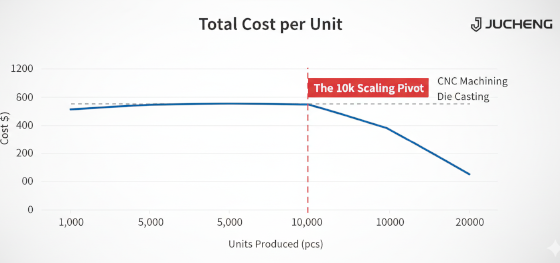
Transitioning from CNC to Die Casting: When annual volume hits 10,000+ units, CNC joint links become too expensive.
Aluminum & Zinc Die Casting: High-speed production of structural frames and motor housings with excellent strength-to-weight ratios.
Post-Machining: Why die-cast parts still need JUCHENG’s CNC centers to hit the +/- 0.01mm tolerances required for robotic bearings.
The JUCHENG Angle: We partner with you for the entire journey.
Frequently Asked Questions: High-Volume Robotic Skeletons
Transitioning from CNC to Die Casting: When annual volume hits 10,000+ units, CNC joint links become too expensive.
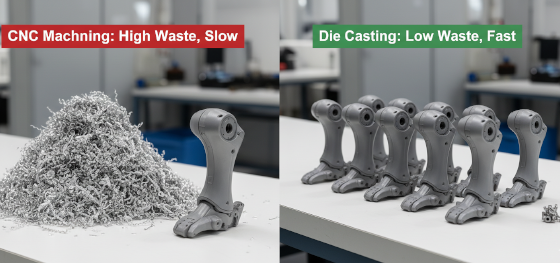
Machine time is the most expensive variable in precision metalwork. A complex robotic femur or shoulder linkage might require 4 to 6 hours of continuous 5-axis milling to complete. If your Estimated Annual Usage (EAU) is 10,000 robots (equating to 20,000 legs), fulfilling that order via CNC would require monopolizing dozens of machines for months, driving the piece price to astronomical levels. Die casting for humanoid robot parts alters this temporal physics entirely. High-Pressure Die Casting (HPDC) forces molten aluminum into a hardened steel mold cavity at velocities exceeding 100 miles per hour, under pressures up to 10,000 psi. The part solidifies and ejects in a cycle time often under 60 seconds. While the initial CapEx for the massive H13 steel die is significant (often $30,000 to $80,000+), the "Amortization Intersection" typically occurs around the 5,000 to 10,000 unit mark. Beyond this threshold, the piece price drops by 60% to 80% compared to a billet-machined part. Furthermore, die casting utilizes near 100% of the raw material, eliminating the wasteful mountain of aluminum chips generated by subtractive milling. We don't just "speed up production"; we fundamentally restructure your unit economics for profitability.
Aluminum & Zinc Die Casting: High-speed production of structural frames and motor housings with excellent strength-to-weight ratios.
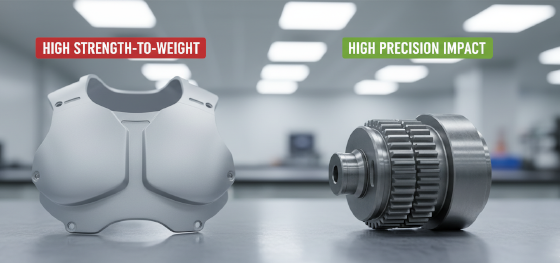
Metallurgical selection in high-volume foundry operations dictates the dynamic mass of the robot. Jucheng Precision primarily utilizes two alloy families for autonomous hardware. For the primary skeletal links (thighs, forearms, torso frames) where mass reduction is the supreme mandate, we deploy Aluminum alloys such as A380 or ADC12. These alloys offer spectacular fluidity during injection, allowing us to cast thin-walled (down to 1.5mm), rib-reinforced structures that provide extreme torsional stiffness while remaining incredibly lightweight. They also offer excellent thermal conductivity, acting as massive heat sinks for the robot's high-current motors. Conversely, for smaller, ultra-dense components like micro-actuator housings or high-impact internal brackets, we pivot to Zinc alloys (Zamak 3 or 5). Zinc is significantly heavier than aluminum but is roughly 2.5 times stronger, offering impact resistance and dimensional stability that rivals mild steel. Zinc also casts at lower temperatures, providing longer tool life and allowing for incredibly intricate, near-net-shape features that rarely require secondary machining. We act as your metallurgical navigators, mapping the specific alloy to the exact stress profile of the robotic joint.
Post-Machining: Why die-cast parts still need JUCHENG’s CNC centers to hit the +/- 0.01mm tolerances required for robotic bearings.
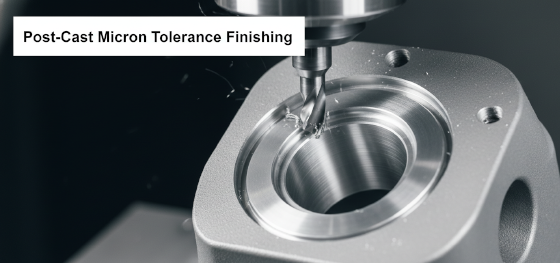
Thermal contraction is the enemy of sub-micron bearing integration. As a molten die-cast part solidifies and cools, it shrinks by roughly 0.6%. This shrinkage is not perfectly uniform; varying wall thicknesses and draft angles (which are required to eject the part from the die) cause slight warping and out-of-roundness. A raw cast hole cannot house a precision cross-roller bearing; the bearing would bind, leading to immediate "Backlash" or actuator failure. This is why "Pure Casting" is insufficient for humanoid robot parts. Jucheng Precision resolves this through a mandatory "Cast-and-Cut" protocol. We design the die-cast tool to leave an extra 0.5mm of "Stock Material" on all critical mounting faces, flange surfaces, and bearing bores. The raw castings are then transferred immediately to our 5-axis CNC machining bays. We utilize custom work-holding fixtures to secure the complex castings while our high-speed spindles execute a final finishing pass. We remove the draft angles and achieve the exact +/- 0.01mm concentricity and Ra 0.4 µm surface finish required for harmonic drive integration. We combine the high-speed mass production of the foundry with the surgical perfection of aerospace machining.
The JUCHENG Angle: We partner with you for the entire journey.
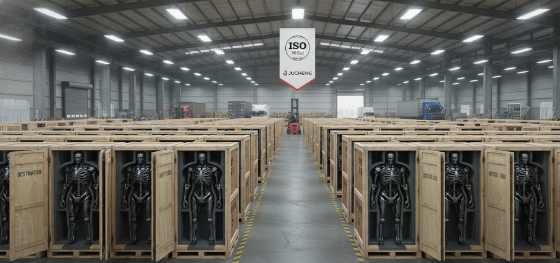
Manufacturing excellence at Jucheng Precision is built on the foundation of lifecycle continuity. We do not believe in forcing a startup to change vendors simply because they succeeded. Fragmented supply chains lead to disastrous "Data Leaks," where the dimensional history learned during the prototyping phase is lost when the project moves to a separate high-volume foundry. JUCHENG eliminates this friction. When your robot is ready for the masses, we seamlessly transfer your CAD files from our low-volume CNC prototyping bays directly into our high-volume High-Pressure Die Casting (HPDC) and automated CNC-finishing lines. The same engineers who perfected the fitment of your first 10 Alpha builds will oversee the DFM and tool-cutting for your 100,000-unit mass production run. We provide the material lot traceability, CMM inspection reports, and hard-anodized surface finishing required for global market dominance. Stop stalling your venture growth with disconnected suppliers. Contact our technical team today for a comprehensive scaling audit and secure your manufacturing sovereignty.
Frequently Asked Questions: High-Volume Robotic Skeletons
Question: How long does it take to build a die-casting mold for a robotic arm link?
Answer: Because HPDC molds must withstand immense thermal and hydraulic shock, they are carved from massive blocks of hardened H13 steel. Depending on complexity and the number of sliders, lead times typically range from 6 to 10 weeks.
Question: Can die-cast aluminum robotic parts be anodized for corrosion resistance?
Answer: Yes, but with caveats. Due to the high silicon content in die-cast alloys like A380, standard anodizing can appear dark or splotchy. Jucheng Precision utilizes specialized casting parameters and painting/powder-coating protocols to provide a premium, retail-ready cosmetic finish.
Question: Does JUCHENG handle the assembly of bearings into the die-cast parts?
Answer: Yes. As an integrated turnkey manufacturer, our cleanroom assembly bays can press-fit the harmonic drives, install threaded inserts, and apply thermal pastes directly into the post-machined die-cast housings, delivering ready-to-run actuator modules.

ㆍPrivacy: We respect your privacy. Here you can find an example of a non-disclosure agreement. By submitting this form, you agree to our terms & conditions and privacy policy.
