


Physical realization is the ultimate filter for artificial intelligence. In the hyper-accelerated landscape of 2026, software algorithms can simulate a bipedal gait endlessly in a digital twin environment, but venture capital flows only toward hardware that actually walks across the boardroom floor. When a robotics startup attempts to build their "Alpha" prototype, they are immediately confronted by a fragmented manufacturing nightmare. A humanoid is not a single product; it is a dense ecosystem of ultra-precise metal joints, complex internal wiring harnesses, and sweeping cosmetic exterior armor. Relying on a single manufacturing technology—like printing the entire robot in fragile resin—guarantees mechanical failure under the immense dynamic load of its own weight. Navigating this multi-disciplinary crisis requires the strategic deployment of Humanoid robot prototyping. This specialized integration discipline transforms a sprawling Bill of Materials (BOM) into a cohesive, functional machine. Jucheng Precision operates as a high-fidelity hardware accelerator in the Shenzhen precision manufacturing hub, providing the technical depth to coordinate 5-axis CNC, industrial 3D printing, and vacuum casting under one roof. Within the broader framework of humanoid robot parts development, we bridge the gap between "simulation" and "sovereignty," ensuring your first physical iteration arrives in days, assembles perfectly, and performs undeniably.
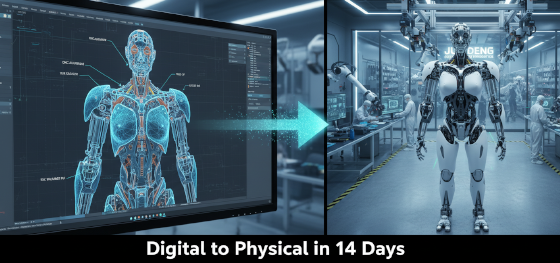
Establishing a resilient iteration cycle demands the absolute rejection of vendor fragmentation. Amateurs spend 40% of their seed funding managing logistics between a CNC shop that doesn't understand aerospace tolerances and a 3D print farm that provides warped plastic. Jucheng Precision eliminates this "Coordination Friction" by acting as your single-source hardware architect. Whether you need a titanium hip actuator or a soft-touch silicone fingertip, our facility provides the material science and metrological rigor required to execute every component simultaneously. This guide deconstructs the physics of rapid iteration, the necessity of mapping specific technologies to specific functional requirements, and why JUCHENG’s "Turnkey Protocol" is the mandatory foundation for anyone aiming to secure Series A funding in the robotics sector.
Velocity Sovereignty: The Race to Secure Venture Capital Funding
Additive Agility: MJF 3D Printing for Internal Brackets and Fit Checks
Cosmetic Authority: Vacuum Casting the First 10 Exterior Skins
Structural Truth: CNC Machining the Critical Load-Bearing Joints
JUCHENG Protocol: Orchestrating the Entire Robot BOM
Frequently Asked Questions: Humanoid Alpha Builds
Velocity Sovereignty: The Race to Secure Venture Capital Funding
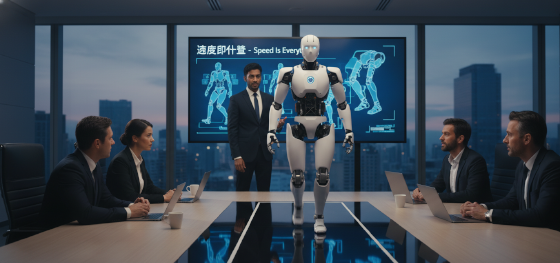
Financial survival in the hardware sector is entirely dictated by the speed of physical iteration. Investors in 2026 are highly skeptical of digital renders and software-only demonstrations; they demand a physical "Proof of Concept" that proves the kinematic logic of your control system. Humanoid robot prototyping provides the "Alpha Build" needed to secure this funding. The primary challenge is that the first design is never perfect. A mounting boss will clash with a battery pack, or a joint housing will require an extra millimeter of clearance. If your supply chain takes four weeks to machine a new revision, your runway evaporates. Jucheng Precision eliminates this "Iteration Debt." Because we house 150+ CNC machines and industrial 3D printers, we can often execute design revisions and ship replacement components in 48 to 72 hours. This extreme velocity allows your engineering team to "Fail Fast and Fix Faster," iterating through three versions of a bionic leg in the time it takes a competitor to receive their first set of parts. We don't just provide metal and plastic; we provide the operational agility that keeps your burn rate low and your momentum high.
Additive Agility: MJF 3D Printing for Internal Brackets and Fit Checks
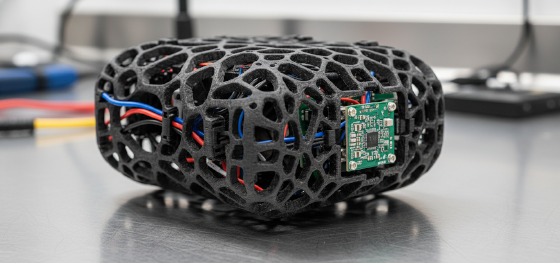
Internal architecture in a bipedal robot is a chaotic puzzle of PCBs, wiring harnesses, and cooling fans. Machining these complex, low-stress internal brackets from solid aluminum is a waste of capital and machine time. For the hidden "skeleton" that organizes the internal organs, Multi Jet Fusion (MJF) 3D printing is the undisputed champion. Jucheng Precision utilizes industrial MJF systems to fuse Carbon-Fiber reinforced Nylon (PA12-CF) powder layer-by-layer. This process creates parts that are exceptionally lightweight and strong enough to secure heavy battery packs. Because MJF requires zero support structures, we can print highly complex, generative-designed lattice brackets that snake around the internal void space of the robot’s chest cavity. This provides the perfect "Fit-Check" geometry, allowing your assembly technicians to verify cable routing paths instantly without paying for expensive 5-axis CNC time on non-load-bearing components.
Cosmetic Authority: Vacuum Casting the First 10 Exterior Skins
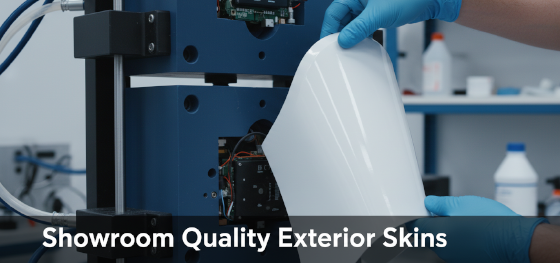
Visual authority dictates the perceived value of the machine. An Alpha prototype covered in rough, layered 3D-printed shells looks like an amateur science project, instantly repelling high-end investors. However, purchasing a $50,000 injection mold for ten sets of exterior armor is financial suicide. Jucheng Precision bridges this "Cosmetic Gap" utilizing Polyurethane Vacuum Casting. By machining a single, highly polished master pattern, we create a flexible silicone tool capable of pouring 20 identical copies of your robot’s chest plate, head unit, and thigh covers. We cast these skins using specialized ABS-like or PC-like liquid resins that mimic the flexural modulus of final production plastics. Our integrated cleanrooms then apply automotive-grade 2K paints and silk-screened branding, delivering a showroom-ready exterior that reflects the sophisticated software running beneath it. You achieve the visual impact of mass production on a prototype budget.
Structural Truth: CNC Machining the Critical Load-Bearing Joints
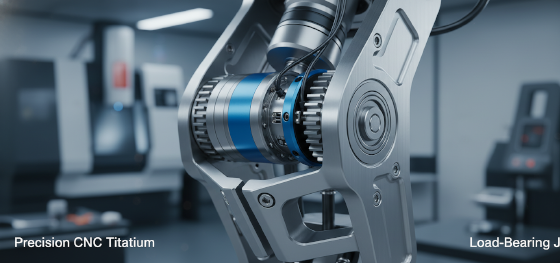
Kinetic survival is impossible without absolute subtractive precision. While plastics are excellent for covers and internal brackets, the joints—specifically the knees, hips, and shoulders—must bear the entire dynamic load of the robot’s walking gait. A 3D-printed ankle will shatter on the first jump, and a cast resin hip joint will flex, causing "Lost Motion" that destroys the balancing algorithm. Jucheng Precision allocates these mission-critical components to our elite 5-axis CNC machining bays. We carve the actuator housings, planetary gear carriers, and main bone linkages from solid billets of Aerospace Aluminum (7075-T6) or Titanium Grade 5. We hold concentricity and bearing-bore tolerances to +/- 0.005mm, ensuring zero-backlash integration with your harmonic drives. By providing the "Structural Truth" of real metal, we ensure your prototype behaves with the exact rigidity and inertia profile of the final mass-produced machine, providing your software team with reliable kinematic data.
JUCHENG Protocol: Orchestrating the Entire Robot BOM
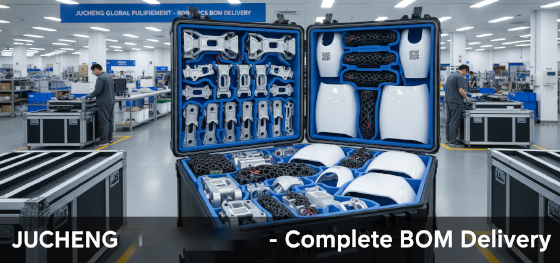
Manufacturing excellence at Jucheng Precision is built on the foundation of comprehensive BOM (Bill of Materials) orchestration. We recognize that an Alpha build is a complex puzzle where a 1mm mismatch between a CNC joint and a cast resin cover halts the entire assembly. When you upload your complete robot CAD to our facility, our veteran engineers perform a "Holistic Integration Audit." We map every single component to the correct process—CNC, MJF, or Vacuum Casting—ensuring that the parts will mate perfectly when they arrive at your lab. We provide full material lot traceability and CMM dimensional inspection reports for the critical joints, providing the "Paper Trail of Quality" required for eventual medical or automotive compliance. Stop gambling your venture funding on fragmented suppliers who treat robotics like a side business. Leverage our decade of multi-process mastery to iterate rapidly, launch confidently, and secure your funding profitably. Contact our technical team today for a free comprehensive DFM review.
Frequently Asked Questions: Humanoid Alpha Builds
Question: How fast can JUCHENG deliver a complete multi-process robotic prototype kit?
Answer: By executing the 3D printing (brackets), CNC machining (joints), and vacuum casting (exterior skins) concurrently in our integrated facility, we typically deliver complete, ready-to-assemble Alpha kits in 10 to 14 business days.
Question: Does JUCHENG provide assembly services for the robotic joints?
Answer: Yes. Beyond machining the raw metal housings, we can press-fit the cross-roller bearings and integrate the harmonic drive wave generators, providing pre-assembled, zero-backlash actuator modules ready for your motors.
Question: Can the vacuum-cast exterior skins be made flame retardant?
Answer: Absolutely. If the robot houses high-capacity batteries or power distribution units, we can cast the exterior skins using specialized UL94 V-0 rated polyurethane resins to ensure maximum thermal safety during testing.

