


Autonomy is entirely dependent on the purity of incoming data. When a humanoid robot navigates a complex factory floor or a drone executes a precision landing, the algorithms rely on LiDAR arrays, stereoscopic cameras, and ultrasonic sensors to map the physical world. If the protective housing covering these delicate instruments warps, leaks moisture, or scatters incoming light, the robot becomes effectively blind, leading to catastrophic operational failures. Navigating this requirement for optical perfection and environmental defense requires the strategic deployment of Custom sensor housings for robots. This specialized discipline transforms a standard plastic box into a precision optical instrument and a Faraday cage. Jucheng Precision operates as a high-fidelity manufacturing sanctuary in the Shenzhen precision manufacturing hub, providing the exotic post-processing depth needed to armor your robot's "eyes and ears." As a critical subset of humanoid robot parts development for the 2026 market, we engineer sensor pods that deliver zero-distortion telemetry, ensuring your machine learning models are fed with flawless physical reality.
Establishing a resilient sensor supply chain demands the absolute rejection of "hobby-grade" 3D printed shells. Amateurs often ignore the devastating effects of microscopic porosity and electromagnetic noise, resulting in LiDAR units that short out during a rainstorm or cameras that lose focus due to structural flexing. Jucheng Precision eliminates these "Data Blind Spots" by enforcing a strict ISO 9001-compliant machining and molding workflow. Whether you are developing a ruggedized sensor array for an agricultural rover or a hyper-compact camera bezel for a medical assistant, our facility provides the material science and metrological rigor required for global market entry. This guide deconstructs the physics of hermetic sealing, the necessity of vapor polishing, and why JUCHENG’s "Integrated Coating Protocol" is the mandatory foundation for anyone developing high-stakes sensory hardware.
IP67 Waterproofing: How do threaded inserts and O-rings create a hermetic seal?
Optical Clarity: Why machine and vapor-polish Polycarbonate (PC) or Acrylic (PMMA)?
EMI Shielding: How do conductive coatings prevent AI chip interference?
The JUCHENG Angle: Delivering the complete post-processing and precision machining package.
Frequently Asked Questions: Robotic Sensor Housings
IP67 Waterproofing: How do threaded inserts and O-rings create a hermetic seal?
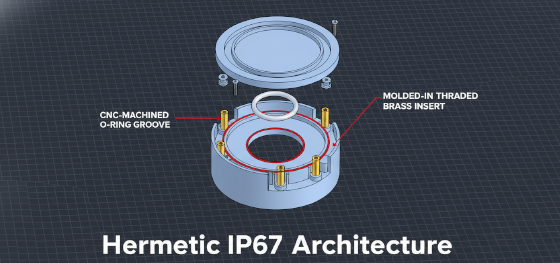
Environmental ingress is the primary assassin of sensitive electronics. For robots operating outdoors or in hospital wash-down zones, the sensor housing must achieve an IP67 rating (total dust protection and immersion in 1 meter of water). Attempting to achieve this with self-tapping screws screwed directly into plastic is a guaranteed leak path; the plastic threads will micro-fracture under torque, allowing water to wick past the seal. Jucheng Precision engineers utilize Insert Molding to embed knurled brass threaded nuts directly into the plastic housing during the injection cycle. This creates a permanent, high-torque metal anchor. We then utilize 5-axis CNC machining to cut a precise O-ring groove around the perimeter of the mating face. By maintaining +/- 0.01mm depth tolerances on this groove, we ensure the rubber gasket compresses with exact uniformity when the metal screws are tightened down. We turn "leaky plastic boxes" into "hermetically sealed vaults," ensuring a drop of water never touches your $1,000 LiDAR sensor.
Optical Clarity: Why machine and vapor-polish Polycarbonate (PC) or Acrylic (PMMA)?
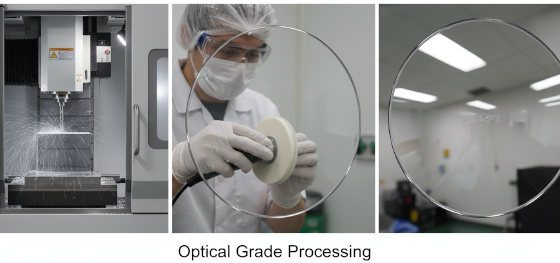
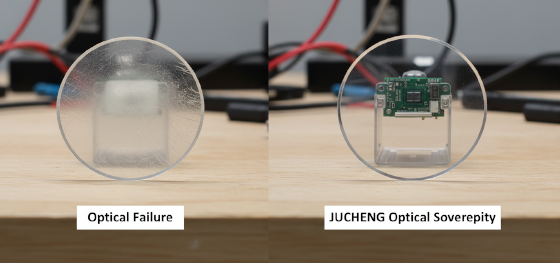
Photon transmission is completely compromised by surface roughness. When a laser or a camera lens "looks" through a plastic window, any microscopic machining marks on the surface will scatter the light, creating "Ghosting" or drastically reducing the range of the sensor. For low-volume robotic builds, CNC machining the sensor window from solid blocks of Polycarbonate (for extreme impact resistance) or Acrylic (for maximum 92% light transmission) is standard practice. However, the CNC cutter leaves a frosted, opaque finish. Jucheng Precision restores optical sovereignty by utilizing a "Vapor Polishing" protocol. We expose the machined PC or PMMA parts to a highly volatile chemical vapor inside a controlled chamber. The vapor momentarily melts the top few microns of the plastic, smoothing out the microscopic valleys and peaks before instantly re-solidifying into a flawless, glass-like finish. This process achieves an SPI A-1 equivalent mirror surface without altering the dimensional geometry of the window, ensuring your robot's vision algorithms receive pristine, uncorrupted visual data.
EMI Shielding: How do conductive coatings prevent AI chip interference?
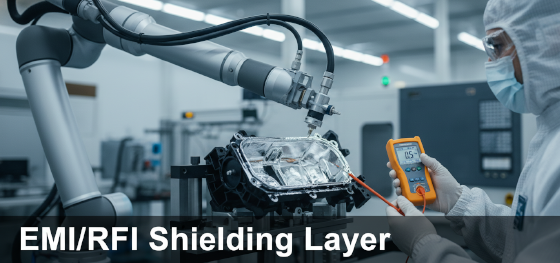
Electromagnetic "Noise" is the invisible predator of high-speed data processing. A humanoid robot is packed with powerful servo motors that generate massive electromagnetic fields. If these fields penetrate the plastic sensor housing, they will induce stray currents into the delicate AI processing chips handling the LiDAR or camera feeds, causing the system to crash or report false data. Standard polymers are insulators and offer zero defense against this Radio Frequency Interference (RFI). Jucheng Precision transforms your plastic enclosure into a conductive "Faraday Cage." In our specialized finishing department, robotic spray arms apply a uniform 25-micron layer of highly conductive Silver, Copper, or Nickel-based paint to the *interior* walls of the housing. This metallic shield reflects and absorbs the rogue electromagnetic waves before they can reach the silicon. We measure the surface resistance of every batch to ensure continuous electrical grounding, providing the signal integrity your neural networks require to operate flawlessly in electrically noisy environments.
The JUCHENG Angle: Delivering the complete post-processing and precision machining package.
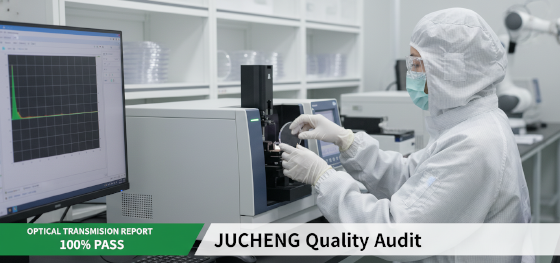
Manufacturing excellence at Jucheng Precision is built on the foundation of the "Single-Source Payload" mandate. We eliminate the friction of managing three different vendors for a single sensor pod. Our facility houses 150+ CNC machines for the base housing, elite vapor-polishing bays for the optical windows, and automated spray lines for the EMI shielding—all under one ISO 9001 certified roof. When you upload a CAD assembly to our facility, our veteran engineers perform a comprehensive "Sensory DFM Audit." We suggest O-ring groove optimizations and identify optimal grounding points for the conductive coating before a single chip of plastic is cut. We provide full material lot traceability and spectrophotometer light-transmission reports for every batch, ensuring your hardware journey is lean, predictable, and market-ready. Stop gambling your robot's autonomy on fragmented suppliers who treat optics like generic plastics. Leverage our decade of high-performance replication mastery to validate rapidly and launch profitably. Contact our technical team today for a free DFM review.
Frequently Asked Questions: Robotic Sensor Housings
Question: Should I use Polycarbonate or Acrylic for a LiDAR window?
Answer: Polycarbonate (PC) is vastly superior if the robot is exposed to impact risks (like flying debris or drops), though it requires UV-resistant coatings for outdoor use. Acrylic (PMMA) offers slightly better raw light transmission and natural UV resistance but is prone to shattering upon impact.
Question: Does vapor polishing alter the dimensions of the machined sensor window?
Answer: The dimensional change is negligible—typically less than a few microns. The chemical vapor only affects the absolute outermost microscopic layer of the plastic, smoothing the peaks of the machining marks without altering the macro-geometry or the focal length of the window.
Question: How do you test the effectiveness of the EMI shielding coating?
Answer: Jucheng Precision utilizes digital multimeters to measure the surface resistance (Ohms per square) of the coated interior. We ensure the resistance remains below the threshold required to achieve the 60+ dB of attenuation necessary for FCC/CE EMC compliance.

