


You are designing a part. It needs to be stainless steel. You look at the options. You see two grades that look almost identical on paper: 304 and 316. Then you get the quotes. The 316 is 25% more expensive.

The question is immediate and critical. Is that extra cost a necessary investment in reliability? Or is it an unnecessary waste of your project's budget?
This is the classic showdown: 304 vs 316 stainless steel. The answer depends entirely on understanding the specific battlefield your part will face. This guide will give you the intelligence to make the right call.
content:
Two Brothers with Different Powers
The Battlefield: General Corrosion vs. Chloride Attack
Cost: Paying the Price for Protection
Making the Final Call
Two Brothers with Different Powers
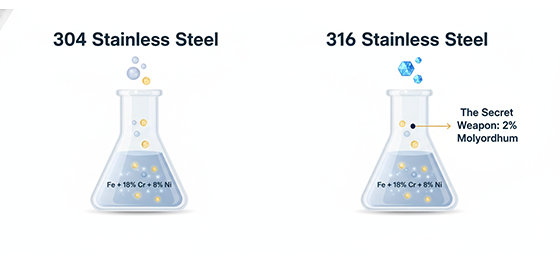
Think of 304 and 316 as two brothers in the austenitic stainless steel family. They look identical. To the naked eye, you cannot tell them apart. They are both non-magnetic. They both have excellent toughness and are easy to weld and form.
Their base recipe is very similar. They are both "18-8" steels, containing approximately 18% chromium and 8-10% nickel. This is the source of their good general corrosion resistance.
But the younger brother, 316, has a secret weapon. Its recipe includes an extra ingredient: about 2-3% Molybdenum. This one, small addition is the source of all the difference. It gives 316 a superpower that 304 does not possess.
The Battlefield: General Corrosion vs. Chloride Attack

The passive chromium oxide layer on all stainless steels is a fantastic shield. For 304, this shield is excellent at repelling general corrosion from things like rain or food acids. This is why it is perfect for kitchen sinks and indoor architectural trim.
But this shield has a vulnerability. It can be breached by chlorides. Chlorides are found everywhere in aggressive environments: saltwater, de-icing salts on winter roads, and many industrial chemicals. Chlorides can attack the passive layer at a microscopic level, causing a devastating type of localized corrosion called "pitting."
This is where Molybdenum's magic comes in. The molybdenum in 316's chemistry significantly strengthens the passive layer. It makes it much more resistant to this specific chloride attack. It is the armor plating on the shield.
This is why 316 is known as "marine grade" stainless steel. It is the only choice for a part that will live on a boat or near the coast. It is also essential for medical implants, as the human body is a chloride-rich environment. The process of stainless steel cnc machining for these parts must maintain this integrity.
Cost: Paying the Price for Protection
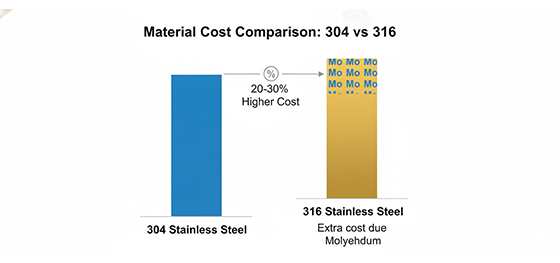
This superior protection comes at a direct financial cost. The two extra ingredients in 316—molybdenum and a slightly higher percentage of nickel—are expensive metals.
As a result, the raw material cost for 316 stainless steel is typically 20% to 30% higher than for 304.
Furthermore, the added alloys make 316 slightly harder and gummier than 304. This means it is a little more difficult to machine. It causes slightly more tool wear and may require slower cutting speeds. This can add a small amount to the final machining cost.
This cost difference is the heart of the decision. Is the extra protection worth the extra price?
Making the Final Call
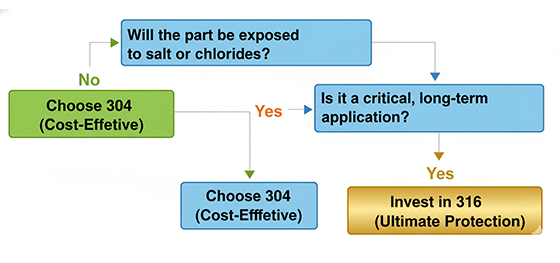
The choice in the 304 vs 316 stainless steel battle is a risk assessment. You must honestly evaluate the environment your part will live in.
| Factor | 304 Stainless Steel | 316 Stainless Steel |
|---|---|---|
| Key Advantage | Cost-Effective | Superior Corrosion Resistance |
| Secret Weapon | None | Molybdenum (Mo) |
| Resists Chlorides (Salt)? | No | Yes |
| Cost Index | ~1.0x | ~1.25x |
| When to Use | General, Indoor, Food Grade | Marine, Medical, Chemical |
If your part will be used indoors, in a controlled environment, or only exposed to fresh water, 304 is the smart, cost-effective choice. Paying for 316 would be a waste of money.
But if there is any chance your part will be exposed to salt, de-icing chemicals, or other corrosive chlorides, choosing 316 is not a luxury. It is a necessity. The higher initial cost is a cheap insurance policy against the much higher cost of a premature product failure. At JUCHENG, our ISO 13485 certification means we are experts in handling and documenting critical 316L medical components. We can help you make the right choice to protect your product and your reputation.

