


What is the visual language of precision? Often, it is the glint of light off a perfectly polished, razor-sharp edge. It is a surface so flawless that it becomes a mirror.
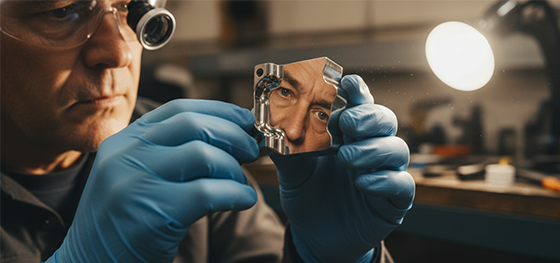
To create such an object, you need a very special material. You need a metal that can not only be hardened to the level of a blade, but can also be polished to the level of a jewel.
This is the unique territory of 420 stainless steel. The process of Machining 420 Stainless Steel is a journey in creating parts that are as beautiful as they are hard.
content:
Meet the 'Cutlery Grade' Steel
The Machining Strategy: Before and After
Its True Calling: The Art of the Polish
Choosing Your Partner for Precision
Meet the 'Cutlery Grade' Steel
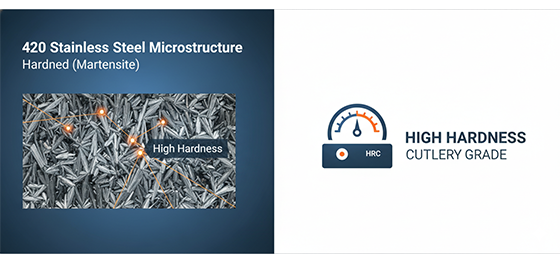
420 stainless steel is a "martensitic" stainless steel. This puts it in a different family from the common 304 and 316 grades. Its defining feature is its ability to be hardened through heat treatment.
Its recipe has a higher carbon content and lower chromium content compared to 304. This chemistry allows it to undergo a transformation. After being heated and quenched, it can achieve a hardness of around 50 HRC. This is very hard. It is the reason 420 has been the traditional material for high-quality knives and cutlery for decades. It can take and hold a very sharp edge.
While its corrosion resistance is good in everyday environments, it is not as robust as the 300-series. Its true talent lies in its unique combination of decent corrosion resistance, excellent hardness, and one other superpower: its incredible polishability.
The Machining Strategy: Before and After
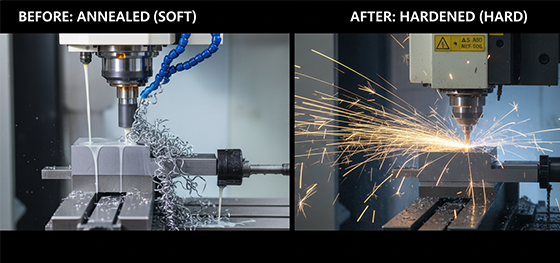
The strategy for Machining 420 Stainless Steel is a two-act play. It is all about managing its hardness.
Act One is machining in the "annealed" or soft state. In this condition, 420 is relatively easy to machine. It is still a challenging stainless steel, but it can be cut efficiently with standard carbide tools and good practices. Most of the rough shaping and material removal is done in this phase.
Then comes the heat treatment. The part is hardened to its final, required hardness.
Act Two is the finishing work. In its hardened state, 420 is extremely difficult to cut with traditional tools. For the final, high-precision features, a machinist must switch to different technologies. Precision grinding is used to achieve the final, tight tolerances. Or, for complex internal features, EDM (Electrical Discharge Machining) is used to erode the metal with sparks. This two-stage approach is key to success.
Its True Calling: The Art of the Polish
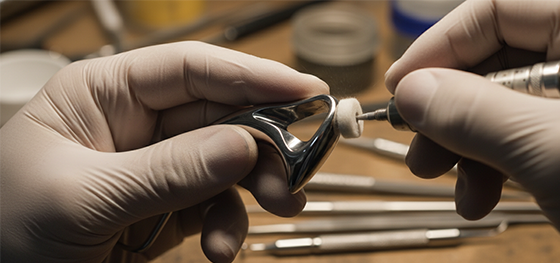
Here is where 420 stainless truly shines, quite literally. Its fine-grained martensitic structure allows it to be polished to a flawless, mirror-like finish.
This is a highly skilled, manual process. After the part is hardened and ground, a master polisher will take it through a multi-stage process. They use a series of progressively finer abrasive stones and diamond pastes.
It is an art of patience and feel. The polisher works the surface for hours, removing every microscopic scratch, until a perfect, distortion-free mirror is achieved.
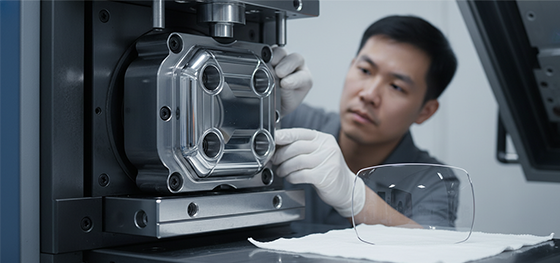
This ability to be both hard and perfectly polished is why 420 is a top choice for making the core and cavity inserts for injection molds that produce clear, optical parts. The perfect polish on the steel mold is directly transferred to the plastic lens, creating a flawless optical surface. It is also essential for surgical instruments that need to be both sharp and easy to sterilize.
Choosing Your Partner for Precision
You choose 420 stainless steel when your part must satisfy two demanding requirements: good hardness and an exceptional surface finish.
It is the material of choice for high-quality cutlery, surgical instruments, bearings, and, most importantly, injection mold inserts.
Successfully manufacturing a part from 420 requires a partner with a diverse set of skills. They need to be experts in stainless steel cnc machining. They need to have trusted partners for precise heat treatment. And they need to have the patience and skill of an artist in their polishing department.
At JUCHENG, we have this integrated expertise. We understand the full journey of a 420 stainless steel part, from the first rough cut to the final, brilliant polish. It is this complete capability that allows us to deliver the uncompromising quality your precision project demands.

