


Kinetic inefficiency is the primary assassin of long-range autonomous flight. In the hyper-agile landscape of 2026, the transition from heavy-cast assemblies to generative polymer structures represents a mandatory leap in mechanical design. For UAV engineers, the primary adversary is not the flight control code—it is the physical "Mass Debt" that anchors your hardware to the ground. If your structural (arms) or landing gear are over-engineered blocks of solid metal, the propulsion system must work harder, leading to thermal throttling and reduced mission duration. Navigating this requirement for extreme strength-to-weight ratios requires the strategic deployment of 3D printed drone parts. Jucheng Precision operates as a high-fidelity additive sanctuary in the Shenzhen precision manufacturing hub, providing the technical depth to transform "impossible" geometries into flight-ready assets. Within the broader framework of drone/uav parts machining, we bridge the gap between "desktop experiments" and "certified aerospace sovereignty," ensuring your fleet scales with absolute material and structural certainty.
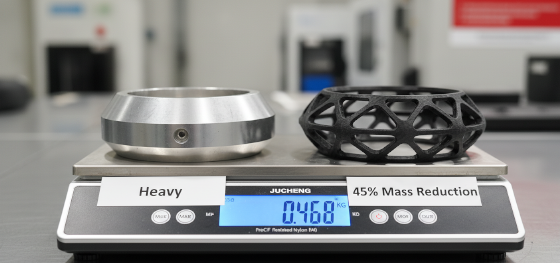
Establishing a resilient aerial supply chain in 2026 demands the rejection of "toy-grade" 3D printing. Amateurs often settle for PLA or PETG filaments, unaware that these polymers will melt under direct solar soak or shatter during high-velocity maneuvers. Jucheng Precision eliminates these "Atmospheric Failures" by providing an integrated ecosystem of industrial-grade Multi Jet Fusion (MJF) and specialized composite resins. Whether you are developing an autonomous sorter for a delivery hub or a long-range surveillance fixed-wing, our facility provides the material science and metrological rigor required for global market entry. This guide deconstructs the necessity of topology optimization, the physics of FST-compliant polymers, and why JUCHENG’s "Composite Protocol" is the mandatory foundation for anyone developing 3D printed drone parts for high-stakes industrial use. We turn "generative concepts" into "certified bionic airframes."
Why use topology optimization for drone airframes?
Why are Nylon-CF and Ultem 9085 the 2026 industry standards?
How does JUCHENG bridge the gap between additive and subtractive flight parts?
FAQ
Why use topology optimization for drone airframes?
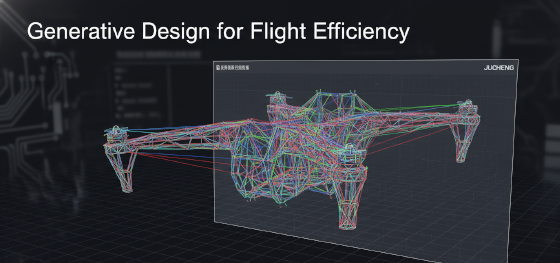
Material placement must be dictated by stress vectors rather than human aesthetics or machining limitations. 3D printed drone parts allow engineers to utilize "Generative Design" to create airframes that resemble organic structures like bird bones or root systems. In traditional subtractive manufacturing, creating a hollow internal lattice is physically impossible because a CNC drill cannot reach inside a closed volume. Jucheng Precision engineers utilize industrial MJF and SLS technology to "grow" these complex architectures layer-by-layer. By removing every cubic millimeter of material that does not actively contribute to supporting a mechanical load, we can reduce the mass of a main fuselage by nearly 40% while actually *increasing* its torsional stiffness. This structural sovereignty allows for the integration of hidden internal cooling channels for flight controllers and ESCs, effectively turning the airframe into a functional participant in the drone's thermal management.
Why are Nylon-CF and Ultem 9085 the 2026 industry standards?
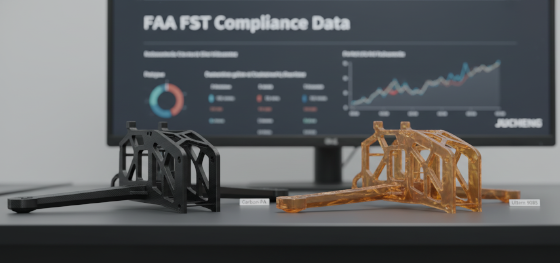
Mechanical survival in the stratosphere depends on the modulus of your polymer matrix. For high-cycle industrial 3D printed drone parts, Jucheng Precision focuses on two elite materials: Carbon-Fiber Filled Polyamide (PA12-CF) and Ultem 9085 (PEI). PA12-CF is the undisputed king of specific stiffness; the addition of microscopic carbon fibers into the Nylon matrix creates a part with 70 MPa of tensile strength, allowing 机臂 (arms) to resist the intense vibration of high-RPM propellers without fatigue. For commercial delivery drones that must pass strict regulatory audits, we pivot to Ultem 9085. This super-polymer possesses inherent flame retardancy and meets the FAA’s FAR 25.853 FST (Flame, Smoke, and Toxicity) requirements. JUCHENG’s all-electric 3D printing bay ensures these materials are processed with zero contamination, delivering airworthy components that maintain their structural integrity from -40°C to 150°C, armoring your hardware against the most hostile environmental cycles.
How does JUCHENG bridge the gap between additive and subtractive flight parts?
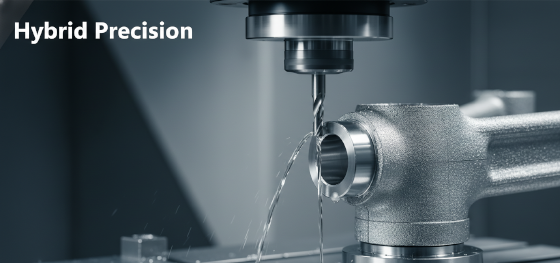
Manufacturing excellence at Jucheng Precision is built on the foundation of the "Hybrid Protocol." We recognize that while 3D printed drone parts can grow impossible bionic shapes, additive methods cannot natively achieve the +/- 0.01mm tolerances required for motor bearing seats or gimbal pivot interfaces. JUCHENG eliminates this "Precision Gap" by housing elite 5-axis CNC centers directly alongside our 3D printing farm. We print your airframe using near-net-shape additive protocols, then transfer the components to our CNC bay for a surgical finishing pass on all critical mounting surfaces. This vertical integration ensures zero data loss during the transition from additive skeleton to high-precision machine. We provide full material lot traceability and CMM dimensional inspection reports for every batch, providing the "Paper Trail of Quality" required for automotive and med-tech tier certification. Stop gambling your flight tests on inaccurate vendors. Leverage our decade of aerospace-grade replication mastery to validate rapidly and scale profitably.
FAQ

Q: Can 3D printed drone parts be as strong as CNC machined aluminum?
A: While aluminum has higher absolute strength, Carbon-Fiber reinforced polymers (PA12-CF) offer a superior strength-to-weight ratio for non-impact structural components, effectively allowing for lighter airframes with identical stiffness.
Q: How does JUCHENG ensure FST compliance for commercial UAVs?
A: We exclusively utilize certified aerospace-grade resins like Ultem 9085 and provide full material certification and burn-test documentation for every production run, satisfying the strict safety audits of the FAA.
Q: What is the typical lead time for an iterated 3D printed drone frame?
A: Utilizing JUCHENG’s expedited additive workflow, we can deliver fully functional, complex drone airframes in as fast as 3 to 5 business days from CAD approval.
Q: Are 3D printed drone parts watertight for marine search and rescue?
A: Industrial MJF and SLS parts are 99% dense but can have microscopic surface porosity. Jucheng Precision applies specialized epoxy coatings or vapor smoothing to ensure our printed enclosures achieve a verifiable IP67 rating.

