


Thermal saturation remains the primary saboteur of high-performance flight autonomy. In the hyper-dense electronic environments of 2026, the transition from simple hobbyist ESCs to complex AI-driven flight controllers represents a violent leap in heat generation. If the thermal energy from a high-current power distribution board is trapped within the carbon-fiber airframe, the resulting "Heat Soak" triggers a cascade of failures: clock-speed throttling, sensor-drift, and—in extreme cases—lithium-polymer battery ignition. Navigating this requirement for extreme heat dissipation without violating the strict "Mass Budget" of an aircraft requires the strategic deployment of Custom UAV heat sink machining. Jucheng Precision operates as a high-fidelity thermodynamic sanctuary in the Shenzhen precision manufacturing hub, providing the technical depth to deliver micro-finned aluminum and copper solutions that possess the mechanical spine and thermal soul your hardware demands. Within the broader framework of drone/uav parts machining, we bridge the gap between "overheated experimental boards" and "stabilized industrial airworthiness," ensuring your UAV fleet maintains its 24/7 mission endurance in any environment.
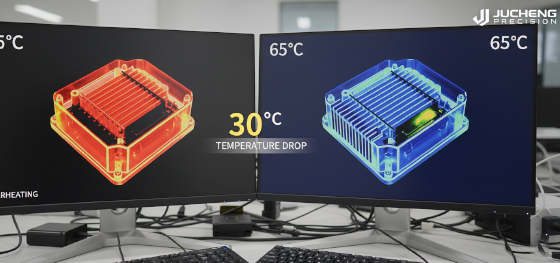
Establishing a resilient aerial supply chain in 2026 demands the rejection of "generic" off-the-shelf cooling. Amateurs often attempt to glue bulky, heavy extruded heat sinks onto their delicate PCBs, unaware that the added mass ruins the robot’s dynamic inertia and the adhesive bond will fail under high-G vibration. Jucheng Precision eliminates these "Thermal Dead-ends" by providing an integrated ecosystem of 5-axis CNC machining and precision skiving. We don't just "cut fins"; we engineer a specialized heat exchanger that perfectly contours your electronic component heights, maximizing surface contact and minimizing takeoff weight. This guide deconstructs the necessity of C110 copper selection, the physics of micro-milling fin density, and why JUCHENG’s metrological audit is the mandatory foundation for anyone developing Custom UAV heat sink machining projects for the global market. We provide the manufacturing insurance needed to ensure your AI "brain" stays cool under pressure.
Thermal Bottlenecks: Why 2026 AI controllers generate massive heat?
Material Standoff: Balancing Copper C110 vs. Aluminum 6063
Manufacturing Precision: Mastering Skiving vs. Micro-Milling
The JUCHENG Angle: Designing Conformal Contours for ROI
FAQ
Thermal Bottlenecks: Why 2026 AI controllers generate massive heat?
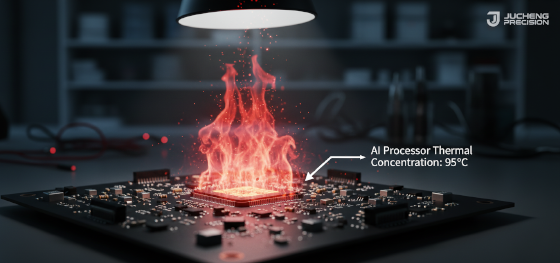
Computational density in the autonomous era is a hostage to thermodynamic extraction. Modern UAVs are equipped with high-wattage GPUs and FPGAs to handle real-time LiDAR processing and obstacle avoidance. These "AI Brains," alongside high-current Electronic Speed Controllers (ESCs), generate a localized heat flux that rivals high-end workstations, but within a space the size of a matchbox. Custom UAV heat sink machining is the primary defense against "Thermal Throttling"—the moment the processor downclocks itself to prevent a meltdown. If your cooling solution is inadequate, the drone's reaction time slows down, leading to navigation errors. Jucheng Precision engineers utilize Moldflow-style thermal simulations to identify these "Hot Zones." We design heat sinks with specific fin orientations that take advantage of the high-velocity propeller downwash, effectively turning the drone’s own propulsion into an active cooling system. We turn "wasted energy" into "stabilized intelligence."
Material Standoff: Balancing Copper C110 vs. Aluminum 6063
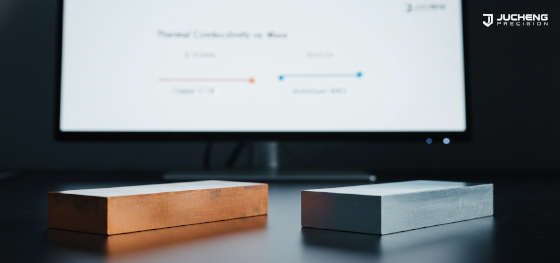
Molecular conductivity dictates the speed of the "Thermal Exit" path. In the world of Custom UAV heat sink machining, engineers must navigate a brutal standoff between the conductivity of Copper C110 (~390 W/m·K) and the lightweight agility of Aluminum 6063 (~200 W/m·K). Jucheng Precision advocates for a "Hybrid Metallurgy" approach. For the baseplate that touches the high-heat AI chip, we often recommend Copper C110 for its unparalleled ability to "pull" heat away from the silicon. However, for the large array of cooling fins exposed to the air, we utilize Aluminum 6063 to save mass. A solid copper heat sink is often too heavy for drone applications, acting as a "Payload Anchor." To assist in your early-stage routing, we provide the following technical comparison matrix:
| Property | Aluminum 6063-T6 | Pure Copper C110 |
|---|---|---|
| Thermal Conductivity | 201 W/m·K | 391 W/m·K (Winner) |
| Density (g/cm³) | 2.70 (Lighter) | 8.96 (Heavy) |
| Machinability | Excellent | Difficult (Gummy) |
| Corrosion Defense | High (Anodized) | Moderate (Oxidizes) |
Manufacturing Precision: Mastering Skiving vs. Micro-Milling
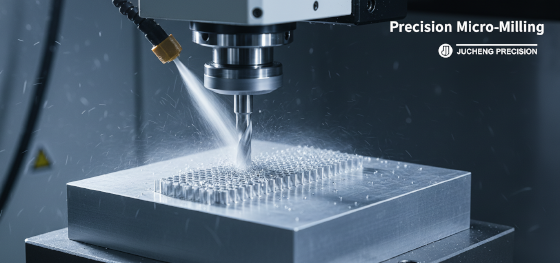
Subtractive perfection dictate the surface area available for cooling. The efficiency of a Custom UAV heat sink machining project is defined by its "Fin Density." Traditional extrusion cannot achieve the thin, tightly packed fins needed for compact 2026 drone housings. Jucheng Precision utilizes two elite manufacturing pathways. "Skiving" involves a sharp blade that shaves off thin slices of metal from a solid base, bending them upward to form fins. This process creates zero thermal resistance at the base because the fins and base are the same piece of metal. For more complex 3D shapes that must wrap around internal mounting bosses, we utilize "Micro-Milling" on our 5-axis CNC machines. We use specialized cutters as thin as 0.3mm to carve "Conformal Fin Arrays." This allows us to deliver a heat sink that isn't just a flat block, but a structural participant in your drone's aerodynamic profile, ensuring every millimeter of airflow is harvested for heat rejection.
The JUCHENG Angle: Designing Conformal Contours for ROI
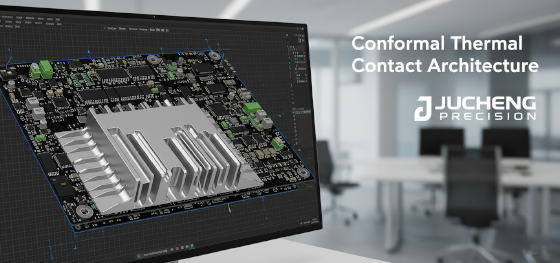
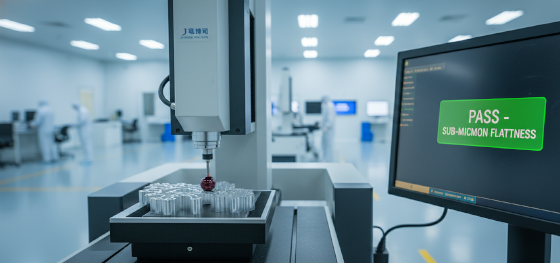
Manufacturing excellence at Jucheng Precision is built on the foundation of single-source accountability for high-stakes aerospace projects. We don't believe in "Hoped-for Cooling"; we prove it through predictive metrology. Our integrated facility allows us to manage the entire lifecycle of your Custom UAV heat sink machining. When you upload a CAD file to our facility, our veteran engineers perform a comprehensive "Contour Audit." We suggest hollowing out non-critical base areas to save 20 grams—which can translate to 60 seconds of extra flight time—while ensuring the primary contact zone has sub-micron flatness (Ra < 0.2µm) for perfect thermal grease contact. We provide full material lot traceability and CMM dimensional reports for every batch, providing the "Paper Trail of Quality" required for aeronautical certification. Stop gambling your drone’s AI brain on unoptimized cooling. Leverage our decade of thermal mastery to validate rapidly and launch confidently. Contact our technical team today for a free DFM review and see how we can turn your digital intent into a structurally sovereign physical reality.
FAQ
Q: Why is CNC better than extrusion for Custom UAV heat sink machining?
A: CNC machining allows for complex 3D contours that follow the specific heights of your PCB components, maximizing contact area and thermal transfer that a flat extruded sink cannot match.
Q: How do you prevent corrosion on copper heat sinks?
A: JUCHENG provides electroless nickel plating for all copper components. This protects the material from oxidation while maintaining high thermal conductivity.
Q: What is the thinnest cooling fin JUCHENG can machine?
A: Utilizing our high-speed 5-axis centers, we can routinely machine aluminum cooling fins down to 0.4mm in thickness with a 10:1 height-to-width ratio.
Q: Can JUCHENG handle the assembly of thermal pads?
A: Yes. We offer secondary assembly services, including the precision application of Phase-Change Materials (PCM) or high-grade thermal pads directly to your Custom UAV heat sink machining components.

