


Helical geometry is the ultimate test of an additive process. In the digital vacuum of a CAD environment, a thread is a mathematically perfect spiral, but in the physical landscape of 3D printing tolerances, that spiral is built from thousands of discrete, flat layers. This transition from a smooth continuous curve to a stepped approximation creates a functional minefield. Most engineers experience the frustration of a printed screw that binds instantly or a tapped hole that strips under the slightest torque. Mastering 3d printing threads tolerance is not about following a standard machinist’s handbook; it is about accounting for the "stair-step" effect and the volumetric expansion of resins and powders. Success here determines whether your assembly is a robust mechanical unit or a collection of disconnected parts held together by luck.
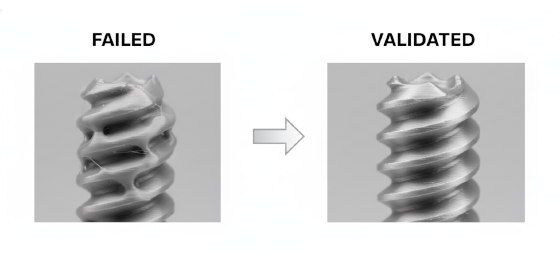
JUCHENG operates as a high-fidelity hub for complex medical and aerospace assemblies where fastening integrity is a safety-critical specification. We understand that for a high-pressure manifold or a satellite chassis, a failed thread is a failed mission. We have moved beyond the "print-and-pray" mindset to provide our clients with a "Fastening Strategy." By integrating high-resolution SLA and MJF systems with professional post-processing, we ensure that your internal and external threads behave with the predictability of machined metal. This guide explores the mechanical thresholds of thread size, the logic of vertical orientation, and why JUCHENG often advocates for the "Hybrid Anchor" approach—utilizing metal inserts to bypass the physical limitations of 3D printed polymers.
Profitability in 3D production is won by designing for the material's shear strength. You aren't just building a feature; you are creating a friction-based load path. Whether you are building an automotive sensor mount or a micro-fluidic manifold, the logic of the helix is your primary manufacturing governor. Let us break down the physical laws of thread design and see how technical foresight can lock the integrity of your next assembly into physical reality.
Minimum Thresholds: Why M4 Defines the Lower Limit
Z-Axis Sovereignty: Orienting for Helical Accuracy
Clearance Adjustments: Engineering the 0.1mm Compensation
Heat-Set Inserts: The Strategic Choice for High Loads
JUCHENG’s Reliability Standard: Validating Every Helix
Minimum Thresholds: Why M4 Defines the Lower Limit

Precision in threading is limited by the "Spot Size" of the machine. In the 3D printing process, the resolution of the laser or the diameter of the extrusion nozzle dictates the smallest feature that can be accurately resolved. For threads, this physical ceiling is usually found at the M4 size. Anything smaller than an M4 thread—such as M2 or M3—requires the machine to carve "V-grooves" that are often smaller than the minimum feature size of the technology. For instance, in MJF (Multi Jet Fusion), a 0.5mm pitch thread results in peaks and valleys that the powder particles cannot cleanly define.
At Jucheng Precision, we advise our clients to avoid "printing" threads smaller than M4 whenever possible. When a thread is too small, the "crests" become brittle and the "roots" become clogged with residual resin or powder. The result is a thread that feels "crunchy" and eventually strips after the first assembly. If your design mandates M2 or M3 threads, we suggest a different strategy: printing a precision pilot hole and then utilizing traditional secondary tapping. By respecting the resolution floor, you ensure that the threads you do print have the structural "meat" required to engage a metal bolt without catastrophic failure. We help you audit your fastener list during the DFM phase, matching the thread size to the resolution of the machine to ensure your 3d printing threads tolerance remains within functional limits.
Z-Axis Sovereignty: Orienting for Helical Accuracy
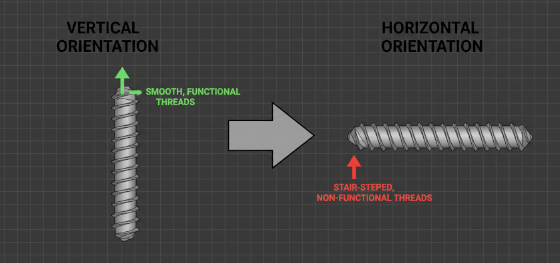
Orientation is the primary architect of thread quality. In additive manufacturing, the highest resolution is always found in the X-Y plane (the path of the laser or nozzle), but the most consistent "circularity" is found along the Z-axis. If you print a thread horizontally—where the axis of the screw lies flat on the build plate—the top and bottom of the thread will suffer from the "Stair-Step" effect. The circular profile will actually become an oval, and the "V" shape of the thread will be jagged and uneven. A horizontal thread is a high-friction disaster that will likely seize during assembly.
JUCHENG’s technicians implement a "Vertical Mandate" for threaded features. Whenever possible, we orient your part so that the threads are aligned vertically (perpendicular to the build plate). This ensures that each "ring" of the thread is produced in the X-Y plane, where the machine’s precision is at its peak. This results in a much smoother helical path and a consistent pitch diameter. However, vertical orientation increases the "Z-Height Tax," which we discussed in our guide on 3d printing cost. We help our clients find the strategic balance: orienting the part to protect the threads while minimizing the total build height. By controlling the physics of the build direction, we provide you with threads that possess the "Geometric Truth" needed for a smooth, hand-tight fit.
Clearance Adjustments: Engineering the 0.1mm Compensation

The biggest error in 3D threading is using a standard Machinist’s handbook to define your CAD hole. Traditional thread tables are designed for metal-on-metal fits where the surfaces are perfectly smooth. In 3D printing, the surface is inherently rough. If you design a "Class 6H" hole in PEEK or Nylon using standard dimensions, the bolt will not fit. The microscopic peaks of the printed layers act as an artificial interference, effectively shrinking the hole. Success in 3d printing threads tolerance requires an intentional "Manufacturing Offset."
At Jucheng Precision, we advocate for the "0.1mm Rule." We suggest modeling your internal threads with an additional 0.1mm to 0.15mm of clearance beyond the standard specification. This provides the "Wiggle Room" needed for the bolt to overcome the surface friction of the additive part. We also suggest utilizing a "Modified Root" profile—widening the valley of the thread to prevent the "over-sintering" or "curing-bleed" that often clogs the base of a 3D printed thread. By engineering the clearance into the CAD model, you allow JUCHENG to deliver parts that assemble effortlessly, reducing the need for manual chasing with a metal tap—a process that often damages the fragile polymer teeth. We don't just follow the standard; we adapt the standard to the reality of the 3D printing process.
Heat-Set Inserts: The Strategic Choice for High Loads
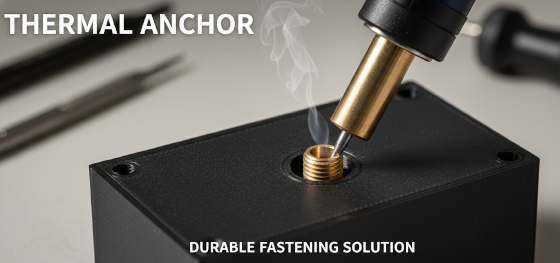
Let us be honest about the mechanical limits of plastic: a 3D printed thread is inherently weak. If your assembly requires frequent tightening and loosening, or if it must carry a significant axial load, a printed nylon or resin thread will eventually shear. The polymer simply cannot match the shear strength of a steel bolt. This is why Jucheng Precision recommends the "Metal-Hybrid" approach for all mission-critical assemblies. Instead of printing the thread, we print a precision pilot hole designed for a Heat-Set Insert.
A heat-set insert is a brass or stainless steel bushing with internal threads and an external knurled surface. We use a controlled thermal press to melt the insert into the plastic housing. As the plastic cools, it "locks" around the knurls, creating a bond that is significantly stronger than a printed thread. This allows you to use standard metal fasteners with a high torque limit, ensuring your housing doesn't fail during field use. At JUCHENG, we provide this as an integrated assembly service. We bridge the gap between additive freedom and mechanical durability, ensuring that your 3D printing materials choice doesn't become a bottleneck for your product's structural reliability.
JUCHENG’s Reliability Standard: Validating Every Helix
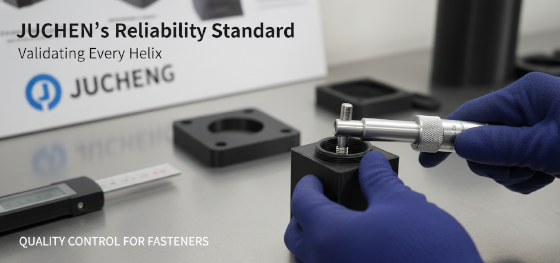
The final hallmark of a professional manufacturing partner is the refusal to accept "fitment" as a subjective check. A thread that feels loose today might bind tomorrow due to moisture absorption—a common problem with Nylon 12. Jucheng Precision eliminates this uncertainty through a rigorous verification protocol. We don't just "try a bolt"; we utilize precision Go and No-Go thread gauges to verify the 3d printing threads tolerance of every batch.
Our quality control department also utilizes optical comparators to inspect the "Crest Radius" of our 3D printed threads. We ensure that the thermal build-up hasn't rounded off the teeth to the point of failure. For aerospace and medical clients, we provide full material traceability and inspection reports that verify the pitch diameter with sub-micron accuracy. When you partner with JUCHENG, you are getting the benefit of optimized physics and massive manufacturing capacity. Whether you are building an innovative heart-rate wearable or a high-capacity telecom rack, our thread-engineering protocols ensure your vision is delivered with absolute visual and structural integrity. Contact Jucheng Precision today for a technical DFM review and see how our specialized 3d printing threads tolerance protocols can armor your next industrial breakthrough.

