


The perfect mechanical fit is an audible success—a satisfying "click" or a friction-held slide that communicates quality to the end-user. In the complex landscape of 3D printing tolerances, achieving this tactile perfection is one of the most significant engineering hurdles. Most designers rely on theoretical CAD values, assuming a 10.00mm pin will automatically hold inside a 10.00mm hole. However, the physical reality of light-curing and thermal fusion introduces a chaotic variable of surface texture and dimensional drift. Mastering 3d printing tolerance for tight fit is not about achieving an impossible zero-deviation; it is about engineering the interference between two surfaces so they work with, rather than against, each other.
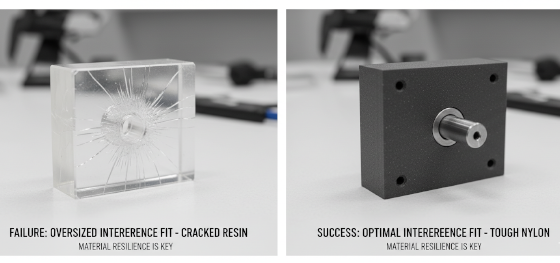
JUCHENG operates a unified technical hub where we treat assembly fits as functional mission-parameters. We understand that for a robotics joint or a high-pressure seal, "loose" is a failure and "too tight" is a crack. By integrating high-resolution SLA and MJF technologies with our 5-axis CNC finishing, we provide a validated roadmap for interference fits. We recognize that every material—from ductile Nylon 12 to brittle high-temp resins—has a different "elastic memory" that dictates how it responds to the pressure of assembly. This guide moves beyond the standard charts to explore the mechanics of the 0.05mm delta, the strategic use of crush ribs, and why JUCHENG’s iterative "Tolerance Kits" are the only way to lock in functional certainty before you commit to a full production run.
Profitability in assembly is won by those who can eliminate the post-build rework cycle. You aren't just buying a component; you are buying a verified mechanical relationship. Whether you are building a custom prosthetic interface or a ruggedized industrial sensor, the logic of the fit is your primary manufacturing governor. Let us break down the physical laws of tight-tolerance design and see how technical foresight can lock the integrity of your next assembly into physical reality.
Mechanics of Interference: Managing the 0.05mm Delta
Technological Stability: Why SLA and MJF Dominate Precise Assemblies
Geometric Guardrails: Designing Lead-In Chamfers and Crush Ribs
Material Resilience: Balancing Elasticity and Brittle Failure
Iterative Certainty: JUCHENG's High-Fidelity Tolerance Kits
Mechanics of Interference: Managing the 0.05mm Delta
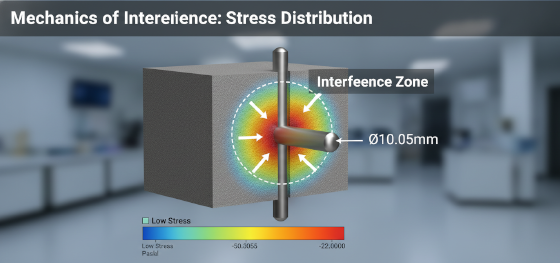
A "Tight Fit" in engineering is defined as an interference fit, where the internal member is slightly larger than the hole it inhabits. In 3d printing tolerance for tight fit, the success of this fit is governed by a delta as small as 0.05mm. If you design for a 0.02mm overlap, the natural surface roughness of the 3D print (the layer lines) will act as microscopic teeth that interlock, creating a "Friction Wall" that prevents assembly. Conversely, if you exceed 0.1mm of interference in a rigid plastic, the hoop stress on the hole will exceed the material's yield strength, leading to a visible crack that propagates from the point of entry.
At Jucheng Precision, we explain this to our clients as the "0.05mm Sweet Spot." This value provides enough friction to hold the part in place under vibration without triggering the "brittle fracture" limit of the resin. We also account for the "Initial Shear." When you press two 3D printed surfaces together, the microscopic peaks of the layer lines are actually sheared off or flattened. This creates a "Break-in" period for the fit. We utilize our high-resolution CMM probes to verify these internal diameters, ensuring that the starting dimension accounts for this mechanical smoothing. By managing the micro-mechanics of the interference zone, we transform a risky "guess" into a predictable engineering specification, providing the documented reliability your high-performance hardware requires.
Technological Stability: Why SLA and MJF Dominate Precise Assemblies
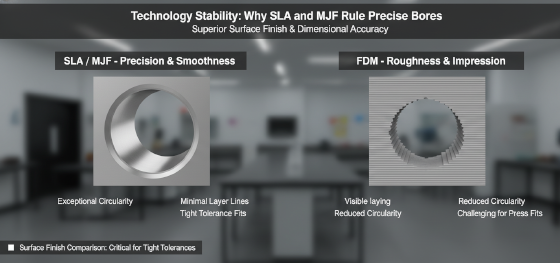
Not all 3D technologies are physically capable of sustaining a tight fit. FDM (Filament) is notoriously difficult for 3d printing tolerance for tight fit because the "out-of-roundness" of the holes is high due to the X-Y gantry movement. A hole that is slightly elliptical will grip a pin on only two points, leading to a loose fit even if the average diameter is correct. For assemblies that demand absolute circularity and consistent friction, JUCHENG steers our clients toward SLA (Resin) or MJF (Multi Jet Fusion).
SLA offers the highest resolution, creating bores with almost mirror-smooth walls that behave similarly to machined parts. This allow for the tightest possible interferences (as low as 0.03mm) because there is minimal "surface noise" to interfere with the fit. MJF, while slightly grainier, offers superior "Batch Stability." Because the parts are born in a self-supporting powder bed, the circularity of the holes remains consistent across a batch of 500 units. We utilize these technological strengths to match your assembly’s mission. If your part is a high-detail surgical tool, SLA is the winner. If it is a ruggedized automotive connector, the structural isotropic strength of MJF provides the "toughness" needed to survive a high-force press-fit. We don't just "print your part"; we choose the photon or the heat-source that ensures your tolerances don't drift after the build.
Geometric Guardrails: Designing Lead-In Chamfers and Crush Ribs
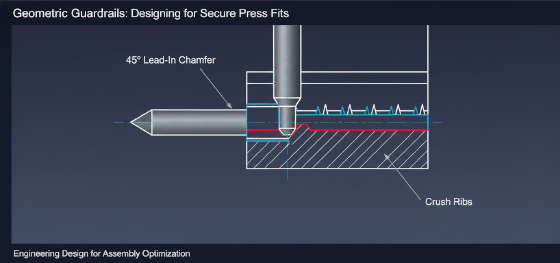
In a tight-fit assembly, the first millimeter is the most dangerous. If a pin enters a hole at a slight angle, it acts as a lever that can split the part instantly. This is why "Geometric Guardrails" are mandatory in 3d printing tolerance for tight fit design. JUCHENG’s DFM engineers advocate for the "Lead-In Chamfer"—a 45-degree angle on the nose of the pin and the entry of the hole. This acts as a self-centering guide, ensuring the parts are perfectly aligned before the interference pressure begins.
For parts requiring extreme security but having lower ductility, we suggest the use of "Crush Ribs." Instead of making the entire hole tight, we design a series of three or four small triangular ridges inside the bore. When the pin is inserted, it only has to "crush" these tiny ribs rather than the entire wall of the part. This provides a secure friction fit while reducing the total force required for assembly and eliminating the risk of catastrophic part failure. This is a "surgical strike" in DFM—engineering the local deformation to preserve the global integrity. By integrating these features into your CAD files, you allow JUCHENG to deliver parts that assemble with industrial-level ease, reducing your labor costs and protecting your brand from the embarrassment of a "broken-at-first-touch" prototype.
Material Resilience: Balancing Elasticity and Brittle Failure
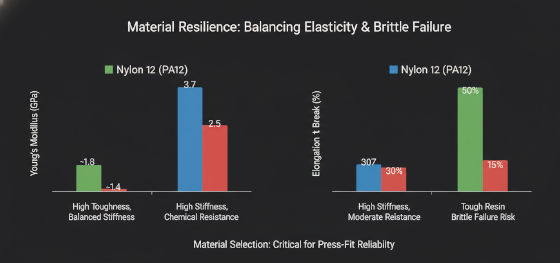
Data is the only cure for assembly doubt. To help you choose the right material for your 3d printing tolerance for tight fit, Jucheng Precision provides the following mechanical baseline. The "Elastic Recovery" of a material dictates how much interference it can handle. A material like Nylon 12 has a high elongation-at-break, meaning it can stretch and recover its shape, making it "forgiving" of tight fits. A standard SLA resin is brittle; it has a low elongation-at-break and will snap like glass if pushed too far.
| Material Category | Elongation % (Resilience) | Recommended Interference | Failure Mode |
|---|---|---|---|
| MJF Nylon 12 | 15-20% (High) | 0.05mm - 0.10mm | Deformation (Ductile) |
| Standard SLA Resin | 3-6% (Low) | 0.02mm - 0.05mm | Cracking (Brittle) |
| Tough/Flexible Resin | 30-50% (Extreme) | 0.10mm - 0.20mm | Oozing (Soft) |
| DMLS Titanium | 10-15% (Metal) | 0.01mm - 0.03mm | Seizing (Gall) |
We help our clients perform a "Mechanical Audit" of their designs. If we see a high-interference fit specified in a brittle material, we don't just print it; we suggest an upgrade to a "Tough" resin or a switch to our CNC Machining Services to ensure the material can handle the stress. By matching the molecular soul of the polymer to the mechanical mission of the fit, JUCHENG ensures your designs survive the transition from a digital rendering to a physical product. We bridge the gap between "concept" and "compliance," providing the technical clarity needed for successful functional testing.
Iterative Certainty: JUCHENG's High-Fidelity Tolerance Kits
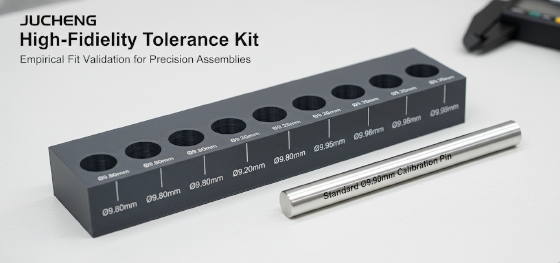
The final hallmark of a professional manufacturing partner is the move away from "transactional" printing toward iterative validation. At Jucheng Precision, we recognize that the "Perfect Fit" is often a matter of perception—what feels "tight" to one engineer might feel "loose" to another. To solve this, we offer our clients a "High-Fidelity Tolerance Kit" before starting a full-scale production run. We print a small test coupon—a "Comb" or "Matrix"—that features a series of pins and holes with incremental clearances ranging from 0.00mm to 0.50mm in 0.02mm steps.
This empirical approach removes the uncertainty of the 3D printing tolerances cycle. You can physically test the fitment with your real hands, choosing the exact "click" or "friction" your assembly requires. Once you identify the winner (e.g., Hole #4), we apply that specific offset to your entire part order. This ensures that when you receive a crate of 500 components from JUCHENG, they assemble flawlessly without a single minute wasted on hand-sanding or rework. We don't just ship parts; we ship the verified engineered certainty that your product is ready for work. Whether you are building an innovative heart pump or a high-performance EV battery housing, our integrated tolerance kits clarify and elevate your vision. Contact our engineering team today for a technical DFM review and see how our iterative protocols can armor your next manufacturing breakthrough.

