


Financial managers and procurement leads often view the machine shop through the cold prism of an Excel spreadsheet. In their world, the choice between a cnc machine vs 3d printer isn't a debate about technology—it is a debate about the bottom line. Most engineers enter the manufacturing cycle with a dangerous assumption: that 3D printing is the universal solution for low-cost complexity. While this holds true for a single handheld prototype, that same logic can bankrupt a project the moment it scales to fifty units. The reality of 3d printing vs cnc cost is a volatile landscape where the winner is decided not by the shape of the part, but by the quantity on the purchase order and the volume of material consumed.

At Jucheng Precision, we operate as a dual-technology hub. We don't have a bias toward one process because we own the entire spectrum of high-speed 5-axis mills and industrial-grade additive systems. This puts us in a unique position to act as an unbiased fiscal auditor for your designs. We understand that "cheap" is a relative term that shifts as the production clock ticks. If you choose additive for a large-volume run, you are paying a "linear tax" on every part. If you choose subtractive for a one-off mockup, you are drowning in "setup debt." This guide is a 1,300-word economic manifesto designed to help you navigate the breakeven point between the laser and the spindle, ensuring your project remains as profitable as it is precise.
Efficiency in modern production is found in the removal of unnecessary machine time. You aren't just paying for metal or plastic; you are renting the capacity of a million-dollar facility. Whether you are building a custom aerospace sensor or a series of industrial enclosures, the logic of the unit-cost curve is your primary manufacturing governor. Let us break down the physical and financial laws of quantity and see how technical foresight can lock the integrity of your budget into physical reality.
Economic Breakeven: Analyzing the Quantity Intersection
Additive Cost Drivers: The Z-Height and Volume Tax
Subtractive Cost Drivers: Tooling, Setups, and Waste
Hidden Time Taxes: Manual Labor vs. Spindle Efficiency
JUCHENG’s Recommendation: Data-Driven Selection Strategy
Economic Breakeven: Analyzing the Quantity Intersection
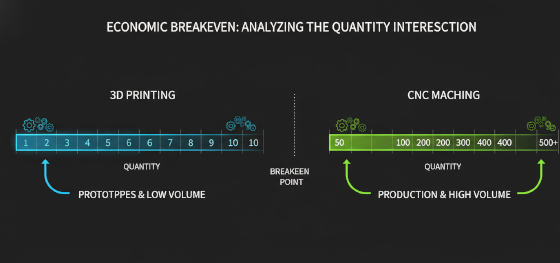
The most powerful graph in the machine shop is the "Unit Cost vs. Quantity" curve. In any 3d printing vs cnc cost analysis, these two technologies start at opposite ends of the chart. 3D printing begins with a remarkably low entry price. For a single complex part, the cost is essentially the price of the material plus a few hours of machine time. There are no fixtures to build and no complex CAM programs to write. This makes the "First Part Cost" of additive manufacturing nearly unbeatable. For prototypes numbering between 1 and 10, the 3D printer is the undisputed champion of the budget.
CNC machining, conversely, starts with a massive "Setup Debt." Before the spindle ever touches metal, a programmer must spend hours defining tool paths, a technician must build custom fixtures, and a set of specialized cutters must be loaded. This "Non-Recurring Engineering" (NRE) fee can be several hundred dollars for a single part. However, once that setup is complete, the per-part price drops precipitously. The machine can produce the 100th part for a fraction of the cost of the first. At JUCHENG, we generally find the breakeven point occurs between 30 and 50 units. If your order is below this threshold, the printer usually wins. If you are ordering 100 units or more, the efficiency of the CNC spindle amortizes the setup costs so effectively that the total invoice will be significantly lower than an additive run. We provide our clients with these comparative curves during the DFM phase, ensuring you don't choose a technology that feels cheap today but becomes a burden tomorrow.
Additive Cost Drivers: The Z-Height and Volume Tax
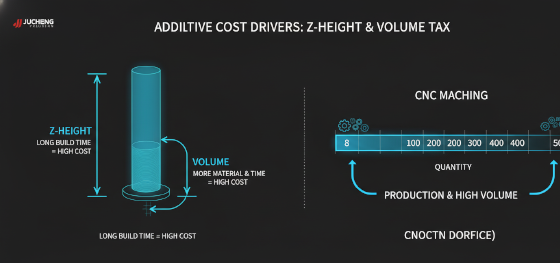
To understand why additive manufacturing is a "linear" cost model, you must look at how it consumes time and material. In 3D printing, volume is the enemy of the budget. Unlike CNC, where a large block of aluminum is relatively inexpensive, 3D printing powders and resins are priced by the gram and are significantly more costly than raw billet. If your design is bulky and solid, you are paying a "Volume Tax" for every cubic centimeter of material used. This is why hollowing out parts is such a critical cost-saving strategy in additive manufacturing.
The second major driver is the "Z-Height Tax." In technologies like SLA or FDM, the time it takes to print is largely determined by how tall the part is. Every additional layer requires a movement of the build plate and a fresh recoating cycle. A part that is tall and thin will take much longer to print than the same part laid flat, even if the material volume is identical. At JUCHENG, we optimize our 3D builds for "Packing Density." In technologies like MJF (Multi Jet Fusion), we can stack hundreds of parts into a single three-dimensional build volume. If we can fit more parts into one "bake," the cost-per-part drops. However, if your geometry is large and occupies most of the build chamber alone, the price remains stubbornly high because you are effectively renting the entire machine for a single part. This volume-and-height-based pricing means that as your part gets larger and more solid, the 3d printing vs cnc cost gap narrows quickly in favor of the mill.
Subtractive Cost Drivers: Tooling, Setups, and Block Size

Subtractive manufacturing operates under a completely different set of economic stressors. The primary driver in CNC is "Spindle Time"—the number of minutes the tool is actually in contact with the material. This makes complexity the enemy of the CNC budget. A part with hundreds of intricate pockets and deep internal radii requires multiple tool changes and slower feed rates, driving the price up. In the 3d printing vs cnc cost battle, complexity is "free" for the printer but "premium" for the mill.
Another critical factor is the "Buy-to-Fly" ratio—the amount of raw material you have to purchase compared to the final part volume. For a complex CNC part, you might start with a 10kg block of aluminum only to mill away 9kg of it into waste chips. You are paying for that 9kg of "lost" material. Furthermore, the number of setups dictates the labor cost. If a part requires five different orientations in a vice, it requires five different fixtures and five different touch-off cycles. Jucheng Precision mitigates this through our 5-axis infrastructure, which allows us to finish five sides of a part in one setup, drastically reducing the labor-load. By understanding that CNC cost is driven by machine-hours and material waste, we can help you simplify your designs to exploit the speed of the spindle, turning a complex "expensive" part into a streamlined "production" part that wins the cost race at scale.
Hidden Time Taxes: Manual Labor vs. Spindle Efficiency
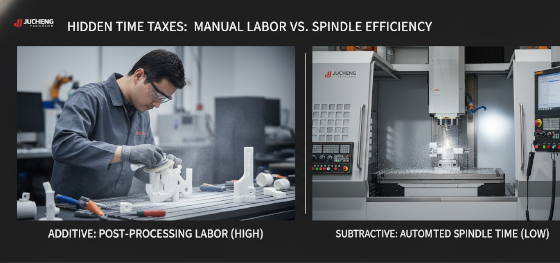
When comparing 3d printing vs cnc cost, many designers forget to account for the "Tail End" of the process. A 3D printer doesn't produce a finished part; it produces a "Near-Net-Shape" preform. Every 3D printed part—especially those in resin or metal—requires significant post-processing. Support structures must be manually clipped off, surfaces must be sanded to remove layer lines, and parts often need thermal curing or bead blasting to achieve an acceptable finish. This is highly variable, skilled manual labor. It doesn't scale well. If you have 500 parts, you need a small army of technicians to sand them all.
CNC machining is the opposite. The "Manual Labor" is front-loaded. It takes time to program and set up the machine, but once the green button is pushed, the process is automated. The part comes off the machine with a finished surface, tapped threads, and verified dimensions. In a production run, the "Human-Hour per Part" for CNC is nearly zero. At JUCHENG, we analyze these hidden taxes for our clients. We often find that for parts requiring a high-quality surface finish, the cost of manual post-processing for a 3D print actually makes the CNC option cheaper, even at lower quantities. We look past the "machine time" to the total "labor cycle," ensuring your material choice reflects the true cost of human intervention in the manufacturing loop.
JUCHENG’s Recommendation: Data-Driven Selection Strategy
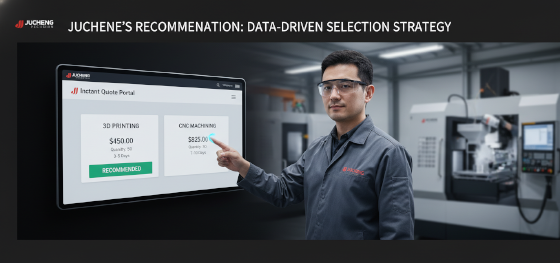
So, which technology wins the budget battle? Jucheng Precision remains neutral because we are experts in both. Our recommendation is always driven by the specific physics and the intended volume of your project. We don't just quote parts; we quote strategies.
| Project Variable | 3D Printing Advantage | CNC Machining Advantage |
|---|---|---|
| Quantity 1-10 | High (No Setup Fee) | Low (High Setup Cost) |
| Quantity 100+ | Low (Linear Material Cost) | High (Scale Efficiency) |
| Complexity | Extreme Freedom (Internal Voids) | Limited (Line-of-Sight) |
| Surface Finish | Requires Manual Labor | Finished Off-Machine |
Choose 3D Printing if: You are in the early R&D phase, need a complex geometry that is impossible to mill (like internal cooling channels), or require a functional prototype within 48 hours for a critical board meeting. It is the king of agility.
Choose CNC Machining if: You have finalized your design, need a batch of 50 or more, or require production-grade material properties and absolute surface perfection. It is the king of scalability and structural certainty.
At Jucheng Precision, our instant quoting system often provides side-by-side pricing for both cnc machine vs 3d printer options. This allows you to make an informed, data-driven decision based on the actual manufacturing capacity of our floor. We bridge the gap between a digital mock-up and a profitable product line. Whether you are building the next generation of medical diagnostics or a high-performance EV chassis, our technical rigor ensures your designs are realized with the best possible ROI. Contact our engineering team today for a comprehensive DFM review and let us help you choose the manufacturing path that clarifies and secures your project budget.

