


Deadlines are the ultimate governors of engineering decisions. In the volatile landscape of product development, the time between a finalized CAD file and a physical, functional component is where market share is won or lost. Most designers view the choice of cnc machine vs 3d printer as a simple race, but speed in manufacturing is a multi-dimensional metric. It isn't just about how fast a nozzle moves or a spindle rotates; it is about the "Time to Certainty." This is the technical crux of CNC vs 3D Printing Speed. One technology offers the agility of an Olympic sprinter for the first few meters, while the other provides the relentless, automated pace of a freight train over the long haul. Choosing the wrong path can leave your R&D team waiting for parts that are already obsolete or bankrupting your production cycle through manual labor bottlenecks.

Jucheng Precision operates as a high-velocity manufacturing hub, and we’ve noticed a consistent friction point: engineers often confuse "Print Speed" with "Delivery Speed." A 3D printer might finish a part in twelve hours, but if that part requires six hours of manual support removal and a four-hour curing cycle, the "Spindle Efficiency" of a CNC mill suddenly looks much more attractive. We operate over 150 machines precisely to solve this temporal riddle. By integrating 5-axis CNC speed with the tool-less agility of MJF and SLA, we provide our clients with a parallel production roadmap. This guide moves past the standard sales gloss to explore the actual mechanics of setup debt, the complexity paradox, and why the right strategic choice for speed dictates the ultimate ROI of your hardware launch.
Profitability in a competitive market is found in the compression of the feedback loop. You aren't just buying metal or plastic; you are buying the ability to fail fast and fix faster. Whether you are building an urgent medical prototype or a production run of thousand-unit automotive clips, the logic of the clock is your primary manufacturing governor. Let us break down the physical laws of manufacturing velocity and see how technical foresight can lock the integrity of your timeline into physical reality.
The Sprint to Prototype: Why Additive Owns Day One
Spindle Velocity: Scaling the Batch via Subtractive Efficiency
Complexity Paradox: When Printing Outruns Milling
Post-Processing Latency: The Hidden Time Tax
JUCHENG’s Agile Protocol: Optimized Parallel Production
The Sprint to Prototype: Why Additive Owns Day One
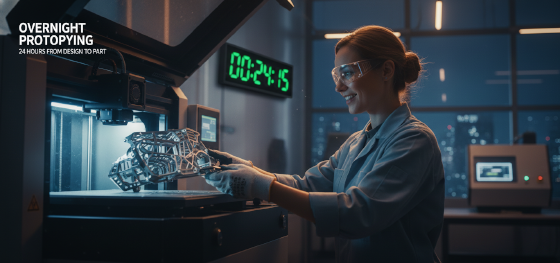
In the comparison of CNC vs 3D Printing Speed, 3D printing is the undisputed king of the first 24 hours. The reason is the total elimination of "Preparation Friction." In a subtractive environment, a part cannot be made until an engineer creates a CAM (Computer-Aided Manufacturing) program, a toolroom sources specific cutters, and a technician builds custom fixtures to hold the raw billet. This "NRE" (Non-Recurring Engineering) time can consume days before the first chip is even cut. For a single, urgent prototype, this is a massive temporal wall.
Additive manufacturing operates with "Zero-Fixture Logic." When you send an SLA or MJF file to Jucheng Precision, our engineers perform a rapid DFM check, and the file goes straight to the machine's slicer. There are no custom clamps to build and no tool paths to optimize for deflection. The machine simply builds. This allows us to provide "Next-Day Delivery" for functional models. If you have an investor meeting on Wednesday, a 3D printer can turn your Tuesday CAD file into a physical object while you sleep. This agility is vital for the early R&D phase where designs are fluid and a two-week wait for a CNC part would stifle the creative momentum of the project. We treat 3D printing as the "emergency lane" for innovation, bypassing the traditional bureaucratic roadblocks of the machine shop.
Spindle Velocity: Scaling the Batch via Subtractive Efficiency

The narrative of speed shifts dramatically the moment you move past the first five units. This is the "Throughput Threshold" of CNC vs 3D Printing Speed. While a 3D printer takes the same amount of time to build the 100th part as it did the first (often several hours), a CNC machine is built for repetitive automation. Once the "Setup Debt" is paid and the machine is dialed in, the time per part (cycle time) drops into minutes or even seconds.
At Jucheng Precision, we utilize high-speed spindles (up to 24,000 RPM) and automated pallet changers to exploit this efficiency. If a complex aluminum bracket takes 10 hours to print on a metal 3D printer, but can be milled in 15 minutes on a CNC center, the math is simple. For a batch of 100 parts, the printer takes 1,000 hours (over 40 days), while the mill—including a 10-hour setup—completes the job in 35 hours (less than 2 days). Subtractive manufacturing is the champion of the "Per-Part" clock. We utilize this velocity to help our clients bridge the gap between "prototype" and "market volume." By moving your project to our CNC floor at the correct moment, we effectively crush your lead times for production batches, delivering thousands of parts in the same window it would take a printer to deliver fifty.
Complexity Paradox: When Printing Outruns Milling

There is a technical exception to the batch-speed rule: Geometric Complexity. In the world of the cnc machine vs 3d printer, complexity is "free" for the printer but "expensive" for the mill. If your part features intricate internal cooling channels, porous lattice structures, or deep, narrow undercuts, a CNC machine must move slowly. It must navigate dozens of tool changes, use tiny, fragile cutters that break easily, and perhaps require multiple manual rotations in a vice. For these high-complexity components, the "Cycle Time" of CNC can actually exceed that of a 3D printer.
This is the Complexity Paradox. At JUCHENG, we analyze the "Geometric Load" of your CAD file. If we see a manifold with hundreds of internal intersections, we will often suggest 3D printing (specifically MJF or DMLS) even for larger batches. Because the printer builds an entire "slice" regardless of its internal detail, it outruns the mill in a high-complexity race. We help our clients find this tipping point, ensuring you don't waste time trying to mill a part that was physically meant to be "grown." By matching the process to the complexity of the void, we minimize the total manufacturing time and get your functional assemblies into testing before your competitors have even finished their first fixture design.
Post-Processing Latency: The Hidden Time Tax
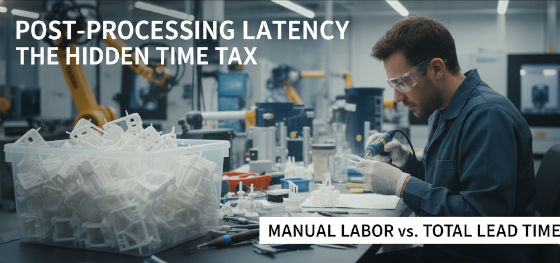
True manufacturing speed is measured from "Design Finish" to "Part Ready for Use." This is where many 3D printing quotes are misleading. A raw print is rarely a finished part. It often requires support removal, thermal curing, bead blasting, or chemical smoothing. This "Post-Processing Latency" is the hidden time tax of additive manufacturing. If you have 500 parts that each require 10 minutes of manual sanding, you have added 83 hours of skilled manual labor to your lead time. In CNC vs 3D Printing Speed comparisons, this is where additive often loses its advantage.
CNC machined parts typically come off the machine with the correct surface finish and tapped threads already in place. The part is "Born Finished." At Jucheng Precision, we operate an integrated finishing lab to mitigate the additive time tax, utilizing automated vapor smoothing and vibratory deburring to speed up the post-print cycle. However, we are honest with our clients: if your part requires a high-quality aesthetic finish and a tight tolerance, the time-to-market is often faster via CNC because the machine does the work of the human hand during the primary cycle. We don't just look at the build time; we look at the "Labor-to-Finish" ratio, ensuring your timeline isn't derailed by the bottleneck of manual craftsmanship.
JUCHENG’s Agile Protocol: Optimized Parallel Production

Choosing a partner for a high-speed launch is a decision of manufacturing depth. Most shops only offer one technology, forcing your design into a timeline that suits their machines, not your market window. Jucheng Precision operates a "Parallel Production" protocol. Because we possess over 150 CNC machines and dozens of industrial 3D printers, we can run your prototype and your production ramp-up simultaneously.
We use 3D printing to provide you with the "Bridge Parts" needed for initial assembly and marketing while our CNC department builds the fixtures and optimizes the programs for your volume run. This integrated approach ensures that your project never hits a technical plateau. We provide full material traceability and documented process validation for both paths, giving our aerospace and medical clients the speed of a startup with the technical rigor of a Tier-1 supplier. When you receive a shipment from JUCHENG, you aren't just getting metal and plastic; you are getting the benefit of a synchronized timeline. We bridge the gap between "now" and "forever." Contact our engineering team today for a comprehensive technical DFM review and see how our dual-technology protocols can clarify and accelerate your next manufacturing breakthrough.

