


Sending high-silicon alloys to a standard finishing shop guarantees a cosmetic disaster. Procurement teams often expect bright, beautiful smartphone finishes on their structural castings, completely ignoring the underlying metallurgy. Executing anodizing die cast aluminum protocols requires battling the very elements that make the liquid metal flow so well inside the mold. Silicon refuses to oxidize, leaving behind a horrifying, patchy, muddy-gray surface that instantly fails visual quality control.

Rescuing these compromised batches wastes immense capital and severely delays product launches. Evaluating your baseline die casting surface finish strategy must happen before you ever approve the tooling budget. Operating our massive Shenzhen chemical processing lines, JUCHENG actively prevents these costly blunders by matching your aesthetic demands to commercial metallurgical reality.
Forcing incompatible chemistry destroys profit margins rapidly. Let's decode exactly why silicon ruins electrical oxidation baths, how our specialized acidic pre-treatments strip the surface clean, and when you should pivot to alternative heavy-duty coatings.
content:
The Silicon Nightmare: Why Do Black Spots Appear?
Specialized Prep: Attacking the Surface Chemistry
Type III Hard Coat vs. Retail Cosmetics
JUCHENG Hub: In-House Chemical Mastery
FAQ: Honest Answers About Dimensional Growth and Color
The Silicon Nightmare: Why Do Black Spots Appear?
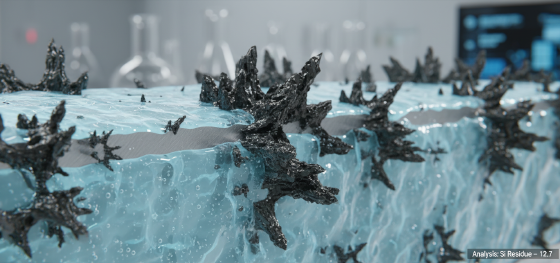
Pouring liquid metal requires heavy doses of silicon to ensure the alloy fills complex cavities without freezing prematurely. That same beneficial silicon turns into a massive liability inside the chemical bath. Standard sulfuric acid completely dissolves the surrounding metallic matrix but leaves the silicon flakes untouched on the exterior skin.
Leaving these microscopic islands behind creates a terrifying defect known across the industry as smutting. Visual inspection reveals an ugly, mottled texture that looks like burnt ash instead of premium metallic armor. Ignorant third-party finishing shops will simply shrug and blame your foundry for providing dirty raw materials.
Fixing this chemical incompatibility requires aggressive, highly specialized factory intervention. Sending standard ADC12 or A380 parts into a normal dipping line is equivalent to burning your manufacturing budget.
Specialized Prep: Attacking the Surface Chemistry
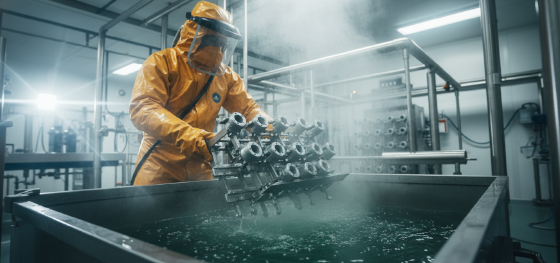
How do professional factories successfully oxidize high-silicon parts?
By submerging the raw hardware into highly hazardous fluoride-based acid dips, which aggressively dissolve the stubborn silicon flakes off the skin before the part ever enters the final electrical tank.
Standard alkaline etching baths used for extruded metal will absolutely destroy a raw casting. Controlling this severe pre-treatment precisely allows the subsequent protective layer to grow uniformly across the substrate. While you still cannot achieve a bright, clear cosmetic color, this specialized prep delivers a highly consistent, dark matte finish.
Managing these dangerous chemicals requires extreme environmental controls. Cheap brokers avoid this process entirely because handling hydrofluoric acid safely demands massive infrastructure investments that small machine shops simply cannot afford.
Type III Hard Coat vs. Retail Cosmetics
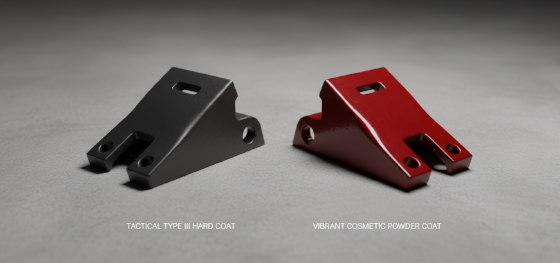
When should hardware engineers actively demand this specific chemical treatment?
Military and aerospace buyers mandate this dark, tactical finish when extreme mechanical abrasion resistance and electrical insulation completely outrank visual beauty.
Type III hard coats build a thick, incredibly tough ceramic-like armor directly into the metal substrate. Demanding bright red or vibrant blue colors on these specific alloys remains mathematically impossible. The thick oxide layer naturally cures into deep olive or gunmetal gray.
Pivoting your strategy toward robust aluminum die casting powder coating completely bypasses the silicon trap if your consumer product requires vibrant retail aesthetics. This alternative delivers flawless, colorful cosmetic protection while hiding the underlying raw metal completely.
JUCHENG Hub: In-House Chemical Mastery
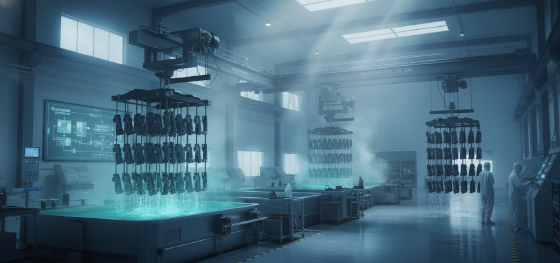
Fragmented supply chains destroy accountability. If a raw casting sits in a humid warehouse for a week before plating, natural oxidation permanently ruins the microscopic surface chemistry. Housing our automated dipping lines directly next to our high-tonnage injection presses eliminates this transit decay entirely.
Transitioning your hardware seamlessly into our chromate conversion coating die casting bay ensures absolute corrosion defense if hard oxidation proves too expensive for your commercial application. We adapt the chemical defense dynamically based on your budget.
Stop paying for ruined batches of mottled, ugly hardware. Send your structural CAD files to our engineering team today. We ruthlessly audit your material choices and deploy the perfect chemical defense strategy for your global rollout.
FAQ: Honest Answers About Dimensional Growth and Color

Can you perform bright dip cosmetic processing on ADC12 or A380 alloys?
Absolutely not. The inherent chemistry of those specific high-flow grades guarantees a dark, patchy finish. Bright cosmetic colors strictly require extruded or CNC-machined billet stock.
Does the thick oxide layer change the dimensions of my tapped screw holes?
Yes, the protective coating grows both into and out of the metal surface, adding measurable thickness. We mathematically oversize our CNC threading operations beforehand to compensate for this exact chemical growth.
Will aggressive mechanical polishing fix the ugly dark spots before the acid bath?
Polishing creates a smoother baseline but cannot change the chemical reality of the silicon flakes. The dark smutting effect will still appear during oxidation, regardless of how aggressively the raw metal was buffed.
What happens if the part is left in the etching tank for too long?
Over-etching physically burns the metallic matrix, dissolving critical dimensional tolerances and leaving the component structurally weakened and completely useless for assembly.

