


Machining tool marks are the fingerprints of production. While a perfectly executed 5-axis tool path is an achievement in geometry, those rhythmic ridges are often a distraction for high-end consumer products and medical devices. They represent a directional texture that can look industrial and raw. To move beyond this "machined look" and achieve a sophisticated, non-directional aesthetic, engineers rely on the bead blast finish. It is a mechanical process that uses the raw energy of high-velocity impact to transform a metal surface into a uniform, light-diffusing canvas. At Jucheng Precision, we consider bead blasting to be the bridge between raw engineering and premium user experience.
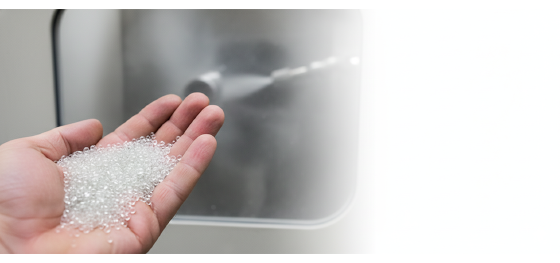
Consistency is the ghost that haunts the finishing booth. Anyone can point a sandblasting gun at a part, but achieving a repeatable "Apple-like" satin finish across a batch of ten thousand components requires a mastery of pneumatic pressure and abrasive chemistry. Within our CNC machining surface treatment ecosystem, bead blasting serves as both a final aesthetic solution and a critical pre-treatment for high-end anodizing. This guide explores the microscopic physics of impact, the strategic selection of media, and the rigorous process controls JUCHENG employs to ensure every surface we touch is flawlessly matte and perfectly uniform.
True surface quality is born from the balance of force and grit. Whether you are aiming for a rugged matte texture or a soft-touch satin, the technical nuances of the bead blast finish are where your brand's tactile identity is defined. Let us dive into the technical pillars of abrasive impact and how it redefines the surface of precision CNC designs.
The Science of Impact: Micro-Dimpling and Light Diffusion
Media Selection: The Battle of Glass vs. Aluminum Oxide
Hiding the Machine's Signature: Uniformity and Tool Marks
The Foundation for Anodizing: Preparing for Color Depth
JUCHENG’s Standard: Controlled Pressure and Consistency
The Science of Impact: Micro-Dimpling and Light Diffusion
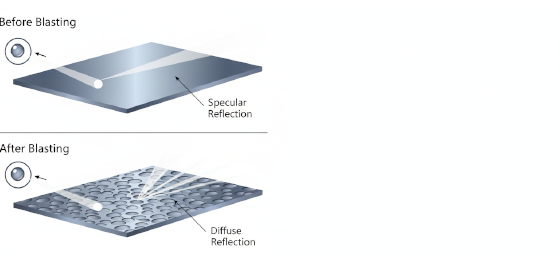
To understand the bead blast finish, you must look at the surface of the metal as a topographic map. Machined parts are characterized by "peaks" and "valleys" created by the cutting tool. These features have a specific orientation—the "lay" of the machining. When light hits these parallel ridges, it reflects in a directional way, creating the "specular" highlights we associate with raw metal. Bead blasting changes this physics entirely. As spherical media (like glass beads) strikes the surface at high pressure, they create millions of microscopic, overlapping hemispherical dimples.
This "micro-dimpling" process effectively randomizes the surface topography. There is no longer a directional grain for the light to follow. Instead, when light rays strike the blasted surface, they are scattered in every possible direction—a phenomenon known as diffuse reflection. This is what creates the "matte" or "satin" look. Beyond the visual appeal, this impact also provides a minor degree of peening. The hammering action of the beads creates a layer of compressive residual stress on the surface, which can improve the fatigue life of aluminum parts by making the surface resistant to microscopic crack initiation. At Jucheng Precision, we use this physical principle to move beyond mere aesthetics, delivering parts that feel warmer and more premium to the touch, while offering a slight boost in structural durability.
Media Selection: The Battle of Glass vs. Aluminum Oxide
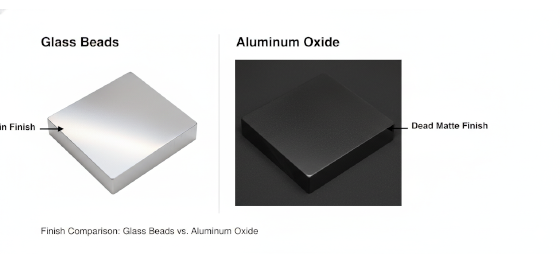
The "grit" is the most important variable in the bead blast finish hierarchy. At Jucheng Precision, we help our clients navigate the choice between media types, as the shape of the particle determines the soul of the finish. Glass Beads are the industry standard for a satin finish. Because they are spherical, they don't "cut" the metal; they "burnish" it. This results in a soft, bright, and semi-reflective matte finish that doesn't change the dimensions of the part significantly. It is the gold standard for medical instrumentation and consumer electronics where a "clean" and "smooth" look is required.
Aluminum Oxide, by contrast, is an angular, jagged grit. It doesn't dimple the metal; it etches it. This creates a much rougher, "dead-matte" finish that is highly effective at reducing glare and providing a high-friction grip. It is significantly more aggressive than glass beads and will remove a small amount of material from the part's surface. We typically recommend aluminum oxide for industrial components that will be painted or powder-coated, as the etched surface provides an incredible mechanical "anchor" for the coating to grab onto. Understanding the difference between a "round impact" and a "sharp cut" allows JUCHENG to tailor the tactile experience of your CNC parts to the exact requirements of your end-user.
Hiding the Machine's Signature: Uniformity and Tool Marks
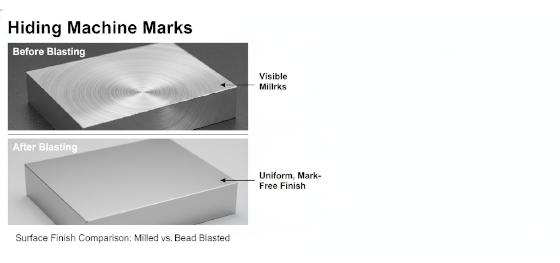
One of the most valuable functional roles of the bead blast finish is its ability to serve as a "visual eraser." In high-speed CNC machining surface treatment, even the most precise tool paths can leave behind ghosting, vibration patterns (chatter), or subtle step-overs from a ball-nose mill. For large, visible surfaces, these marks are often seen as defects by quality inspectors. Hand-sanding every part to remove these marks is labor-intensive, expensive, and often leads to inconsistent results.
Bead blasting provides an automated, uniform solution to this problem. The chaotic nature of the abrasive stream allows the media to penetrate into corners and complex 3D profiles, blending the tool marks into a single, cohesive texture. It effectively "averages" the surface roughness across the entire part. However, JUCHENG engineers provide a critical warning: bead blasting is not a cure for poor machining. If the tool marks are too deep (Ra 3.2 or higher), the blast will simply turn them into "matte grooves." We optimize our initial milling passes to achieve a consistent substrate, using the bead blast as the final refining step. This synergy between the mill and the blast cabinet ensures that your parts arrive with a level of surface perfection that looks as if it were molded rather than carved from a solid block.
The Foundation for Anodizing: Preparing for Color Depth
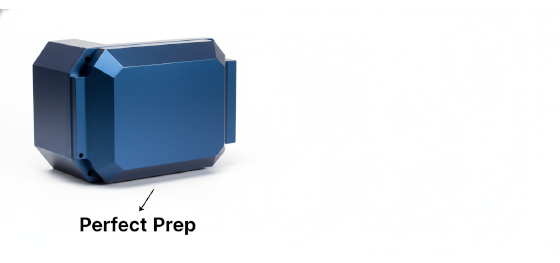
For aluminum parts, the bead blast finish is rarely the final step. It is most often the preparation layer for anodizing. The interaction between the blasted texture and the anodic oxide layer is what defines the "visual depth" of the color. If you anodize a raw, polished aluminum part, the color will look bright and "thin"—like a piece of colored glass. If you anodize a bead-blasted part, the color becomes deep, rich, and sophisticated. The microscopic dimples trap the light within the color layer, creating a "soft" visual appearance that is synonymous with premium technology brands.
This combination—bead blasting followed by Type II anodizing—is our most requested finish at Jucheng Precision. It hides fingerprints, reduces the visibility of scratches during use, and provides a professional matte aesthetic that doesn't reflect overhead lighting. We manage the "Time-to-Tank" window meticulously. Once an aluminum part is blasted, its surface area is vastly increased and it becomes highly sensitive to oxidation and skin oils. We move the parts directly from the blast cabinet into the cleaning tanks of our anodizing line to ensure that no contaminants are trapped beneath the oxide layer. This integrated workflow is the secret to achieving those vibrant, consistent colors that remain flawless for the entire life of the product.
JUCHENG’s Standard: Controlled Pressure and Consistency
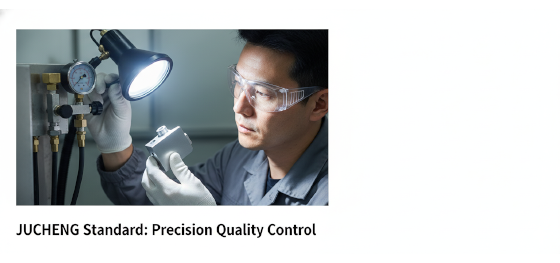
The greatest risk in the finishing room is human variability. If an operator holds the blast nozzle too close to the part, the texture will be rough. If they move too fast, the tool marks won't be fully blended. This results in "blotchy" parts that fail assembly inspections. Jucheng Precision eliminates this risk through standardized process controls. We utilize automated blasting cabinets for high-volume orders, where the nozzle distance, air pressure, and feed rate are digitally controlled and reproducible.
For our manual blasting stations, we utilize "Saturation Coupons" to verify the media's energy before starting a batch. We also implement a "Fresh-Media Guarantee." Over time, glass beads shatter into sharp dust, turning a burnishing process into a destructive etching process. We constantly cycle our media to ensure that the grit size remains within spec. When you receive a package from JUCHENG, you receive components that are visually identical, whether it is the first part of the batch or the thousandth. Our commitment to the bead blast finish goes beyond simple cleaning; it is a dedicated manufacturing discipline designed to give your designs a world-class finish. Whether you are building a custom drone chassis or a high-end medical sensor, let Jucheng Precision armor your engineering with the perfect matte texture. Contact our engineering team today for a free technical consultation on your next project's final layer.

