


A surface that looks smooth to the naked eye is often a rugged mountain range under a microscope. In high-precision manufacturing, "smoothness" is not an opinion—it is a measurable engineering variable that dictates whether a part will slide, seal, or fail. When you are designing a high-speed engine piston or a medical fluid manifold, the specific texture of the metal interface is the primary driver of performance. This technical requirement is codified in the CNC Surface Roughness Chart. It is the universal language that allows a designer in Detroit to communicate exact frictional requirements to a machinist at Jucheng Precision.
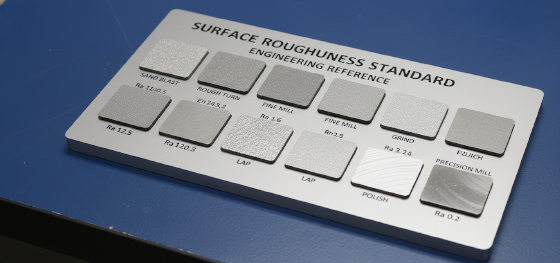
At Jucheng Precision, we integrate the CNC machining surface treatment philosophy into every tool path we program. We recognize that the "finish" isn't something you add later; it is something you engineer into the cut. Choosing the wrong Ra value can lead to premature seal wear, catastrophic seizure in rotating assemblies, or poor coating adhesion. This guide moves beyond the simple numbers to explore the physics of surface topography, the relationship between process and texture, and why JUCHENG utilizes the CNC Surface Roughness Chart as the ultimate roadmap for manufacturing excellence.
Precision is found in the valleys, not just the peaks. Whether you need an industrial-grade Ra 3.2 or an optical-grade Ra 0.1, understanding the technical pillars of surface metrology is essential. Let us dive into the mechanics of texture and how it redefines the integrity of your most critical CNC designs.
The Anatomy of a Surface: Peaks, Valleys, and Ra
Decoding the Chart: Mapping Process to Performance
The Cost of Perfection: Why Ra 0.4 is Expensive
Functional Sovereignty: Roughness in Real-World Use
JUCHENG’s Metrology: Verification via Digital Profilometry
The Anatomy of a Surface: Peaks, Valleys, and Ra
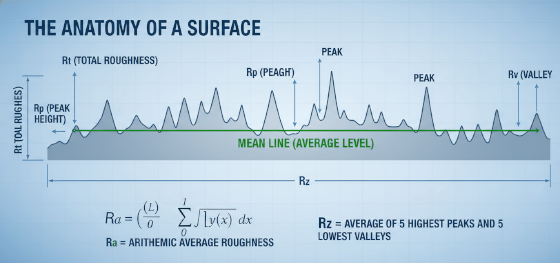
To understand the CNC Surface Roughness Chart, one must move past the concept of "smoothness" and look at the "profile." Every machined surface has a specific geometry created by the interaction between the cutting tool and the metal. This profile is a series of peaks and valleys. In technical metrology, we use several parameters to define this landscape, with Ra (Arithmetical Average) being the most common. Ra represents the average distance between the peaks and valleys relative to a mean center line. However, Ra is an average; it can hide a single deep scratch that could cause a seal to leak.
This is where Rz (Average Peak-to-Valley Height) becomes a vital secondary metric. Rz measures the average of the five largest peaks and five deepest valleys within a sampling length. At Jucheng Precision, we use both Ra and Rz to audit our CNC machining surface treatment results. A part might have a "smooth" Ra of 0.8, but if the Rz is high, it indicates jagged peaks that will quickly grind down a rubber seal. We also analyze the "Lay"—the direction of the machining marks. For parts involved in fluid dynamics, a circumferential lay is often required to prevent oil from channeling out under pressure. By dissecting the surface at the micron level, we move beyond aesthetics and into the realm of functional reliability. We don't just cut metal; we engineer the topography to match your mechanical requirements.
Decoding the Chart: Mapping Process to Performance
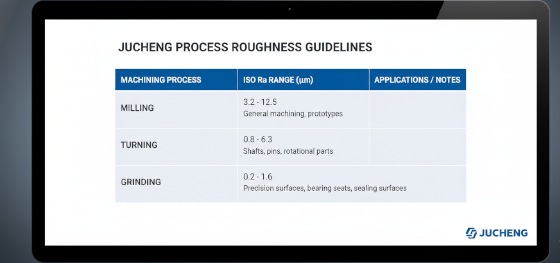
The CNC Surface Roughness Chart is not just a list of numbers; it is a feasibility map for the machine shop. Every machining process has a natural "floor" for the roughness it can achieve. A standard rough-milling pass, for instance, typically delivers an Ra 3.2 µm (125 micro-inches). This is the standard industrial finish where tool marks are visible and tangible. It is perfectly adequate for structural brackets and non-mating surfaces.
As we move down the CNC Surface Roughness Chart, the technical requirements increase. Ra 1.6 µm (63 micro-inches) is the "high-quality" standard for most commercial parts, achieved through fine turning or milling with a high step-over. To reach Ra 0.8 µm (32 micro-inches), Jucheng Precision utilizes specialized finishing tools and lower feed rates. This level is required for bearing fits and high-pressure gaskets. To go even further—into the Ra 0.4 to 0.1 range—we must move from milling to precision grinding or honing. Each step down the chart represents a transition in physics: from shearing metal to burnishing it. At JUCHENG, we help our clients match their performance needs to the correct process, ensuring you don't specify a "grinding-level" finish when a "milled-level" finish is sufficient for the application.
The Cost of Perfection: Why Ra 0.4 is Expensive
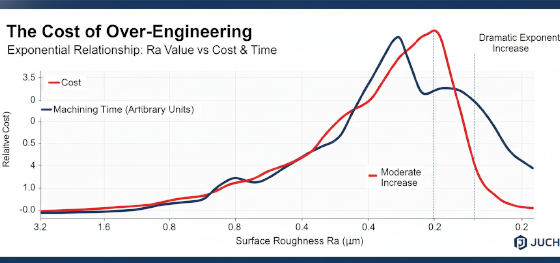
There is a direct, exponential relationship between surface smoothness and production cost. This is the "hidden trap" of the CNC Surface Roughness Chart. Many engineers default to an Ra 0.8 specification because they want "high quality," without realizing that it can double the machining time of an Ra 3.2 part. To achieve a smoother finish, the CNC machine must move slower, taking more "bites" with a smaller step-over. This consumes more electricity, more tool life, and more machine hours.
At Jucheng Precision, we advocate for "Strategic Roughness." If a surface is purely cosmetic or handles no load, we suggest keeping the Ra value higher to conserve your budget. However, we also recognize when perfection is mandatory. For medical implants or high-speed turbine components, a rough surface is a liability that leads to stress fractures or bacterial growth. Our DFM team uses the CNC Surface Roughness Chart to perform a cost-benefit analysis for your project. We identify where you can save money by relaxing tolerances and where you must invest in precision to ensure the part doesn't fail in the field. This economic transparency is what makes JUCHENG a partner rather than just a vendor; we help you find the "Goldilocks" zone of surface quality—not too rough, not too smooth, but exactly right for your ROI.
Functional Sovereignty: Roughness in Real-World Use
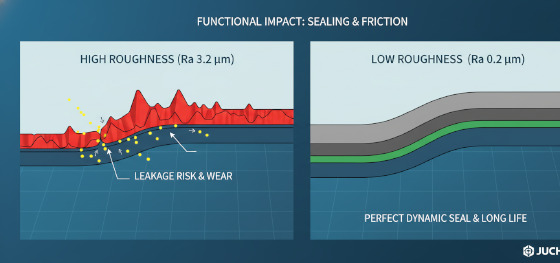
Beyond the shop floor, the CNC Surface Roughness Chart determines the "Functional Sovereignty" of your part. Friction is a direct byproduct of surface texture. If two parts rub together, high peaks will act like microscopic teeth, grinding each other down and generating heat. This is why bearing journals and sliding shafts require an Ra 0.4 or better. A smooth surface reduces the "break-in" period of a machine and prevents the formation of metallic debris in the oil system.
Another critical area is coating adhesion. If you are planning on CNC machining surface treatment like powder coating or electroplating, you actually need a specific amount of roughness. A mirror-polished surface is too smooth for paint to grab onto; the coating will eventually peel or flake off. We often use the CNC Surface Roughness Chart to target a specific "anchor profile" for our coating line—typically an Ra 1.6 or 3.2 achieved through bead blasting. This microscopic "tooth" is what allows the polymer to bond permanently to the metal. By understanding how surface texture interacts with secondary finishes and real-world friction, JUCHENG ensures that your parts don't just look good—they survive the brutal mechanical and chemical stresses of their final environment.
JUCHENG’s Metrology: Verification via Digital Profilometry
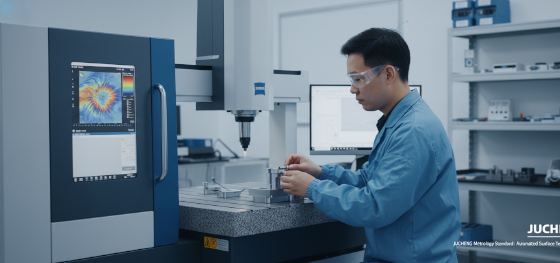
The final hallmark of a professional manufacturer is the ability to prove the finish. You cannot verify a 0.8 Ra finish with your fingernail or a visual check; you need specialized metrology. Jucheng Precision has invested in state-of-the-art digital profilometers and multi-sensor CMMs to provide our clients with absolute data. We don't just "hit the number"; we document it.
Our quality control team performs standardized surface scans across multiple points on a part to ensure uniformity. We provide our aerospace and medical clients with detailed roughness reports that include profile graphs and peak-density data. This level of technical rigor is essential for compliance with international standards like ISO 4287. When you receive a shipment from JUCHENG, you aren't just getting metal components; you are getting verified engineering data that guarantees your parts will perform exactly as designed. Whether you are building an ultra-high-vacuum chamber or a high-volume automotive assembly, our expertise in the CNC Surface Roughness Chart ensures your designs are delivered with the perfect finish. Contact Jucheng Precision today for a technical DFM review and see how our surface treatment protocols can stabilize and enhance your next project.
| Ra Value (µm) | Typical Process | Common Application |
|---|---|---|
| Ra 3.2 | Standard Milling / Turning | Structural Brackets, Housings |
| Ra 1.6 | Fine Machining / Bead Blast | Consumer Electronics, Gaskets |
| Ra 0.8 | Grinding / Precision Milling | Bearing Seats, Valve Components |
| Ra 0.4 | Lapping / Polishing | High-Speed Shafts, Optical Molds |

