


In the landscape of high-volume manufacturing, precision is often held hostage by the clock. While a multi-axis CNC machine can mill a thousand brackets with terrifying speed, the manual task of removing the heavy burrs and sharp flashes left behind can paralyze a production line. For rugged, high-strength components that don't require the delicate "whisper" of vibratory finishing, engineers rely on the raw, gravity-driven energy of tumble finishing. It is the industrial workhorse of mass finishing—a process that uses the relentless force of a cascading mass to grind, smooth, and strengthen thousands of parts simultaneously.
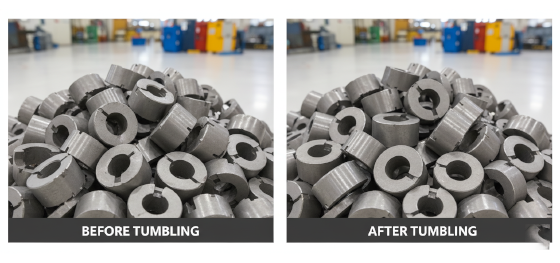
At Jucheng Precision, we integrate CNC machining surface treatment into our core workflow to ensure that "high volume" never means "low quality." We understand that for heavy steel forgings, cast iron housings, and thick-gauge stampings, the goal is not just a smooth surface, but a cost-effective path to assembly-ready components. Tumble finishing, or barrel finishing, utilizes a rotating chamber to create a continuous "landslide" of abrasive media that scours every exposed surface of a part. This guide dives into the physics of the cascade, the strategic selection of heavy-duty media, and why JUCHENG utilizes this aggressive method to obliterate deburring costs for our global partners.
True efficiency in surface finishing is found in the management of kinetic energy. You cannot simply throw parts into a barrel and hope for the best; you must engineer the fall. Whether you are looking to remove significant machining ridges or achieve a uniform pre-plate texture on heavy hardware, understanding the variables of the tumble cycle is the key to industrial success. Let us explore the technical pillars of gravity-phase refinement and how it redefines the economics of your most rugged CNC designs.
The Physics of the Cascade: Gravity-Driven Energy
Tumbling vs. Vibratory: When to Choose Aggression
The Media Matrix: From River Rocks to Steel Balls
Edge Breaking and Surface Peening: The Structural Bonus
JUCHENG’s Large-Scale Capacity: Cutting Costs
The Physics of the Cascade: Gravity-Driven Energy
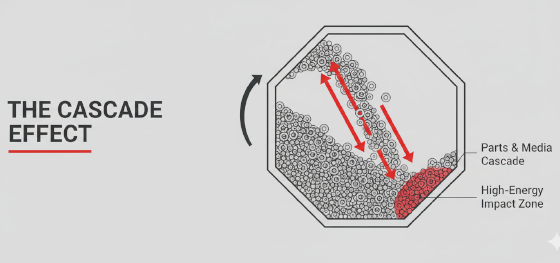
The mechanics of tumble finishing are rooted in the concept of the "sliding zone." A horizontal barrel—usually hexagonal or octagonal in shape to prevent the parts from simply sliding along a round wall—is filled with parts, abrasive media, and a liquid compound. As the barrel rotates, the entire mass is carried upward by the internal walls. When the mass reaches the "angle of repose," gravity takes over. The top layer of the mass breaks away and slides down the face of the remaining material in a violent, turbulent cascade.
This "waterfall" of parts and stones is where the actual work happens. The sliding motion creates high-pressure friction, while the tumbling action causes parts to strike the media repeatedly. Unlike vibratory systems that rely on high-frequency, low-amplitude scrubbing, tumbling utilizes low-frequency, high-amplitude impact. At Jucheng Precision, we calibrate the rotational speed (RPM) of the barrel to maximize the height of this cascade. If the speed is too slow, the parts just slide without energy; if it's too fast, centrifugal force pins the parts to the wall, stopping the finish entirely. By finding the "sweet spot" of the cascade, we can achieve heavy material removal on steel parts in a fraction of the time required by more gentle methods. This is the ultimate "brute force" tool for removing thick machining burrs and scale from raw forgings, ensuring that the base metal is clean and structurally exposed.
Tumbling vs. Vibratory: When to Choose Aggression
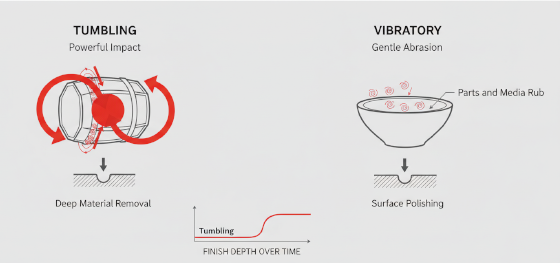
Choosing between these two mass-finishing giants is a strategic engineering decision. Vibratory finishing is the "scalpel"—it is gentle, reaches into complex internal cavities, and preserves the delicate geometry of thin-walled parts. Tumble finishing is the "sledgehammer." It is more aggressive, it creates more significant edge radii, and it is capable of removing much heavier burrs that a vibratory tub would simply bounce off of.
At Jucheng Precision, we recommend tumbling for rugged parts made from steel, iron, or heavy-duty alloys. Because the parts fall over one another in a tumbling barrel, there is a risk of "part-on-part" contact. This makes it unsuitable for high-precision aesthetic aluminum parts or components with delicate external threads. However, for industrial hardware, fasteners, and heavy brackets, the aggressive nature of tumbling is a massive advantage. It can obliterate the heavy "flash" left by casting or the stubborn "tags" from plasma cutting that would take hours to remove manually. By understanding the intensity of the fall, JUCHENG helps you select the process that matches the durability of your design, ensuring you don't over-pay for a gentle finish when your part needs an aggressive one.
The Media Matrix: From River Rocks to Steel Balls
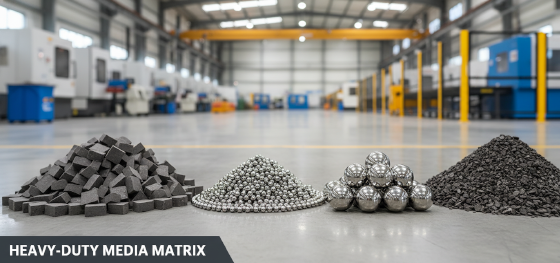
In the tumbling barrel, the media acts as the "teeth" of the machine. Because tumble finishing is a high-energy process, we often use heavier, more durable media than we would in a vibratory bowl. Ceramic Media remains the standard for aggressive deburring. These high-density "stones" come in triangles, stars, and cylinders, designed to wedge into specific corners or flow through large holes. For heavy steel parts, we often use larger media sizes—up to 50mm—to increase the impact energy of the cascade.
For parts that require "burnishing" rather than deburring, Jucheng Precision utilizes Steel Shot. This involves tumbling parts with thousands of tiny, hardened steel balls in a lubricating compound. Instead of scratching the surface, the steel balls hammer it, compressing the surface peaks and creating a high-luster, work-hardened finish. This is the gold standard for high-volume automotive fasteners and household hardware. We even utilize "Dry Tumbling" with organic media like walnut shells or corn cob for high-end plastic parts or delicate jewelry components that require a soft-touch polish without any chemical residue. By controlling the abrasive matrix—the weight, the shape, and the hardness—we ensure that the tumble cycle is perfectly tuned to your part's metallurgical and aesthetic requirements.
Edge Breaking and Surface Peening: The Structural Bonus
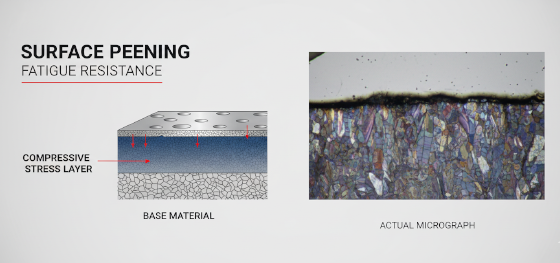
The aggressive nature of tumble finishing provides a hidden engineering benefit that spray finishes cannot provide: Surface Peening. As parts fall and strike the heavy abrasive media, the surface of the metal is essentially cold-worked. This constant bombardment acts like a millions-of-micro-hammers, compressing the grain structure of the metal's skin. This creates a layer of residual compressive stress, which is a powerful defense against fatigue failure and stress-corrosion cracking.
In CNC machining surface treatment, we often use tumbling for parts that will face high-vibration environments, such as engine mounts or agricultural linkages. The tumbling process not only "breaks" the sharp, dangerous edges—reducing the risk of cuts for assembly workers—but it also homogenizes the surface. It removes the directional "scars" left by the milling tool, creating a uniform, matte appearance that hides minor casting defects or machining chatter. At Jucheng Precision, we treat tumbling as a dual-purpose cycle: it is an aesthetic refinement and a structural fortification. We provide our clients with parts that aren't just smooth to the touch, but are mechanically superior to their raw machined predecessors.
JUCHENG’s Large-Scale Capacity: Cutting Costs

The primary driver for choosing tumble finishing is the bottom line. It is arguably the most cost-effective mass-finishing method in existence. Because a single rotating barrel can handle massive loads—sometimes up to 500kg of parts in a single batch—the per-unit cost of finishing drops into the pennies. There is no manual labor involved during the cycle, and the consumables (media and water) are inexpensive and recyclable. For high-volume projects, the ROI of switching from manual deburring to a JUCHENG tumble cycle is measured in thousands of dollars per week.
At Jucheng Precision, we manage this capacity through an automated "Finishing Hub." We don't just "roll" your parts; we validate them. Our quality assurance team performs batch audits using digital comparators to ensure that the edge radii and surface $Ra$ values meet your specifications. We also offer integrated cleaning and rust-prevention dipping as a final stage of the tumble cycle, ensuring your parts arrive clean, dry, and protected from oxidation. Whether you are scaling up a production run of heavy-duty industrial fasteners or looking for a rugged, matte finish for a new consumer tool, JUCHENG has the technical rigor and the massive capacity to deliver. We don't just cut corners; we round them perfectly through the science of mass finishing. Contact Jucheng Precision today for a technical DFM review and see how our tumbling protocols can clarify and secure your next ruggedized supply chain challenge.

