


Machining the perfect stainless steel part is an achievement in mechanical discipline. But for many industries, the tool marks left by a CNC mill—however beautiful—are a source of contamination. In the sterilized halls of a surgical suite or the high-vacuum chambers of a semiconductor lab, surface texture isn't just about looks. It's about chemistry. Standard mechanical finishes often hide microscopic burrs and pockets of trapped oil beneath a smeared layer of metal. This hidden debris is a time bomb for corrosion and bacterial growth. To reach the ultimate state of purity and smoothness, engineers turn to electropolishing stainless steel. It is the "reverse plating" process that strips away the imperfections of machining to reveal a surface that is molecularly clean and optically brilliant.
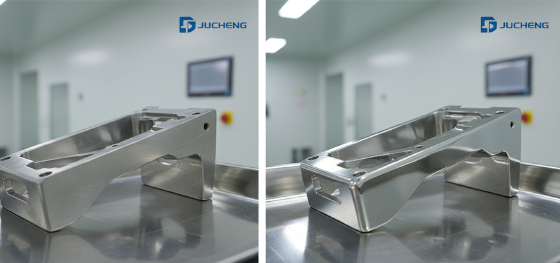
At Jucheng Precision, we integrate this electrochemical finish into our CNC machining surface treatment workflow for our most demanding clients. We recognize that for a 316L heart valve component or a high-purity gas manifold, the final ten microns of material removal are the most important. Electropolishing doesn't just make a part shine; it changes the ratio of chromium to iron on the surface, creating a shield that is vastly superior to standard passivation. This guide explores the sophisticated physics of ion stripping, the biological necessity of smooth surfaces, and the rigorous process controls JUCHENG employs to ensure your tight-tolerance designs survive the scrutiny of a microscope.
Achieving a mirror finish is easy. Achieving a mirror finish while maintaining a +/- 0.01mm tolerance is an engineering feat. Moving beyond the "buffing wheel" mindset is the first step toward high-purity manufacturing. Let us examine the technical pillars of electropolishing and why it remains the gold standard for high-performance stainless steel.
content:
The Science of Ion Stripping: Precision Leveling
Biofilm Resistance: The Geometric Key to Hygiene
Micron-Level Control: Preserving Machined Tolerances
Beyond Passivation: Supercharged Corrosion Resistance
Technical Standards: ISO 13485 and High Purity
JUCHENG’s Protocol: Integrated Electrochemical Excellence
The Science of Ion Stripping: Precision Leveling
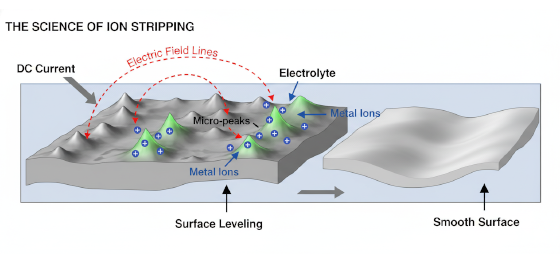
To understand electropolishing stainless steel, you must visualize the surface of a machined part under a high-power microscope. Even the smoothest milled surface is a landscape of "peaks" and "valleys." Traditional mechanical polishing works like a lawnmower, physically smashing these peaks down. This often "smears" the metal, trapping contaminants like machining oil or abrasive grit inside the valleys. Electropolishing takes the opposite approach. It is an electrochemical bath where the part is submerged in a concentrated acid electrolyte and becomes the "anode" in a high-current electrical circuit.
When the current is applied, a viscous, resistive layer forms on the surface of the metal. Because the "peaks" of the machining marks protrude further into the electrolyte, the electrical current density is highest at these points. This causes the metal atoms at the peaks to dissolve into the liquid significantly faster than the atoms in the valleys. This is ion stripping. The result is a selective, microscopic leveling of the surface. As the peaks vanish, the surface becomes increasingly flat and reflective. But unlike mechanical buffing, there is zero friction, zero heat, and zero smearing. You aren't pushing metal around; you are surgically removing it atom by atom. This non-mechanical nature ensures that the crystalline structure of the stainless steel remains unstressed and pristine, a critical requirement for fatigue-sensitive components in the aerospace industry.
Biofilm Resistance: The Geometric Key to Hygiene
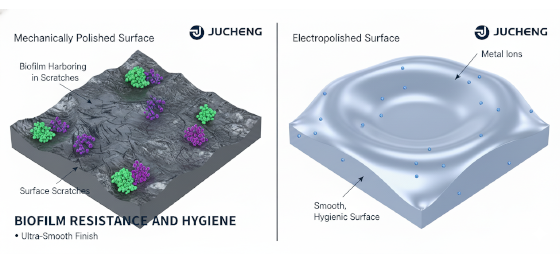
In the medical and food processing sectors, a surface is only as safe as its ability to be cleaned. Bacteria are microscopic survivors; they seek out scratches and pits where they can attach themselves and form a "biofilm"—a protective colony that is incredibly resistant to standard sanitization. Mechanical polishing, while making a part look shiny, often leaves behind jagged microscopic furrows that provide the perfect anchor points for these pathogens. This is why high-end surgical tools and vaccine production vessels must undergo electropolishing stainless steel.
The electrochemical process rounds off the sharp edges of any remaining pits. It creates a "featureless" surface at the microscopic level. Without ridges to cling to, bacteria and proteins are easily washed away by standard Clean-In-Place (CIP) or sterilization cycles. At Jucheng Precision, we use this geometric advantage to help our healthcare clients achieve the "sterility-ready" state required for human implants. By eliminating the microscopic hiding spots, we provide a surface that is fundamentally hostile to bacterial adhesion. This is not just a cosmetic upgrade; it is a life-saving safety feature that ensures the long-term biocompatibility of complex surgical assemblies.
Micron-Level Control: Preserving Machined Tolerances
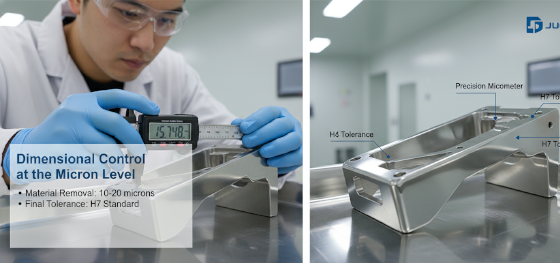
One of the most frequent questions we receive at Jucheng Precision is: "How much material will I lose?" Because electropolishing is a subtractive process, it will inevitably change the dimensions of your part. If managed poorly, it can turn a precision H7 bore into an oversized hole. However, when executed with technical rigor, this material removal is a predictable and controllable variable. Typically, we remove between 10 to 25 microns (0.0004" to 0.001") per surface to achieve a full mirror finish.
Successful CNC machining surface treatment for electropolishing requires "Reverse Engineering" the dimensions. Our DFM team calculates the exact material removal based on the current density and immersion time. We then machine the raw stainless steel slightly oversized to account for this chemical "skim." Because the material removal is perfectly uniform, even complex internal threads and intricate pockets maintain their geometric form. We use high-precision CMM measurement before and after the bath to validate the removal rate down to the single micron. This level of dimensional control allows JUCHENG to deliver parts that have the optical quality of a piece of jewelry with the functional precision of a laboratory instrument. We don't guess the outcome; we program the chemistry to match your blueprints.
Beyond Passivation: Supercharged Corrosion Resistance
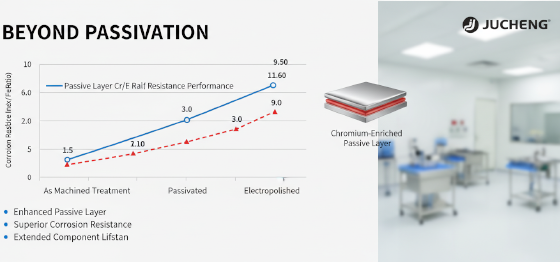
While standard passivation (ASTM A967) is an excellent way to remove free iron, it is a passive process. It simply cleans the surface. Electropolishing stainless steel is an active process that fundamentally re-engineers the surface chemistry. In a stainless steel alloy, the atoms are a mix of iron, chromium, and nickel. Iron is the most reactive and prone to rust. During electropolishing, the iron atoms are dissolved into the electrolyte more readily than the chromium atoms.
This results in a surface that is "Chromium-Enriched." The ratio of chromium to iron on the skin of an electropolished part is significantly higher than in the base metal. This enrichment creates a thicker, more stable passive layer of chromium oxide that is virtually impervious to saltwater, fuming acids, and harsh cleaning agents. Laboratory tests show that an electropolished surface can offer up to 30 times the corrosion resistance of a standard passivated surface. At Jucheng Precision, we recommend this finish for marine-grade hardware and subsea sensors where failure due to salt-spray is not an option. It is the ultimate insurance policy for your stainless steel designs, providing a self-healing armor that protects the structural integrity of the part for its entire service life.
Technical Standards: ISO 13485 and High Purity
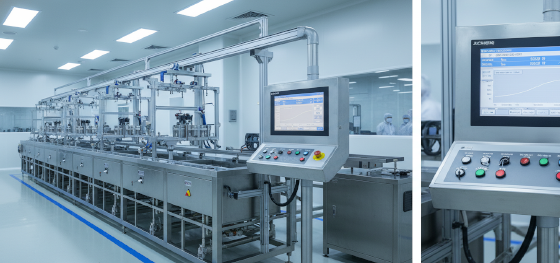
The requirements of the medical and semiconductor industries are governed by strict regulatory compliance. You cannot simply dip a part in a tank and claim it is "medical grade." Jucheng Precision is an ISO 13485:2016 certified facility, which means our electropolishing process is validated, documented, and reproducible. For our medical clients, we follow strict protocols to prevent cross-contamination, ensuring that the electrolyte baths are pristine and the rinsing cycles use deionized water of 18 megohm purity.
In the semiconductor industry, electropolishing is mandatory for gas delivery systems. Any microscopic surface roughness causes "outgassing"—the release of trapped gas molecules that can ruin a silicon wafer. We provide SEM (Scanning Electron Microscope) imaging and surface roughness certificates to prove that our finishes meet the exacting Ra 0.2 µm standards required for ultra-high-vacuum (UHV) components. We understand that in these high-tech sectors, the "finish" is a functional specification as vital as the thread pitch or the hole diameter. Our quality control team ensures that every electropolished component arrives with the paper trail required for high-integrity supply chains, bridging the gap between raw manufacturing and laboratory science.
JUCHENG’s Protocol: Integrated Electrochemical Excellence
The greatest risk in high-end finishing is the "vendor gap." If you buy precision machining from one shop and electropolishing from another, you lose control over the final outcome. If the part is out of spec, who is responsible? Jucheng Precision eliminates this risk by offering a fully integrated, one-stop-shop solution. We manage the entire lifecycle of the part: from the initial 5-axis CNC machining surface treatment preparation to the final electrochemical polish and cleanroom packaging.
Our internal workflow ensures that the machining marks are minimized before the part ever touches the electrolyte, which is the secret to achieving that deep, distortion-free mirror shine. We utilize automated racks and precise current-control power supplies to ensure that every part in a 1,000-unit batch is identical. When you receive a component from JUCHENG, it is a finished engineered masterpiece, verified for purity, smoothness, and dimensional accuracy. Whether you are building an innovative heart-lung machine or a high-performance chemical reactor, let our expertise in electropolishing armor your engineering. Contact Jucheng Precision today for a comprehensive DFM review and see how our integrated electrochemical protocols can clarify and secure your next high-purity project.

