


Speed is a dangerous drug in manufacturing. When you look at the 3D printing process, most technologies are obsessed with lasers and heat, but these energy sources create their own bottlenecks in terms of build volume and thermal distortion. binder jetting 3d printing offers a radical alternative by borrowing its primary logic from the office inkjet printer. Instead of using high-power heat to melt material point-by-point, it utilizes a multi-nozzle array to spray a liquid binding agent onto a bed of powder, layer by layer. This "cold" build process removes the shackles of heat-induced warping, enabling the production of massive sand casting molds or batches of complex metal preforms at a velocity that leaves laser-based systems in the dust.
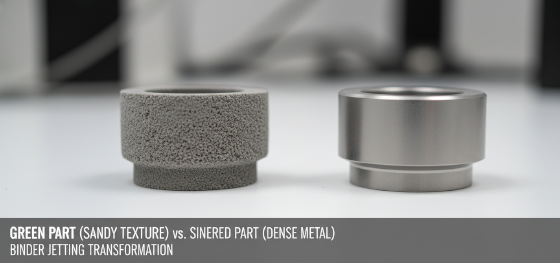
At JUCHENG, we analyze additive manufacturing through the cold lens of mechanical integrity. We understand that while binder jetting is a miracle of throughput, it introduces a significant second-stage challenge: the transition from a fragile "green" part to a fully dense functional component. For engineers in the foundry and automotive industries, this technology is a game-changer for rapid tooling and sand core production. However, for those seeking mission-critical metal strength, the trade-offs in porosity and shrinkage must be meticulously managed. This guide moves beyond the marketing hype to explore the hydrodynamic reality of inkjet bonding, the architectural shifts in modern foundry work, and why JUCHENG’s focus on high-density DMLS often serves as the necessary corrective for designs that require absolute structural invincibility.
True efficiency isn't just about the time on the machine; it's about the reliability of the final result. In the world of liquid-on-powder fusion, success is found in the chemistry of the binder and the patience of the sintering oven. Whether you are building a complex internal core for a high-performance engine block or a series of low-density metal mockups, the logic of the jet is a powerful tool. Let us break down the physical laws of droplet orchestration and see how JUCHENG navigates the chasm between raw sand and engineered reality.
Inkjet Logic on a Powder Bed: Mechanics of Bonding
Accelerating the Foundry: Digital Sand Molds
Green Part Fragility: Survival in the Sintering Furnace
Predicting the Shrink: Geometric Math in Binder Jetting
JUCHENG’s Technical Selection: When DMLS Outperforms the Jet
Inkjet Logic on a Powder Bed: Mechanics of Bonding
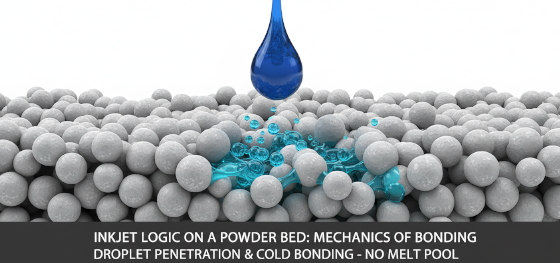
To master binder jetting 3d printing, you must first understand the concept of localized saturation. The machine operates with a reciprocating print head containing thousands of tiny nozzles, similar to high-end industrial inkjet printers. As the head sweeps across a bed of sand or metal powder, it deposits a precise volume of liquid resin. This resin acts as a chemical glue, wetting the surface of the powder and wicking into the gaps between particles through capillary action. Unlike laser-based systems that fight against the physics of thermal expansion and contraction, binder jetting is a "room temperature" process during the build phase. This means there are no residual stresses accumulating in the part while it is being formed, allowing for the creation of massive, stable parts that stay flat and true on the build plate.
The technical brilliance here is the speed of deposition. Because the print head can jet millions of droplets per second, a single layer can be completed in under a minute, regardless of how many parts are on the bed. At JUCHENG, we calibrate the droplet volume and the "powder-to-binder ratio" for every specific build. If the saturation is too high, the part loses resolution as the liquid bleeds into the surrounding powder; if it is too low, the part lacks the "green strength" needed to survive post-print handling. This balance is the primary challenge of the jetting stage. By managing the hydrodynamics of the bind, we produce preforms with high fidelity, ensuring that the internal cavities and complex external geometries of your design are captured with crisp accuracy before they ever enter the heat of the kiln.
Accelerating the Foundry: Digital Sand Molds
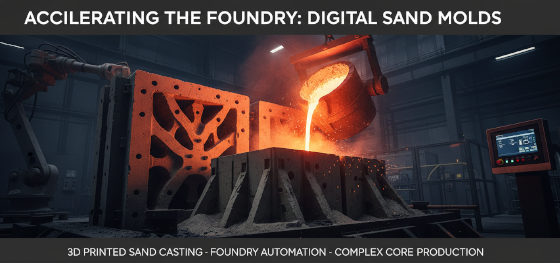
The industry that has most aggressively adopted binder jetting 3d printing is the traditional foundry. In the past, creating a complex sand mold for a large engine block or a turbine housing required weeks of pattern-making and manual labor. If the design changed, the entire pattern had to be rebuilt. Binder jetting erases this bottleneck by printing the sand mold directly from a CAD file. This is "Digital Sand Casting." We use high-purity silica or ceramic sand mixed with a high-performance binder to build molds that can withstand the violent thermal shock of molten iron or aluminum.
The value for the engineer is found in "Impossible Geometry." Because the binder jet can create internal cores with undercut features and organic vents that no physical pattern could ever pull out of a mold, you can design parts for maximum fluid efficiency. JUCHENG utilizes this digital foundry approach to shorten lead times for cast prototypes from months to days. This agility allows automotive and heavy-machinery designers to iterate on their thermodynamic models with real-world cast metal parts, ensuring that the cooling performance of a production engine is verified long before the final assembly line is built. By digitizing the oldest manufacturing craft on earth, binder jetting has turned the foundry into a high-speed innovation lab.
Green Part Fragility: Survival in the Sintering Furnace
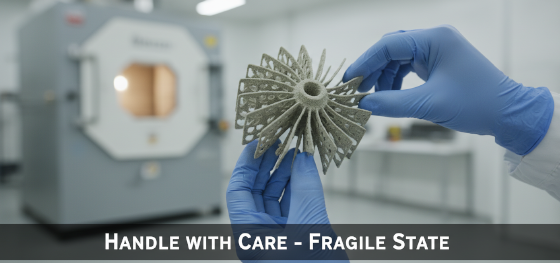
When we move from sand to metal, the 3D printing process in binder jetting becomes a two-stage marathon. The part that comes out of the powder bed is known as a "Green Part." It is essentially a delicate sandcastle made of metal dust held together by a tiny amount of glue. In this state, the part has zero mechanical strength; a firm squeeze with a human hand will crumble it into dust. The real challenge of metal binder jetting is the "Debinding and Sintering" phase. The green preform must be moved into a high-temperature furnace where the binder is burned away and the metal particles are heated until they fuse together.
This transition is a technical high-wire act. As the binder vanishes, the part is momentarily unsupported at a molecular level. If the furnace ramp-rate is too fast, the internal gases will expand and cause the part to explode or bloat. At Jucheng Precision, we manage this "Thermal Metamorphosis" through a multi-stage cycle in a controlled-atmosphere furnace. We account for the fact that as the metal fuses, the part will shrink significantly—often by as much as 20% in volume. For parts requiring high functional strength, we may also perform "Infiltration," where a second metal with a lower melting point (like bronze) is drawn into the pores of the steel preform to create a dense, composite solid. This multi-step journey is why binder jetting is a process of metallurgical patience. It offers massive speed in the printing stage, but it requires a master's touch in the thermal stage to ensure the part doesn't lose its soul in the fire.
Predicting the Shrink: Geometric Math in Binder Jetting
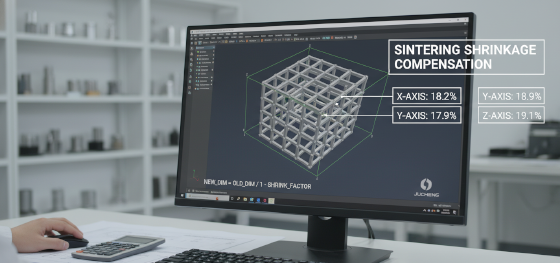
How do you maintain a +/- 0.1mm tolerance on a part that shrinks by 20%? This is the central engineering riddle of binder jetting 3d printing. Unlike CNC machining, where you cut the part to its final size, binder jetting requires you to design a part that is physically larger than it should be. The "Sintering Math" is the most valuable intellectual property in an industrial shop. You must calculate not just the linear shrink, but the "Gravity Sag" that occurs as the part softens in the furnace. Large overhangs and tall vertical walls will deform under their own weight if not correctly oriented or supported by ceramic fixtures.
At Jucheng Precision, our CAM engineers utilize advanced simulation software to predict these movements. We apply "Non-Uniform Scaling" to your CAD models, compensating for the fact that parts often shrink differently in the X and Z axes due to powder settling and bed friction. This predictive logic is essential for functional preforms. While binder jetting will never match the absolute precision of a 5-axis mill, our ability to control the shrink ensures that your large metal prototypes have the "near-net-shape" accuracy needed for functional assembly. We treat the shrinkage not as an error, but as a manufacturing parameter that must be engineered, allowing us to deliver complex, large-scale metal preforms that other shops simply cannot hold to tolerance.
JUCHENG’s Technical Selection: When DMLS Outperforms the Jet
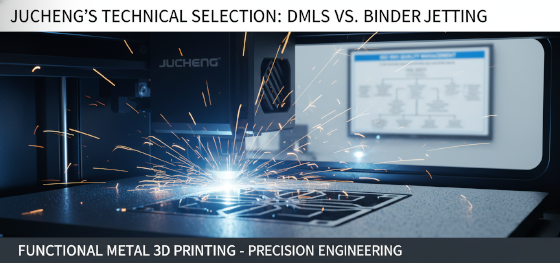
Choosing a manufacturer is a move of technical trust. At Jucheng Precision, we act as unbiased advisors for your 3D printing process. We are honest with our clients: binder jetting is the champion of speed and large-scale sand molding, but it has limitations for functional metal parts. Because the resulting metal parts are often porous (unless infiltrated), they lack the extreme fatigue strength and 99.9% density provided by JUCHENG’s core competency: DMLS (Direct Metal Laser Sintering).
If you are building a visual metal mock-up or a complex sand mold, we will direct you toward our high-speed Binder Jetting line to save you money and time. However, if your design involves high-pressure hydraulics, rotating aerospace nodes, or medical implants, we will pivot your project toward our DMLS and 5-Axis CNC cell. This technical honesty is the cornerstone of our brand. We don't just "push" the technology we have; we provide the solution that satisfies the physics of your design. When you receive a component from JUCHENG, you are getting the benefit of a diversified manufacturing hub that understands when to use the speed of the jet and when to use the precision of the laser. Contact our engineering team today for a comprehensive DFM review and let our multi-technology protocols clarify and secure your next manufacturing breakthrough.

