


Stop treating additive manufacturing as a process restricted to a clean, flat build plate. While most technologies in the 3D printing process require building a part from absolute zero, there is a high-energy titan designed to breathe new life into existing hardware. This is direct energy deposition 3d printing (DED). It functions more like a precision-controlled robotic welder than a standard 3D printer. By focusing a high-power laser or electron beam onto a specific point while simultaneously injecting metal powder or wire, DED allows engineers to "grow" metal directly onto a pre-existing component. It is the definitive solution for repairing five-figure turbine blades, adding complex features to large castings, or creating multi-material coatings that protect surfaces from extreme heat and abrasion.

At JUCHENG, we analyze the industrial landscape through a lens of total lifecycle cost. We understand that in sectors like oil and gas, aerospace, and heavy power generation, replacement is often the last and most expensive resort. Direct energy deposition 3d printing represents a technical sanctuary where a worn-out shaft or a cracked impeller can be restored to its original specifications—or even improved—using high-performance superalloys. However, DED is a "near-net-shape" process; the surface comes off the machine rough and requires sophisticated secondary finishing. This guide explores the mechanical foundations of laser cladding, the metallurgical logic of bonding additive layers to heavy substrates, and why JUCHENG’s integrated 5-axis CNC expertise is the mandatory final step in turning a raw DED buildup into a verified engineering masterpiece.
Precision in metal growth is a struggle against localized thermodynamics. You aren't just melting powder; you are managing a moving heat-affected zone across a massive structure. Whether you are cladding a pump sleeve with cobalt-chrome or repairing a landing gear node, understanding the logic of the deposit is essential. Let us examine the technical pillars of Direct Energy Deposition and see how it redefines the survival of your most expensive industrial assets.
Thermal Sculpting: Mechanics of the Coaxial Nozzle
Repair over Replacement: The Economic Logic of DED
Material Synergy: Building on Existing Surfaces
Metallurgical Integrity: Managing the Rapid Quench
Strategic Pivot: When DMLS and 5-Axis Outperform DED
Thermal Sculpting: Mechanics of the Coaxial Nozzle

The operational brilliance of direct energy deposition 3d printing lies in its delivery system. Unlike powder-bed systems that are confined by the dimensions of a static tank, DED utilizes a mobile nozzle that can be mounted on a multi-axis CNC gantry or a 6-axis robotic arm. This nozzle is a complex assembly of coaxial channels. In a powder-fed system, the high-power laser beam (often 1kW to 4kW) travels through the center of the nozzle, focused to a point on the workpiece. Surrounding the laser is a cone of pressurized inert gas—Argon or Helium—that carries the metal powder into the focal point. The moment the powder enters the laser’s path, it melts into a liquid state and bonds to the substrate.
This "flying melt pool" allows for the creation of features at angles that would cause other printers to collapse. Because the nozzle can rotate to stay perpendicular to the surface, DED can build material on vertical walls, 45-degree slopes, or even overhead. At JUCHENG, we monitor the "Catchment Efficiency"—the percentage of powder that successfully enters the melt pool—with extreme rigor. High-velocity sensors and thermal cameras track the temperature of the deposition zone in real-time. If the heat builds up too much, the material becomes runny and loses dimensional control; if it’s too cold, the bonding is weak. By orchestrating this high-energy event at the nozzle tip, we achieve material deposition rates that are ten times faster than laser sintering, making DED the undisputed champion for large-scale, ruggedized industrial hardware.
Repair over Replacement: The Economic Logic of DED
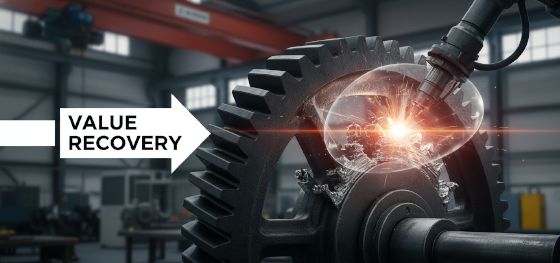
In the heavy machinery sector, the most expensive part is the one you can't get. Lead times for large forged shafts or specialized turbine blades can exceed six months. When these parts suffer localized wear or damage, traditional repair methods like manual welding are often too crude, introducing massive amounts of thermal stress that warp the part beyond repair. Direct energy deposition 3d printing offers a surgical alternative. By using the digital model of the original part, we can precisely "print" new metal only where the wear has occurred.
The ROI here is staggering. We have worked with clients in the energy sector who were able to return a multi-thousand-dollar impeller to service for a fraction of the cost of a new one. The process, known as "Laser Cladding," uses DED to deposit a layer of sacrificial or hard-facing material onto a worn surface. Because the heat input is so localized compared to traditional arc welding, the base part experiences minimal distortion. This allows JUCHENG to perform repairs on fully machined components with only a final "skim" pass on our 5-axis mills needed to restore original tolerances. We transform the 3D printing process from a tool of creation into a tool of industrial salvage, proving that even a broken component has a path back to 100% functional integrity.
Material Synergy: Building on Existing Surfaces
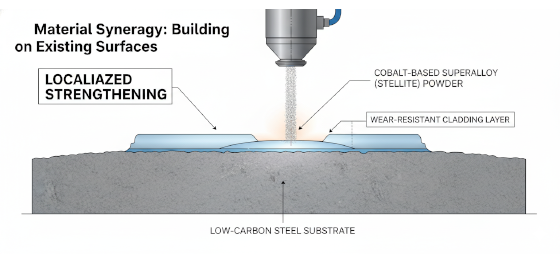
DED is not just for repair; it is a tool for metallurgical alchemy. One of its most powerful applications is "Functional Coating." Imagine a component that needs the cheap mass of mild steel for its core but the extreme heat resistance of Inconel for its skin. Traditional manufacturing would force you to make the entire part out of expensive Inconel or attempt a difficult cladding process. Direct energy deposition 3d printing allows us to deposit high-performance alloys directly onto a lower-cost substrate with a true metallurgical bond.
This "Material Synergy" allows engineers to optimize for both cost and performance. We can build structural ribs of stainless steel onto a basic aluminum frame, or we can coat a drill bit with tungsten carbide for extreme abrasion resistance. At JUCHENG, we manage the "Dilution Rate"—the amount of mixing that occurs between the substrate and the added material. We ensure that the transition zone is strong enough to prevent delamination but thin enough to preserve the purity of the top-coat. This ability to mix and match metal properties across a single part is a rare technical capability, making DED a vital link in the aerospace and chemical processing industries where parts must survive in environments that would destroy a single-material part.
Metallurgical Integrity: Managing the Rapid Quench
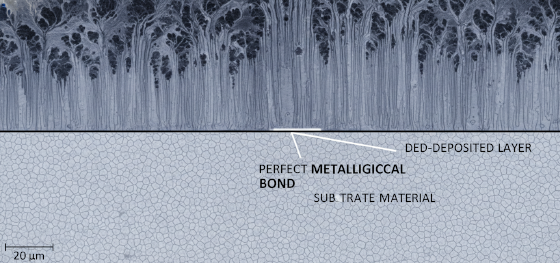
The quality of a DED part is decided in the cooling phase. Because a high-energy laser is moving quickly across a relatively cold substrate, the molten metal is "quenched" almost instantly. This rapid cooling leads to a very fine, dense micro-structure that often features higher tensile strength than traditional castings. However, this same rapid cooling introduces "Thermal Stress." If the deposition strategy is not perfectly balanced, the part will experience internal tension that can lead to warping or microscopic cracking (crazing).
JUCHENG technicians utilize a "Stress-Balancing" tool path strategy. We don't just print in one direction; we alternate the scan angles and manage the "Interpass Temperature" to ensure the heat remains uniform. For critical aerospace components, we implement post-process stress-relief annealing. This thermal cycle allows the metal atoms to reorganize, locking in the strength and ensuring dimensional stability. We use non-destructive testing, including ultrasonic and dye-penetrant inspection, to verify that the bond between the DED layer and the substrate is absolute. We treat the metallurgical integrity of the part with the same technical reverence as our 5-axis peek cnc machining, ensuring that your parts are structurally sound from the atomic level up to the final visible surface.
Strategic Pivot: When DMLS and 5-Axis Outperform DED
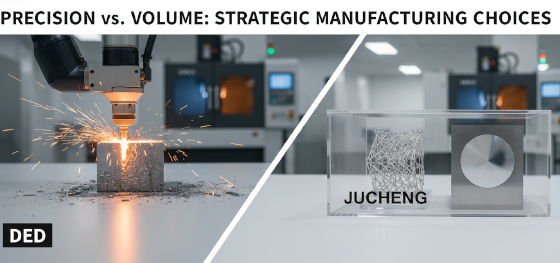
Choosing the right technology for your metal project is a move of engineering trust. At Jucheng Precision, we act as an unbiased advisor for your 3D printing process. We are honest with our clients: direct energy deposition 3d printing is the king of repair and large-scale growth, but it lacks the fine-feature resolution and 100% theoretical density of DMLS (Direct Metal Laser Sintering) or the sub-micron accuracy of 5-axis CNC. A DED part is a "near-net-shape" preform that almost always requires secondary machining to be functional.
If you need a small, high-detail medical implant with complex internal lattices, we will direct you to our DMLS line. If you need a high-precision aerospace valve with mirror-smooth surfaces, our 5-axis CNC machining centers are the superior choice. However, if you have a massive, expensive part that needs a new feature or a structural repair, DED is your champion. When you partner with JUCHENG, you are accessing a diversified manufacturing hub that understands how to combine these tools. We can print the bulk of a part via DED and then use our precision mills to finish the critical mating faces to +/- 0.01mm. This hybrid synergy is the ultimate competitive edge for modern hardware development. Contact our engineering team today for a technical DFM review and let our multi-technology protocols clarify and armor your next industrial breakthrough.

