


Designers of premium hardware often find themselves at a critical sensory crossroads: the choice between the disciplined, linear rhythm of a grain and the boundless depth of a mirror. This is the enduring technical standoff of brushed vs polished finishes. While both are achieved through mechanical abrasion, they communicate entirely different brand values. One speaks to industrial ruggedness and high-traffic durability; the other projects an image of luxury, precision, and surgical cleanliness.

At Jucheng Precision, we integrate these textures into our CNC machining surface treatment workflow as functional engineering specifications. We know that a surface is more than a visual layer—it is the interface that defines how a part will handle fingerprints, resist environmental wear, and interact with the human hand. Choosing incorrectly can turn a masterpiece of milling into a maintenance nightmare. This guide dives into the microscopic physics of reflection, the labor-intensive reality of grit progression, and the strategic reasons JUCHENG utilizes specific mechanical finishes to secure the success of your most visible designs.
Consistency in a mechanical finish is a test of technique and patience. You cannot simply "buff out" a poor machining job. Achieving a world-class shine or a perfectly parallel grain requires a foundation of precision tool paths. Let us examine the pillars of brushed and polished surfaces and how they redefine the tactile soul of your CNC components.
Surface Anatomy: The Physics of Directional Light
The Brushed Aesthetic: Hiding the Real World
The Polished Mirror: Achieving Optical-Grade Reflection
The Maintenance Standoff: Scratches and Fingerprints
Preparing for Perfection: Tool Paths and Roughness
JUCHENG’s Hybrid Strategy: Multi-Texture Integration
Surface Anatomy: The Physics of Directional Light

To understand the brushed vs polished debate, you must view the metal surface through a lens of topography. A brushed finish is a landscape of millions of microscopic, parallel "canyons." These are created by intentionally scratching the metal with an abrasive of a specific grit—usually between 120 and 240. These parallel lines interact with light in a directional way. When light rays hit a brushed surface, they are reflected primarily in a single axis perpendicular to the grain, creating a "soft" glow rather than a sharp reflection. This directional grain is what gives brushed metal its characteristically modern, high-tech appearance.
Polishing takes the opposite path. Instead of creating uniform scratches, the goal of polishing is to eliminate scratches entirely. Through a series of progressively finer abrasives—eventually reaching diamond pastes and soft cloth wheels—the machinist levels the surface until the peaks are removed and the valleys are filled. At the molecular level, high-end polishing creates a "Beilby layer," where the surface atoms actually flow into an amorphous, glass-like state. This results in specular reflection, where light rays bounce back at the exact same angle they arrived. This absence of surface noise is what creates the mirror effect. At Jucheng Precision, we use this topographical understanding to manage expectations; we know that a "high-polish" on a soft aluminum alloy will behave differently than on a hardened tool steel, and we adjust our abrasive grit progression to ensure the physics of the light match your visual intent.
The Brushed Aesthetic: Hiding the Real World
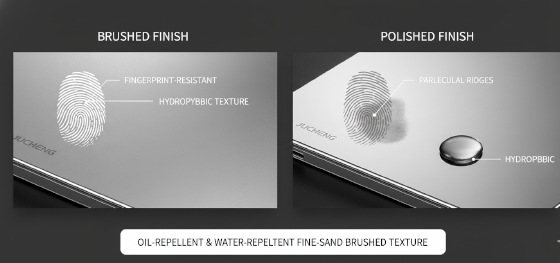
Brushed finishes are the pragmatist's choice in CNC machining surface treatment. The linear texture serves as a built-in camouflage. Because the surface is already covered in intentional, uniform scratches, any secondary scratches—the kind that occur during daily handling or cleaning—are lost in the grain. This makes brushed finishes the mandatory standard for high-traffic environments like commercial kitchen appliances, elevator panels, and industrial control housings. It is a finish that ages gracefully because it hides the scars of its service.
Beyond scratch resistance, brushing is highly effective at diffusing the oil from human skin. Fingerprints, which appear as high-contrast smears on a mirror, become almost invisible against a satin-brushed background. At Jucheng Precision, we utilize various abrasive media—from specialized 3M Scotch-Brite wheels to silicon carbide belts—to tailor the "depth" of the grain. A "Long Grain" finish provides a sleek, elongated look for architectural trim, while a "Short Grain" or "Satin" finish offers a more muted, uniform appearance for handheld electronics. We help our clients select the grit level that balances this aesthetic depth with the functional need to mask surface imperfections. For parts that must look pristine after years of manual handling, the brushed choice is an engineering insurance policy.
The Polished Mirror: Achieving Optical-Grade Reflection
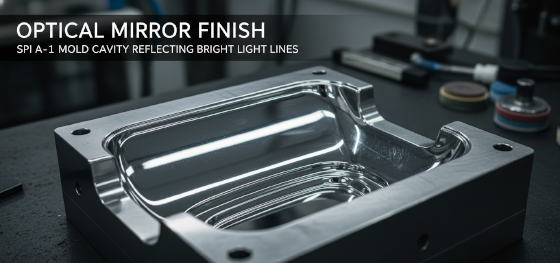
Polishing is the pursuit of purity. In the brushed vs polished comparison, polishing represents the extreme end of the manufacturing spectrum. It is a labor-intensive process that can take many times longer than brushing. To achieve a true #8 Mirror Finish on stainless steel, our technicians move through a rigorous ladder of grits: 400, 600, 800, 1200, and finally a compound buffing stage. Each step must completely erase the signature of the previous grit. If a single 400-grit scratch is left behind, it will show up as a "ghost mark" in the final mirror finish, requiring the entire process to start over.
Functionally, polishing is essential for more than just vanity. In the medical and food processing sectors, a mirror finish is a hygiene requirement. A polished surface has no microscopic "nooks" where bacteria can hide or where proteins can bind. It is much easier to sanitize than a brushed surface. In the world of high-precision molding, a SPI A-1 polish on a mold cavity is what allows a plastic part to be ejected smoothly and ensures its surface is crystal clear. Jucheng Precision specializes in this "Functional Polish," providing molders and surgeons with components that are molecularly smooth. We combine mechanical buffing with electrolytic methods to reach into complex geometries, delivering a consistent high-gloss finish that meets the optical and sanitary standards of the world's most regulated industries.
The Maintenance Standoff: Scratches and Fingerprints

Selection between these two finishes is often decided by the end-user's willingness to perform maintenance. A polished part is at its most beautiful the second it leaves the factory, and then it begins a slow decline. Because the surface is so perfect, any imperfection stands out. A single fingerprint can look like a grease stain; a minor scratch from a piece of jewelry can look like a canyon. For consumer-facing products like high-end smartphones or jewelry, this high maintenance is part of the "luxury tax"—it requires the user to constantly wipe and care for the object.
Brushed finishes offer a "low-stress" alternative. They are the working-class hero of CNC machining surface treatment. You can handle a brushed aluminum handle all day, and it will still look clean. In the event of a deep scratch, a brushed surface can often be repaired in the field using a simple abrasive pad, as the user can follow the existing grain to blend the damage. Repairing a mirror polish in the field is virtually impossible; it requires specialized machinery and expert knowledge. At Jucheng Precision, we ask our clients: "Who will be touching this part?" If it's a technician in a dusty factory, we mandate brushed. If it's a surgeon in a sterile lab, or a luxury consumer, we prepare for the rigor of polished. We ensure your material choice survives the lifestyle of your target market.
Preparing for Perfection: Tool Paths and Roughness

A critical mistake in manufacturing is assuming that finishing can "fix" a bad part. In reality, the brushed vs polished outcome is decided in the CNC mill. If a part has deep chatter marks or high $Ra$ values (roughness), the finishing process will only highlight these defects. A polished mirror over a wavy surface looks distorted, like a funhouse mirror. A brushed finish over deep tool marks creates a "plaid" effect where the grain and the tool marks fight for attention.
Jucheng Precision employs a "Pre-Finish Optimization" strategy. We adjust our spindle speeds, feed rates, and tool step-overs to deliver a consistent $Ra$ 0.8 or better substrate. For parts destined for mirror polishing, we use ball-nose mills with a 90% overlap to ensure the scallops are almost invisible. This reduces the manual labor required in the polishing room by half, ensuring that the dimensional tolerances are not compromised by excessive sanding. By engineering the machining and the finishing as a single continuous cycle, we provide our clients with a level of surface integrity that is repeatable across every batch. We don't just buff the surface; we engineer the light.
JUCHENG’s Hybrid Strategy: Multi-Texture Integration

The most sophisticated modern designs don't choose between brushed vs polished—they use both. A "Hybrid Finish" utilizes the contrast between directional grain and mirror depth to highlight specific features. Imagine a premium automotive wheel with a brushed face and polished "windows," or a medical console with polished buttons against a brushed housing. This contrast creates a visual complexity that screams "high-end."
Executing these hybrid finishes requires exceptional masking skills and a deep understanding of manufacturing sequences. At Jucheng Precision, we have perfected the art of multi-texture integration. We utilize custom-cut laser masks and high-precision fixtures to protect one finish while applying the other. This integrated workflow ensures that the transition lines between textures are crisp and professional, without any cross-contamination of grits. When you receive a component from JUCHENG, you are getting a finished engineered masterpiece, verified for both aesthetic brilliance and dimensional accuracy. Whether you are building the next iconic consumer device or a high-purity medical assembly, our surface treatment expertise clarifies your design vision. Contact Jucheng Precision today for a comprehensive DFM review and let our finishing protocols armor your next project with the perfect texture.

