


Encountering surface crazing or sudden brittle failure in medical enclosures after a few months of hospital use reveals a critical flaw in traditional material selection: the lack of chemical immunity. In the high-stakes world of medical device prototyping, hardware must survive thousands of sanitation cycles without structural degradation. While standard plastics like ABS or Polycarbonate are easy to mold, they are highly susceptible to chemical assault from clinical cleaners and industrial solvents. Achieving the necessary environmental resilience demands a strategic approach to the chemical resistance of polyurethane RIM parts. This liquid-to-solid chemistry creates a cross-linked shield that protects your technology from the aggressive reality of the modern ward or factory floor.
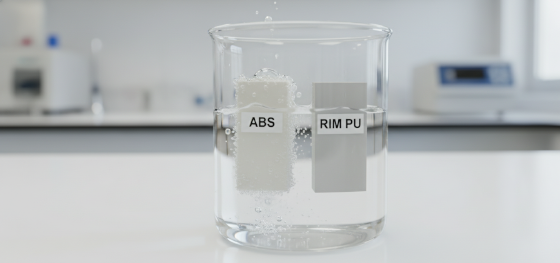
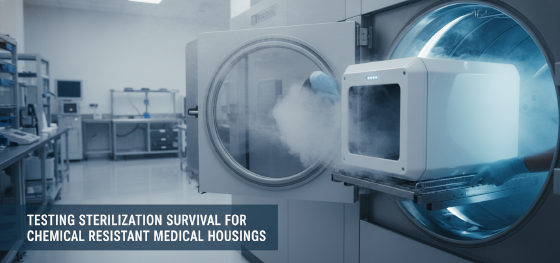
Precision in material formulation is the secret to sterilization survival for next-generation hardware. If an enclosure cannot withstand Isopropyl Alcohol (IPA), Bleach, or Hydrogen Peroxide vapor, it will eventually leak, leading to internal electronics failure. Jucheng Precision addresses these critical chemical hurdles by utilizing high-tier Polyurethane Molding Services that incorporate chemically inert polyether and polyester resins. JUCHENG delivers parts that maintain their high-gloss aesthetics and mechanical strength throughout their entire lifecycle in our Shenzhen precision manufacturing hub.
Operating under a strict ISO 13485 quality management system, Jucheng Precision serves as the high-accuracy manufacturing partner for global MedTech and AgTech OEMs. JUCHENG transforms raw liquid chemistry into validated structural components in as fast as 15 business days, leveraging our fleet of 150+ CNC machines. This guide explores the essential chemical compatibility standards, the physics of environmental stress cracking prevention, and the hydrolysis resistance required for manufacturing chemical resistance of polyurethane RIM parts hardware that ensures patient safety and unyielding field performance.
content:
Clinical Survival: How to Survive 1,000+ Wipe-Down Cycles?
Technical Data: Comparing Chemical Resistance Across Material Groups
Solving ESC: Why Low-Pressure RIM Prevents Brittle Cracking?
Custom Formulation: Tuning Resins for Specific Chemical Environments
JUCHENG Hub: The Shenzhen Engine for Chemically Inert Hardware
FAQ: Logistics and Performance of Chemical Resistant RIM Parts
Clinical Survival: How to Survive 1,000+ Wipe-Down Cycles?
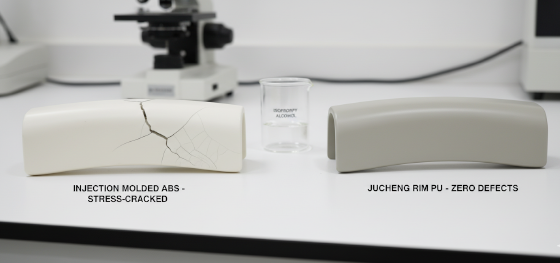
Durability in the medical sector is measured by the part's ability to remain non-porous after constant exposure to solvents. In the context of the chemical resistance of polyurethane RIM parts, the cross-linked nature of the thermoset matrix is the primary advantage. Unlike injection-molded thermoplastics that can "melt" or soften when they absorb alcohol, RIM parts are chemically stable. JUCHENG’s medical-grade formulations are tested to survive repeated exposure to 70% IPA and 10% bleach solutions, ensuring the surface does not become tacky or lose its high-gloss automotive finish. This is vital for prototype robot units that must maintain a "retail-ready" appearance through multi-site hospital trials.
Can RIM parts survive Hydrogen Peroxide (VHP) sterilization?
Yes. Specialized RIM formulations from JUCHENG are resistant to VHP fogging, making them the ideal choice for enclosures used in sterile surgical suites and cleanroom laboratories.
Surface integrity after sterilization is critical for preventing pathogen colonization. If a plastic surface develops microscopic pits or scratches due to chemical erosion, it becomes a reservoir for bacteria that standard wipe-downs cannot reach. JUCHENG utilizes 25 5-axis Haas/Mazak units to achieve a Ra 0.4 surface finish on our aluminum molds. The resulting RIM part possesses a mirror-smooth density that actively rejects moisture and protein adhesion. This level of physical cleanliness is essential for devices used in minimally invasive surgery or blood diagnostic testing, where any contamination can lead to inaccurate data or patient infection.
Hydrolysis resistance is the second pillar of clinical survival. Many medical devices operate in high-humidity environments or are subjected to steam cleaning. JUCHENG utilizes polyether-based polyols for these applications, as they offer superior stability against moisture-induced breakdown compared to standard polyester systems. By preventing the polymer chains from un-zipping in the presence of water, JUCHENG ensures your medical housings remain rigid and impact-resistant for over a decade of service. Our Shenzhen hub manages these material formulations with sub-micron precision, providing the unyielding foundations required for global healthcare innovations.
Technical Data: Comparing Chemical Resistance Across Material Groups
Success in hardware R&D depends on matching the material to its specific chemical threat. If your robot operates in an oil-heavy factory, its needs are different from a surgical assistant. Jucheng Precision provides full compatibility logs to help your engineering team validate their material choices. The following table compares the essential performance metrics of chemical resistance of polyurethane RIM parts against common industrial plastics for the current market.
| Chemical Group | Polyurethane RIM (Rigid) | Injection Molded ABS | Polycarbonate (PC) |
|---|---|---|---|
| Alcohols (IPA/Ethanol) | Excellent | Poor (Cracks) | Moderate (Pits) |
| Acids (Fertilizers) | Very High | Moderate | Poor |
| Oils and Greases | Exceptional | Good | Moderate |
| ESC Potential | Near Zero | Very High | High |
This data illustrates why RIM is the preferred choice for Polyurethane Molding Services in high-requirement sectors. The "Near Zero" ESC potential is the standout feature. Because JUCHENG’s polyurethane reaction injection molding process happens at low pressures (typically below 100 psi), the parts are cured in a "Relaxed State." This eliminates the internal molded-in stresses that serve as the fuel for chemical cracking in high-pressure injection parts. By delivering "Stress-Free" hardware, JUCHENG prevents the sudden field failures that can bankrupt a hardware startup during its first commercial rollout.
Solving ESC: Why Low-Pressure RIM Prevents Brittle Cracking?

Environmental Stress Cracking (ESC) is the leading cause of plastic part failure in [2026] hardware. ESC occurs when internal mechanical stresses react with a chemical agent, causing the polymer chains to snap prematurely. In high-pressure injection molding, the molten plastic is forced into the tool at 15,000+ psi, stretching the molecules and freezing them in place. When a technician wipes an ABS part with alcohol, the chemical penetrates the surface and allows those stressed chains to "relax" by cracking. In the chemical resistance of polyurethane RIM parts, this failure mode is eliminated because the liquid components react without hydraulic force, resulting in a zero-stress molecular lattice.
How to ensure zero internal stress in large shells?
Utilize the low-pressure RIM process to ensure the polymer cross-links in a neutral geometric state, preventing the "Locked-In" tension that leads to chemical crazing.
Geometric complexity further increases the risk of ESC in standard molding. Every internal rib, boss, and sharp corner acts as a stress concentrator. JUCHENG’s free DFM analysis in 24 hours service identifies these "High-Risk Nodes" in your CAD file. We suggest geometric modifications, such as increased fillets and optimized wall thickness transitions, to ensure that the chemical resistance of your part is uniform across its entire surface. By combining smart design with low-pressure physics, JUCHENG delivers industrial robot parts that can handle both the mechanical torque of a 6-axis arm and the chemical environment of a manufacturing plant.
Chemical absorption management is the final step in ESC prevention. Some plastics act like a sponge, absorbing chemicals and swelling, which puts pressure on adjacent components. JUCHENG’s RIM polyurethanes are formulated with high cross-link density to minimize permeability. This ensures that the chemical resistance of polyurethane RIM parts extends beyond the surface, preventing deep penetration that could compromise the dimensional stability after aging of your assembly. We provide the material integrity required to ensure your gasket seals and mounting points remain accurate through years of chemical exposure.
Custom Formulation: Tuning Resins for Specific Chemical Environments

The "Material Chameleon" nature of polyurethane allows JUCHENG to tune your part's chemistry to match its specific environmental threat. If your autonomous tractor is designed for a citrus orchard, the chemical resistance of polyurethane RIM parts must account for the acidic nature of pesticides. If your device is for an industrial kitchen, it must resist hot fatty oils. JUCHENG’s material experts adjust the Side B polyol blend, incorporating specific additives that block molecular penetration from targeted chemical groups. This bespoke approach ensures that your hardware doesn't just survive; it thrives in its intended mission profile.
Can RIM parts be formulated for extreme pH levels?
Yes. By utilizing specialized fluoropolymer additives or high-functionality cross-linkers, JUCHENG creates RIM parts that withstand both high-alkaline and low-acid environments without loss of hardness.
Antimicrobial integration is the secondary layer of tuning for the medical sector. Beyond simple chemical resistance, JUCHENG can integrate silver-ion additives directly into the resin matrix. This creates a part that actively inhibits bacterial growth on the surface, augmenting your device’s chemical hygiene. This level of advanced medical device prototyping is essential for PASSING the latest hospital-acquired infection (HAI) prevention standards. By delivering "Self-Sanitizing" hardware, JUCHENG helps you secure a competitive edge in the global [2026] MedTech market.
Secondary coatings are provided for the most extreme chemical scenarios. While the base RIM material is highly resistant, certain defense or aerospace applications require a "Sacrificial Shield." JUCHENG applies automotive-grade 2K urethane topcoats in our dust-free facility. These coatings provide an additional layer of scratch and chemical protection, ensuring that even if the outer finish is damaged, the structural polyurethane core remains untouched. This multi-layered defense strategy is why JUCHENG remains the preferred partner for the world's most aggressive hardware challenges, delivering the unyielding foundations your innovation demands.
JUCHENG Hub: The Shenzhen Engine for Chemically Inert Hardware

Dominating the large-format hardware market requires a partner that can scale from a single functional prototype to a commercial deployment of 5,000 units without losing a millisecond of momentum. Jucheng Precision operates with a 24/7 manufacturing mindset in our Shenzhen precision manufacturing hub, delivering high-tolerance polyurethane reaction injection molding and structural components with industry-leading speed. JUCHENG provides a bridge to production that ensures your innovations move from concept to clinical trial with 100% regulatory and metallurgical confidence.
Integrating your secure design goals with JUCHENG’s expertise ensures that your hardware survives the regulatory audit season and moves into mass adoption. JUCHENG offers comprehensive DFM reviews within 24 hours, identifying potential chemical-trap zones or mechanical weak spots in your design before they become field failures. Whether you are building an autonomous blood analyzer or a multi-part MRI housing, Jucheng Precision provides the rigid, precise, and chemically optimized foundations that keep your innovation moving through the high-stakes cycles and the years of hard labor.
Our facility is equipped with dedicated high-pressure RIM assembly cells and dedicated ISO 14001 and ISO 9001 quality labs, allowing JUCHENG to manage the entire hardware lifecycle in one location. JUCHENG manages the complexity of multi-component chemistry and structural integrity so your engineering team can focus on the clinical outcomes and the AI. By combining Shenzhen's speed with industrial-grade material verification and global quality standards, JUCHENG remains the preferred partner for the world's most aggressive hardware challenges. Contact us today to start your next project.
FAQ: Logistics and Performance of Chemical Resistant RIM Parts
Does chemical resistance wear off over time?
No. The resistance is a permanent part of the cross-linked polymer matrix; it is not a temporary surface treatment.
Can JUCHENG provide a chemical compatibility report for my specific cleaner?
Yes. We can perform coupon-level immersion tests for your proprietary chemicals to verify material stability before production.
What is the maximum part size for chemically resistant RIM?
We regularly mold structural panels and fenders up to 2.5 meters in length with consistent chemical properties across the entire span.
How do you handle waste from chemical-heavy production?
Under our ISO 14001 mandate, we utilize closed-loop recycling and specialized hazardous waste management systems to ensure sustainable manufacturing.
What is the lead time for a chemically validated prototype?
Functional RIM assemblies are typically delivered in 12 to 15 business days, including material formulation and tool fabrication.
Chemical crazing and brittle fractures are absolute project killers for clinical hardware. Partnering with Jucheng Precision ensures that your functional iterations are built with the unyielding polyurethane reaction injection molding and specialized chemical resistance of polyurethane RIM parts the industry demands. Reach out to our Shenzhen manufacturing hub today for a complete DFM review and build the unyielding foundation your autonomous fleet requires.

