


Navigational integrity remains the primary judge of autonomous reliability on the factory floor. When an engineering team transitions an Autonomous Mobile Robot (AMR) or a high-speed AGV from a digital twin to a physical heavy-lifter, the "vision system" is the most vulnerable link in the mechanical chain. If the mounting bracket for a $5,000 LiDAR sensor flexes, vibrates, or drifts out of alignment, the SLAM (Simultaneous Localization and Mapping) algorithm receives corrupted data, leading to obstacle-avoidance failure or catastrophic docking errors. Navigating this requirement for sub-micron geometric stability requires the strategic deployment of CNC machining LiDAR sensor mounts. Jucheng Precision operates as a high-fidelity subtractive sanctuary in the Shenzhen precision manufacturing hub, providing the 5-axis CNC depth needed to ensure your robot’s "eyes" remain perfectly calibrated through millions of operational cycles. Within the broader framework of AGV and AMR Parts, we bridge the gap between "concept vision" and "optical sovereignty," ensuring your mobile fleet maintains its sub-millimeter positioning accuracy across every acre of warehouse space.
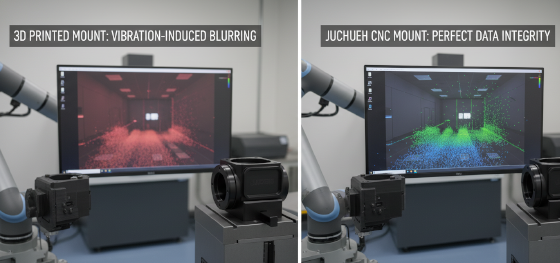
Establishing a resilient robotics launch in 2026 demands the absolute rejection of "low-modulus" fabrication. Amateurs often default to 3D printed plastic brackets for initial LiDAR fitment, unaware that the thermal expansion and inherent porosity of printed polymers will trigger navigational drift as the robot's motors generate heat. Jucheng Precision eliminates these "Sensor Failures" by enforcing a strict "Rigid-Seat" protocol. We utilize aerospace-grade aluminum and 5-axis milling to deliver mounts that serve as a rock-solid datum for your robot’s spatial awareness. Whether you are developing a warehouse sorter requiring high-frequency oscillation resistance or a medical delivery bot needing sterile chemical defense, our facility provides the material science and metrological rigor required for global market entry. This guide deconstructs the necessity of CNC machining LiDAR sensor mounts, focusing on the physics of angular error, the thermodynamics of heat-sinking, and why JUCHENG’s "Metrology-First" protocol is the mandatory foundation for anyone developing autonomous sensor pods.
Alignment Sovereignty: Why a 0.1-degree tilt ruins robotic navigation?
Thermodynamic Stability: Why Aluminum 6061 is preferred for sensor mounts?
Mechanical Velocity: How 5-axis CNC eliminates re-fixturing errors?
The JUCHENG Angle: CMM reports and true position verification
Frequently Asked Questions: LiDAR Sensor Hardware
Alignment Sovereignty: Why a 0.1-degree tilt ruins robotic navigation?

Kinetic geometry dictates the limits of autonomous perception. In the world of CNC machining LiDAR sensor mounts, the mathematical amplification of error is the primary engineering adversary. A LiDAR sensor works by emitting photons and measuring their return time across distances often exceeding 100 meters. If the mounting bracket is machined with a seemingly minor 0.1-degree tilt relative to the robot's chassis, that error propagates linearly. At a 100-meter range, that 0.1-degree variance results in a positioning drift of nearly 5 meters in the point-cloud data. Jucheng Precision eliminates this "Navigation Fog" by achieving sub-micron parallelism on all mounting faces. We understand that a sensor mount is not just a bracket; it is a technical contract of alignment. We utilize specialized diamond-tipped cutters to achieve +/- 0.01mm tolerances on mounting hole positions, ensuring that your sensors point exactly where the software expects, effectively eradicating the odometry drift that ruins high-speed autonomous throughput.
Thermodynamic Stability: Why Aluminum 6061 is preferred for sensor mounts?

Thermal expansion remains the invisible saboteur of sensor calibration. High-performance LiDAR and stereoscopic cameras generate significant internal heat during 24/7 autonomous operation. If the mount is made of plastic or low-grade steel, the heat remains trapped near the sensor, causing the electronics to throttle and the material to expand, which shifts the optical center-line. Jucheng Precision utilizes Aerospace-Grade 6061-T6 Aluminum for CNC machining LiDAR sensor mounts because of its spectacular thermal conductivity (approx. 167 W/m·K). We don't just machine a flat plate; we often design integrated cooling fins directly into the bracket geometry, transforming the mount into a high-efficiency heat sink. This thermodynamic management ensures that your vision systems operate at a stable temperature, preventing the "Calibration Creep" that causes robots to require frequent, expensive re-mapping of their environments. We turn "mounting hardware" into "thermal insurance" for your most expensive robotic assets.
Mechanical Velocity: How 5-axis CNC eliminates re-fixturing errors?
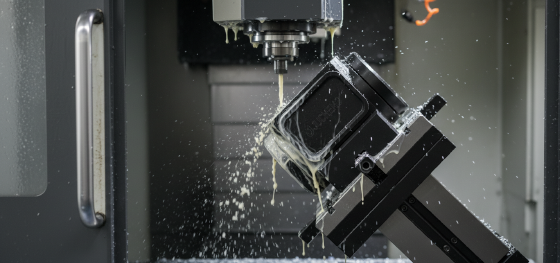
Subtractive perfection is won by minimizing the "Human Touch" during the production cycle. Sensor mounts for AGV and AMR Parts often feature complex, multi-angled mounting facets designed to maximize the sensor's field-of-view. Attempting to machine these parts on a standard 3-axis mill requires the operator to unclamp and rotate the part multiple times. Every manual "Flip" introduces a microscopic alignment error known as "Fixture Drift." Over three or four setups, these errors accumulate, ruining the true position of the mounting bores. Jucheng Precision operates a fleet of 5-axis Haas and Mazak CNC centers that rotate the part and the tool simultaneously. We execute CNC machining LiDAR sensor mounts in a "Single Setup," ensuring that every angled mounting face is perfectly orthogonal to the primary datum. This surgical consistency is why JUCHENG parts assemble with zero-friction, providing the high-fidelity skeletal frame needed for surgical-level robotic navigation.
The JUCHENG Angle: CMM reports and true position verification

Manufacturing excellence at Jucheng Precision is built on the foundation of the metrological audit. We don't just "cut and ship"; we prove your geometry is stable with scientific data. Our facility, certified to ISO 9001 and IATF 16949, houses a dedicated metrology lab equipped with ruby-tipped Coordinate Measuring Machines (CMM). For every batch of CNC machining LiDAR sensor mounts, we provide a full dimensional report verifying the "True Position" and "Flatness" of your mounting interfaces. We recognize that for our clients in the logistics and automotive sectors, a bracket that is 0.05mm out of spec is a failure that stalls an entire assembly line. Stop gambling your robot’s navigation on uncertified vendors who lack the specialized metrology for optical seating. Leverage our decade of high-performance replication mastery to validate rapidly and launch profitably. Contact our technical team today for a free DFM review and see how we can anchor your robot’s "Vision" with the mechanical soul of professional CNC machining.
Frequently Asked Questions: LiDAR Sensor Hardware
Question: What is the best material for outdoor CNC machining LiDAR sensor mounts?
Answer: Aluminum 6061-T6 is the optimal choice for 2026 robotics due to its high strength-to-weight ratio, excellent thermal conductivity for sensor cooling, and its ability to accept Type II or Type III hard-coat anodizing for weatherproofing.
Question: How do you ensure the mount doesn't vibrate during robot operation?
Answer: We prioritize "Structural Modulus" in our DFM reviews, suggesting rib reinforcements and high-rigidity mounting points. Furthermore, our 5-axis CNC process ensures a dense, monolithic part that eliminates the harmonic resonances found in assembled or 3D printed brackets.
Question: Can JUCHENG help with the design of O-ring grooves for waterproof sensor pods?
Answer: Absolutely. We provide expert feedback on O-ring gland design, ensuring the CNC-machined grooves possess the Ra 0.8µm surface finish and +/- 0.02mm depth tolerances required for a reliable IP67 or IP68 seal.
Question: What is the lead time for a custom set of 10 LiDAR mounts?
Answer: Utilizing our expedited robotics workflow, JUCHENG can CNC machine, anodize, and inspect a custom set of sensor mounts in as fast as 5 to 7 business days.

