


Visual authority in autonomous logistics dictates the perceived value of the hardware. When a design team finalizes a CAD model for a new warehouse AMR or an automated hospital courier, the physical shell must communicate a "Retail-Ready" soul to secure market adoption. For innovators in 2026, the primary adversary is the "Oversized Component Barrier"—the dangerous gap where a 1-meter enclosure is too complex for thermoforming, too massive for 3D printing, and too low-volume to justify the $120,000 "Financial Ransom" of a high-pressure steel mold. Navigating this requirement for complex, impact-resistant, and beautiful protective shells requires the strategic deployment of Large AMR enclosure manufacturing. Jucheng Precision operates as a high-fidelity manufacturing sanctuary in the Shenzhen precision manufacturing hub, providing the low-pressure thermodynamic depth needed to deliver these massive geometries. Within the broader framework of AGV and AMR Parts, we bridge the gap between "digital intent" and "physical brand authority," ensuring your autonomous fleet scales with absolute cosmetic and structural certainty.
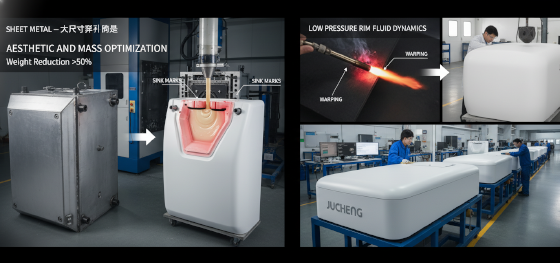
Establishing a resilient launch for mobile robotics demands the absolute rejection of "Office-Grade" fabrication methods. Amateurs often default to heavy sheet metal for large shrouds, unaware that the weight penalty drains battery life and the boxy aesthetics repel high-end investors. Jucheng Precision eliminates this "Mechanical Stagnation" by positioning Reaction Injection Molding (RIM) as the hero for oversized covers. Whether you are developing a 500-unit pilot run for a retail chain or a ruggedized industrial rover, our facility provides the material science and finishing rigor required for 2026 market entry. We turn "raw industrial shells" into "integrated mechanical assemblies," providing the visual authority and impact-defense needed to survive the chaos of the shipping dock. This guide deconstructs the necessity of Large AMR enclosure manufacturing, focusing on the economics of aluminum tooling, the physics of zero-sink design, and why JUCHENG’s "Integrated Protocol" is the mandatory foundation for anyone developing autonomous mobile hardware.
Mechanical Stagnation: Why oversized enclosures kill robotics budgets?
Thermodynamic Agility: How RIM solves the large-part problem?
Material Sovereignty: Impact resistance and UL94 V-0 fire safety
JUCHENG Protocol: Showroom-ready finishes for the autonomous fleet
Frequently Asked Questions: AMR Enclosure Manufacturing
Mechanical Stagnation: Why oversized enclosures kill robotics budgets?
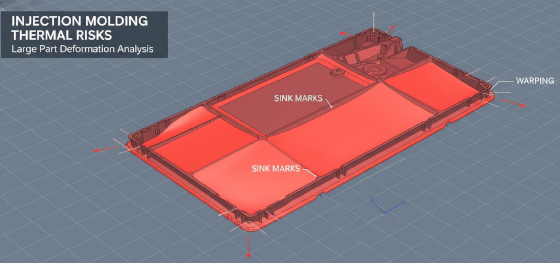
Financial paralysis occurs when high-volume logic is applied to niche robotics projects. In the context of Large AMR enclosure manufacturing, the size of the component dictates the financial gravity of the tooling. A meter-long side panel requires a massive steel mold that must withstand injection pressures exceeding 20,000 psi. To keep the mold from blowing open, a 1,500-ton press is required, which carries an hourly machine rate that kills the ROI of a 500-unit batch. Jucheng Precision eliminates this "CapEx Barrier" by moving away from brute-force hydraulic pressure. We recognize that for mobile robots, the enclosure must be a lightweight structural shell, not a solid block. By identifying the "Tooling Debt" early through our DFM audits, we help startups preserve their runway for software development rather than burying it in multi-ton blocks of H13 steel.
Thermodynamic Agility: How RIM solves the large-part problem?
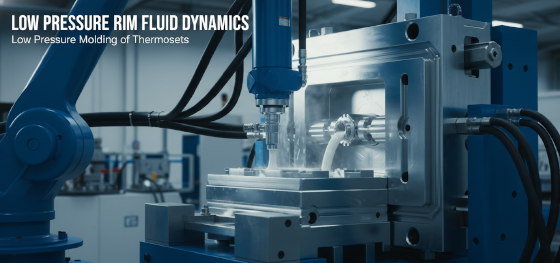
Molecular transformation in RIM is achieved through liquid chemistry rather than thermal melting. Large AMR enclosure manufacturing at Jucheng Precision utilizes two low-viscosity liquid components—Polyol and Isocyanate—mixed at high speed and poured into a tool at pressures under 100 psi. This "Gentle Fill" allows us to utilize cost-effective aluminum tools that are 80% cheaper and ten times lighter than steel. Because the material expands to fill the cavity via an exothermic reaction, it captures intricate 3D details without the residual internal stress that causes warping in injection-molded parts. This technology is the undisputed king of oversized components; it allows you to design 15mm strengthening ribs directly behind 3mm cosmetic walls without a single "Sink Mark" blemish. We don't just "mold covers"; we engineer structural masterpieces that possess the mechanical spine of an industrial asset.
Material Sovereignty: Impact resistance and UL94 V-0 fire safety
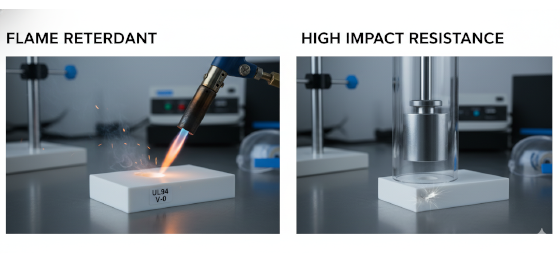
Molecular toughness dictates the field survival of autonomous fleets. Large AMR enclosure manufacturing often requires the protection of expensive LiDAR and logic boards during high-speed warehouse collisions. Jucheng Precision utilizes specialized "Elastomeric RIM" formulations that mimic the impact resistance of ABS and Polypropylene. These materials absorb kinetic energy through molecular deformation, acting as a structural shock absorber that refuses to shatter. Furthermore, our resins are formulated to meet the UL94 V-0 fire safety standard—a mandatory legal requirement for any robot housing high-capacity lithium-ion batteries. We provide the material lot traceability and safety documentation required for global compliance audits, ensuring your hardware is as safe as it is strong. We turn "vulnerable logic" into "armored autonomy," ensuring your brand survives the most abusive industrial cycles.
JUCHENG Protocol: Showroom-ready finishes for the autonomous fleet
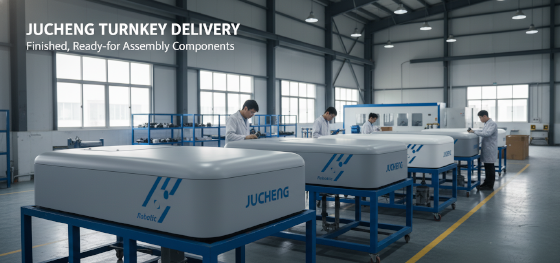
Manufacturing excellence at Jucheng Precision is built on the foundation of single-source cosmetic authority. We recognize that Large AMR enclosure manufacturing is only complete when the part is showroom-ready. Our facility integrates automated painting cleanrooms where we apply automotive-grade 2K coatings that provide extreme scratch resistance and chemical defense. Because RIM parts have high surface energy, they provide a superior bond for primers and paints, ensuring your fleet maintains its pristine appearance after months of wiping down with aggressive cleaners. We provide full CMM dimensional inspection reports and silk-screening services for corporate branding under one ISO 9001 certified roof. Stop gambling your robot's visual identity on fragmented vendors who treat large parts like simple boxes. Leverage our decade of large-scale replication mastery to validate rapidly and launch profitably. Contact our technical team today for a free DFM review.
Frequently Asked Questions: AMR Enclosure Manufacturing
Question: How big can JUCHENG manufacture an AMR enclosure using RIM?
Answer: Our specialized RIM facility in Shenzhen can produce monolithic plastic panels up to 2.5 meters in length, making it ideal for full-size heavy-payload AMRs and agricultural robots.
Question: Can I add metal inserts into a Large AMR enclosure manufacturing project?
Answer: Absolutely. Jucheng Precision specializes in encapsulating brass threaded nuts and mounting brackets directly during the RIM pour, providing high-torque anchor points for internal hardware.
Question: How long does the aluminum RIM tool last for production?
Answer: Our high-grade aluminum tools are rated for 1,000 to 5,000 shots. This is the perfect "Scale-up Bridge" for robotics companies to generate revenue before moving to permanent steel tooling.

