


Kinetic energy management remains the ultimate judge of robotic field durability. In the high-velocity environment of an autonomous warehouse or a collaborative factory floor, a robot is a moving mass of expensive logic and delicate sensors. When an Autonomous Mobile Robot (AMR) navigates a narrow corridor or docks with a high-speed conveyor, the risk of a low-velocity collision is an absolute certainty. If the contact point is a rigid, unforgiving piece of sheet metal or hard plastic, the resulting shockwave travels through the frame, potentially unseating PCB connectors or blurring LiDAR data. Navigating this requirement for active kinetic defense requires the strategic deployment of Overmolded bumpers for mobile robots. This advanced multi-material discipline transforms a simple protective cover into a structural shock absorber. Jucheng Precision operates as a high-fidelity manufacturing sanctuary in the Shenzhen precision manufacturing hub, providing the technical depth to fuse disparate material durometers into a single, monolithic safety asset. Within the broader framework of AGV and AMR Parts, we bridge the gap between "brittle enclosures" and "impact-ready sovereignty," ensuring your mobile fleet scales with absolute mechanical and aesthetic certainty.
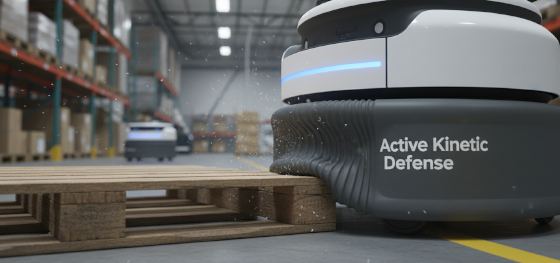
Establishing a resilient robotics launch demands the rejection of crude "post-process" additions. Amateurs often attempt to glue foam strips or stick-on rubber pads to their robot's chassis, unaware that these superficial bonds will invariably peel, flake, or degrade under the oily, high-friction conditions of an industrial warehouse. Jucheng Precision eliminates these "Maintenance Nightmares" by utilizing advanced molecular bonding protocols. We don't just "cover" your robot; we engineer a permanent tactile interface that possesses the mechanical soul of a factory-line product. Whether you are developing a 500-unit pilot run for a hospital sorter or a heavy-duty pallet mover, our facility provides the material science and finishing rigor required for 2026 market entry. This guide deconstructs the necessity of soft-touch compliance, the physics of TPE-to-ABS bonding, and why JUCHENG’s "Integrated Protocol" is the mandatory foundation for anyone developing Overmolded bumpers for mobile robots for global deployment.
Why soft bumpers matter: OSHA compliance and electronics protection?
What is overmolding: Fusing soft elastomers to rigid skeletons?
Bonding Mechanics: How to prevent bumpers from peeling off?
The JUCHENG Angle: Seamless and professional impact protection
Frequently Asked Questions: Overmolded Robot Bumpers
Why soft bumpers matter: OSHA compliance and electronics protection?
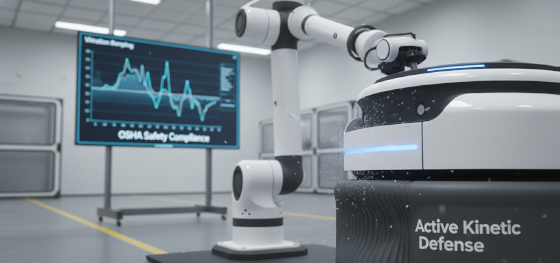
Human safety and internal logic protection represent the dual mandate of Overmolded bumpers for mobile robots. From a regulatory perspective, OSHA and international safety standards (ISO 3691-4) require mobile robots to minimize the force of any potential impact with human workers. A soft, compliant bumper increases the "Impact Duration" during a collision, effectively lowering the peak force exerted on the bystander. Internally, these bumpers act as a "Mechanical Fuse." By utilizing energy-absorbing elastomers like TPU (Thermoplastic Polyurethane), Jucheng Precision engineers design protective skins that dissipate kinetic energy as a minute amount of heat, preventing the shock from reaching the sensitive 3D cameras and AI chips inside the AMR. We turn "vulnerable shells" into "damped enclosures," ensuring your bot remains compliant with safety codes and operational after accidental bumps.
What is overmolding: Fusing soft elastomers to rigid skeletons?
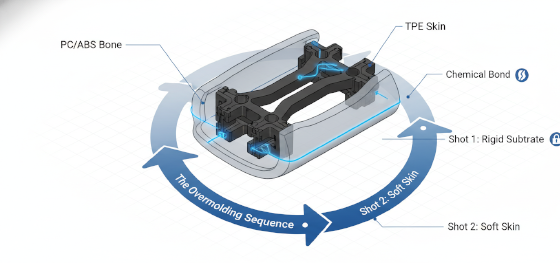
Molecular fusion dictates the success of a multi-material robotic part. Overmolding is a specialized injection molding process where a soft elastomer is injected directly over a pre-molded rigid part. For Overmolded bumpers for mobile robots, we typically utilize a rigid high-modulus skeleton made of PC/ABS or Glass-Filled Nylon. This "Bone" provides the mounting points and structural rigidity. The "Skin"—often a Shore 40A to 60A TPE (Thermoplastic Elastomer)—is then molded over it. Jucheng Precision utilizes two primary methods: "Two-Shot" molding for high-volume automation and "Pick-and-Place" overmolding for agile low-volume runs. By managing the melt temperatures of the two disparate resins, we induce a covalent bond at the interface, ensuring the soft skin is chemically welded to the rigid core. This creates a part that handles like a single monolithic unit, with zero risk of the rubber shifting or detaching during its 24/7 service life.
Bonding Mechanics: How to prevent bumpers from peeling off?
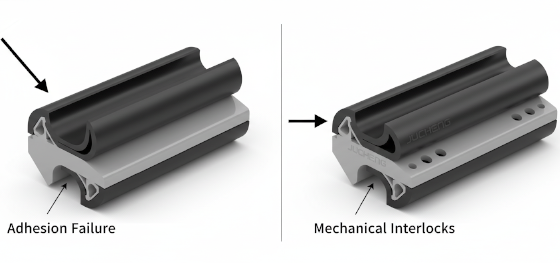
Geometric insurance remains the ultimate defense against interfacial delamination. While chemical bonding is the goal of Overmolded bumpers for mobile robots, industrial environments can weaken these bonds over years of exposure to cleaning chemicals or extreme temperature swings. Jucheng Precision eliminates the "Peel Risk" by advocating for mechanical interlocks. During our complimentary DFM audit, we recommend adding "Through-Holes," "Dovetail Channels," or "Undercut Bridges" to the rigid substrate. During the second shot, the molten elastomer flows *through* these holes and solidifies on the opposite side, creating a permanent physical anchor. This "Polymer Rivet" ensures that even if the chemical bond is compromised, the bumper cannot physically be ripped away from the robot’s frame. We turn "aesthetic layers" into "indestructible structural armor," documented for survival in the most abusive warehouse conditions.
The JUCHENG Angle: Seamless and professional impact protection
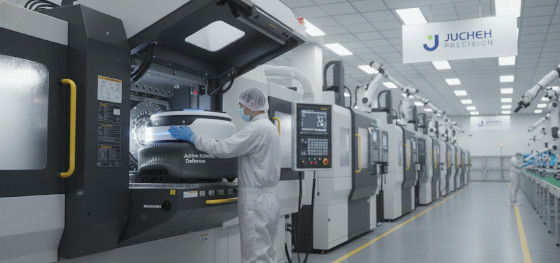
Manufacturing excellence at Jucheng Precision is built on the foundation of single-source accountability. We don't believe you should manage one vendor for your rigid robot chassis and another for your overmolded bumpers. JUCHENG houses elite multi-shot injection bays and 5-axis CNC mold shops under one ISO 9001 certified roof. We provide the material lot traceability and destructive "Peel-Strength" reports needed for Tier-1 robotics supply chains. Our facility specializes in the Large AMR enclosure manufacturing sector, allowing us to produce 1.5-meter long protective bumpers that fit perfectly over your welded frames. Stop gambling your robot’s safety on stick-on foam or uncertified vendors. Leverage our decade of multi-resin replication mastery to validate rapidly and launch profitably. Contact our technical team today for a free DFM review and see how we can turn your digital safety intent into a structurally sovereign physical reality.
Frequently Asked Questions: Overmolded Robot Bumpers
Question: Can JUCHENG color-match the bumper to my company's Pantone color?
Answer: Yes. We offer precise "In-Mold Pigmentation" for our TPE and TPU resins, ensuring your overmolded bumpers for mobile robots maintain high-fidelity brand consistency that won't rub off or fade over time.
Question: What is the recommended hardness for a warehouse robot bumper?
Answer: For optimal impact absorption and durability, we typically recommend a Shore A hardness between 50A and 70A. This provides enough compliance to protect sensors while remaining tough enough to resist abrasion from industrial flooring.
Question: Is it possible to overmold a bumper directly onto a metal (Aluminum) chassis?
Answer: Yes. While metal does not naturally chemically bond with plastic, JUCHENG utilizes specialized heat-activated primers and aggressive mechanical interlock designs to permanently anchor the soft bumper skin to CNC-machined aluminum linkages.
Question: Can these bumpers handle CNC machining LiDAR sensor mounts integration?
Answer: Absolutely. We often design the bumper to have cut-outs or integrated mounting features for LiDAR and camera sensors, ensuring the sensor's vision is unobstructed while the surrounding housing is protected from impact.

