


Observing a high-speed picking robot in an electronics facility reveals the invisible struggle between physics and precision in industrial robot parts. Every time the arm accelerates, it must overcome its own inertia; every time it stops, it must resist the bending forces of its own momentum. The mechanical links connecting the joints are the primary victims of these dynamic loads. Achieving the required cycle times in [2026] automation demands a mastery of CNC machining robot arm links to ensure that every gram of weight contributes to structural stiffness rather than parasitic mass.
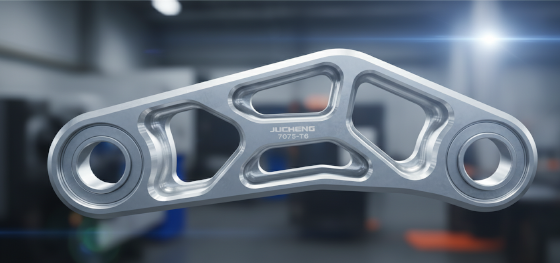
Kinematic performance depends entirely on the stiffness-to-weight ratio of the arm segments. If a link is too heavy, the motors must work harder, increasing heat and reducing the robot's maximum payload; if it is too flexible, the arm will oscillate at the end of its travel, ruining point-to-point repeatability. Jucheng Precision addresses this conflict by utilizing high-strength 7075-T6 aluminum and aggressive weight-reduction strategies. We manufacture the "bones" of modern industrial robots that move faster and hit harder without sacrificing sub-millimeter accuracy.
Operating within the Shenzhen precision manufacturing hub, JUCHENG provides a "Bridge to Production" for robot OEMs targeting high-speed applications. We transform solid alloy billets into skeletal, hollowed-out structures that serve as the high-performance conduit for motion. This guide explores the material selection, weight-optimization techniques, and internal routing challenges necessary for manufacturing robot arm links that thrive under millions of high-acceleration cycles.
The Inertia Problem: Balancing Mass and Structural Stiffness
Comparative Data: Aluminum Alloys for Robot Kinematics
Hollow-Core Machining: Lightweighting through 5-Axis CNC
Integrated Routing: Machining Channels for Nerves and Air
JUCHENG: Engineering the Lightweight Foundation of Motion
FAQ: Manufacturing High-Performance Robot Arm Segments
The Inertia Problem: Balancing Mass and Structural Stiffness
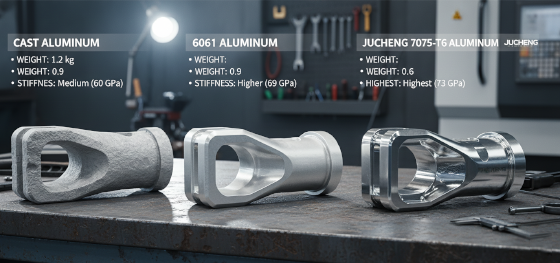
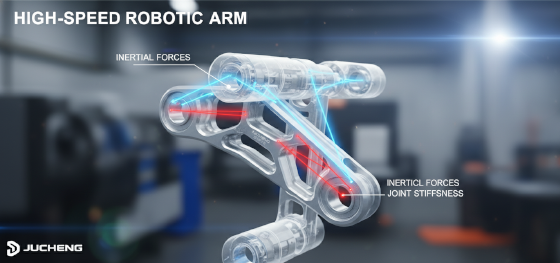
Inertial moments dictate the maximum acceleration limits of any 6-axis robot. In CNC machining robot arm links, every cubic centimeter of unnecessary material is a penalty that slows down the machine. When a robot reaches its full extension, the mechanical advantage shifts in favor of gravity and momentum; a heavy link creates a massive cantilever effect that can stress the J2 and J3 axis gearboxes to their breaking point. JUCHENG utilizes topology optimization data to remove material from neutral-axis zones, ensuring that the link is rigid only where the stress is highest.
Structural stiffness is non-negotiable for high-speed repeatability. If an arm link exhibits elastic deformation during an emergency stop or a rapid reversal, the vibration will propagate down the kinematic chain, causing "overshoot" at the end-effector. This is particularly critical for robots performing delicate tasks like silicon wafer handling or surgical assistance. By utilizing 5-axis CNC machining, JUCHENG carves organic internal ribs that provide maximum torsional resistance while maintaining a skeletal external profile, effectively "tuning" the arm segments for high-frequency stability.
Resonant frequencies must be managed at the link level. A thin-walled arm link can act as a tuning fork, amplifying the harmonic noise of the servo motors. JUCHENG’s manufacturing process involves varying wall thicknesses and strategic dampening features to move the link’s natural frequency far outside the robot’s operating envelope. This ensures that the robot remains silent and stable even during the most aggressive move-sets, preventing the jitter that can lead to sensor errors or dropped payloads in a high-speed production line.
Precision at the joint interface is the final pillar of stiffness. An arm link is only as stable as its connection to the joint housing. JUCHENG machines the mounting flanges for these links with extreme parallelism standards (+/- 0.01mm) to ensure that the bolted joint acts as a monolithic structure. This eliminates the microscopic "play" that can develop into a massive mechanical failure after several million cycles, ensuring that the industrial robot parts we produce maintain their kinematic integrity for the duration of their 10-year service life.
Comparative Data: Aluminum Alloys for Robot Kinematics
Selecting the right aluminum grade is the most significant factor in arm link performance. While 6061 is common, it often lacks the Young's Modulus required for high-acceleration industrial bots. Jucheng Precision provides technical consultations to help you navigate the trade-offs between yield strength, weight, and machinability. The following table compares the primary materials used in high-performance CNC machining robot arm links for the [2026] automation market.
| Material Grade | Yield Strength (MPa) | Elastic Modulus (GPa) | Kinematic Advantage |
|---|---|---|---|
| 7075-T6 Aluminum | 500 - 540 | 71.7 | Maximum Stiffness-to-Weight |
| 6061-T6 Aluminum | 240 - 270 | 68.9 | Cost-Effective / Standard |
| Cast Aluminum (A356) | 160 - 200 | 72.4 | High Vibration Dampening |
| Carbon Fiber (Hybrid) | 600+ | 150 - 230 | Ultra-Low Inertia |
7075-T6 Aluminum is the preferred choice for robot arm links because its yield strength is comparable to many steels while remaining one-third the weight. This allows JUCHENG to machine ultra-thin-walled links that can still handle the crushing torque of a 50kg payload at full extension. In our Shenzhen hub, we utilize specialized high-speed spindles to process 7075 with zero thermal distortion, ensuring that the crystalline structure of the alloy remains intact for maximum fatigue resistance.
Cast Aluminum (A356) is often used for the larger, lower-axis links where vibration dampening is more important than absolute weight reduction. The casting process allows for complex internal webbing that is difficult to CNC machine. JUCHENG provides secondary CNC machining for these castings, refining the joint interfaces and bearing seats to micron-level accuracy. This hybrid approach—combining the dampening of cast parts with the precision of CNC milling—provides the ideal foundation for the "heavy lifters" of the industrial robot world.
Hollow-Core Machining: Lightweighting through 5-Axis CNC
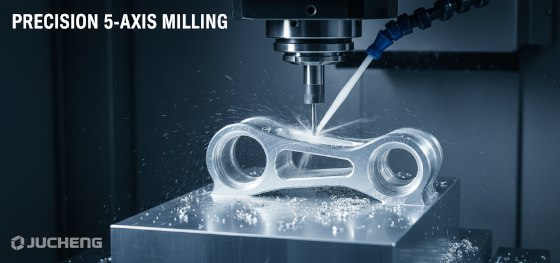
Achieving a "hollow-core" design in a solid metal link is the ultimate test of CNC machining robot arm links. Every gram of material removed from the interior center-line of the link reduces inertia without significantly impacting torsional stiffness. JUCHENG utilize 5-axis CNC machines to "undercut" the internal cavities of arm links, creating a skeletal structure that is both light and incredibly strong. This process requires advanced tool-path strategies to maintain a constant wall thickness, preventing localized weak spots that could lead to fatigue failure.
Structural "honeycomb" or lattice internal features are becoming standard in [2026] robot designs. By hollowing out the link and leaving a network of reinforcing ribs, JUCHENG creates segments that act like aerospace wings. This hollowing process also creates natural "thermal chimneys" that help dissipate the heat generated by the high-duty-cycle servo motors located at the joints. Cooling is often the limiting factor in robot speed; a well-machined link acts as a passive radiator, allowing the motors to run at higher peak currents without overheating.
Thin-wall machining requires extreme care to prevent "chatter" or dimensional drift. As the wall of the link becomes thinner, the metal becomes more prone to vibrating under the force of the cutting tool. JUCHENG utilizes specialized high-frequency dampening tool holders and custom clamping jigs to ensure that even at 2mm wall thicknesses, we maintain +/- 0.02mm tolerances. This level of precision is essential for ensuring that the link remains perfectly balanced, preventing the asymmetrical loads that can lead to premature joint bearing wear.
Internal stress relief is the final step in the hollow-core process. Removing such a large volume of material from a solid billet can release internal stresses that cause the link to warp. JUCHENG utilizes multi-stage machining cycles—roughing, aging, and then final finishing—to ensure that the link remains straight and true. A warped link is a disaster for robot kinematics; it forces the software to compensate for a geometric error, leading to increased compute load and reduced accuracy. Our Shenzhen hub ensures that every link is a "perfect cylinder" for the kinematic model.
Integrated Routing: Machining Channels for Nerves and Air
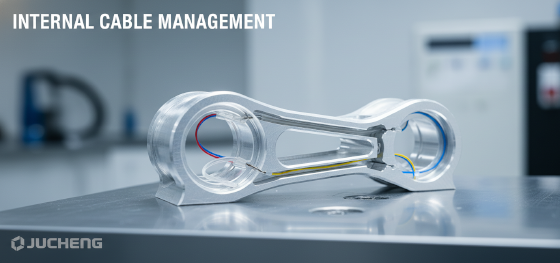
Modern industrial robots are packed with "nerves" (high-speed data cables) and "veins" (pneumatic lines for end-effectors). In the past, these were often draped externally, where they could snag or wear through. Current standards in CNC machining robot arm links demand internal routing to protect these critical lines from the industrial environment. JUCHENG machines complex internal channels and access ports into the links, allowing cables to pass through the center of the joints. This reduces cable fatigue and significantly extends the mean-time-between-failures (MTBF) for the entire robotic system.
Surface finish inside these routing channels is a critical, often-overlooked detail. If the internal passage has sharp burrs or rough machining marks, it will act like a saw against the cable insulation during millions of flex cycles. JUCHENG utilizes specialized abrasive flow machining or manual deburring to ensure all internal passages are smooth to the touch. This prevents the "hidden" electrical shorts that can ground an entire production line, ensuring that the industrial robot parts we provide are as safe for the cables as they are strong for the load.
Integrated mounting features for "energy chains" are also machined directly into the links. By providing precision-tapped holes and recessed seats for cable carriers, JUCHENG allows for a much tighter, more compact robot profile. This is essential for collaborative robots (cobots) that must operate in cramped electronics assembly lines where space is at a premium. Our CNC process ensures that these mounting points are perfectly aligned with the robot's kinematic path, preventing any interference between the cables and the robot's own structure during extreme move-sets.
Modular link extensions are another innovation JUCHENG supports. We machine precision "plug-and-play" interfaces on the ends of the arm links, allowing robot manufacturers to offer variable arm lengths using the same base segments. This modularity requires sub-micron tolerances on the mating faces and dowel pin holes to ensure that the arm remains perfectly rigid even when extended to its maximum limit. JUCHENG’s industrial robot parts facility provides the repeatability necessary to make this "modular kinematic" strategy a reality for the 2026 factory floor.
JUCHENG: Engineering the Lightweight Foundation of Motion
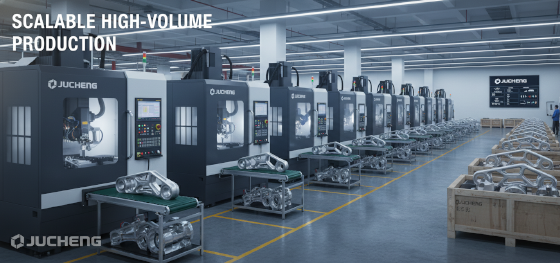
Dominating the high-speed automation market requires a partner that can bridge the gap between material science and heavy-duty manufacturing. Jucheng Precision operates with a 24/7 manufacturing mindset in our Shenzhen precision manufacturing hub, delivering lightweight arm links and structural industrial robot parts with lead times as fast as 15 business days. We provide a "Bridge to Production" that allows you to move from a single 3D-printed prototype to a commercial deployment of 1,000 arm links with consistent metallurgical and kinematic quality.
Integrating your kinematic design with JUCHENG’s expertise ensures that your robot survives the "First-Million Cycle" test and moves into mass adoption. We offer comprehensive DFM reviews within 24 hours, identifying potential vibration bottlenecks or weight-reduction opportunities in your link design before they become field failures. Whether you are building a delta robot for food packaging or a 6-axis giant for automotive welding, Jucheng Precision provides the lightweight skeletons that keep your innovation moving through the high-speed cycles and the years of hard labor.
Our facility is equipped with high-speed 5-axis CNC units and specialized metrology labs, allowing us to manage the entire link lifecycle from raw alloy billet to finished, verified assembly. We manage the complexity of hollow-core machining so your engineering team can focus on the path-planning and the AI. By combining Shenzhen's speed with industrial-grade material verification, JUCHENG remains the preferred partner for the world's most aggressive industrial robot parts challenges. Contact us today to start your next project.
FAQ: Manufacturing High-Performance Robot Arm Segments
Why is 7075-T6 better than 6061 for robot arm links?
7075-T6 offers nearly double the yield strength, allowing for much thinner wall sections and lower inertia while maintaining rigidity.
How do you ensure cables don't snag inside a hollow link?
We utilize specialized deburring and internal polishing to ensure a mirror-smooth finish on all internal routing channels.
Can JUCHENG machine links for 200kg+ payload robots?
Yes. We utilize heavy-duty 5-axis mills and high-strength alloys or castings to handle extreme torsional loads.
What is the typical wall thickness for a collaborative robot link?
Depending on the load, we can machine arm links with wall thicknesses as low as 1.5mm to 2.5mm for cobots.
How do you verify the straightness of a long robot link?
We use coordinate measuring machines (CMM) and laser trackers to verify GD&T standards across the entire length of the part.
Inertial fatigue in industrial robotics is an absolute hardware killer. Partnering with Jucheng Precision ensures that your arm segments are built with the high-strength 7075-T6 aluminum and specialized hollow-core machining techniques the industry demands. Reach out to our Shenzhen manufacturing hub today for a complete DFM review and build the lightweight foundation your autonomous fleet requires.

