


Manufacturing is essentially a game of rotation. Every component ever carved from a solid block of metal or plastic owes its existence to a fundamental decision made at the very beginning of the production cycle: which element will spin? In the diverse landscape of the cnc machining process, this question splits the world into two primary mechanical religions. On one side, you have the versatile power of the milling cutter; on the other, the relentless precision of the lathe. This is the technical heart of cnc milling vs cnc turning.
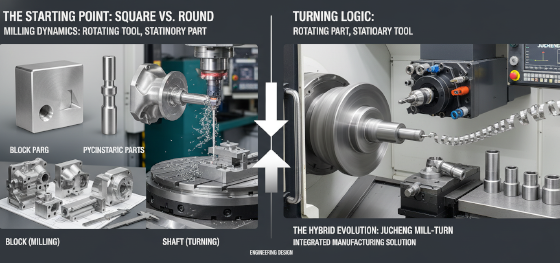
At Jucheng Precision, we don't view these technologies as competing forces, but as a complementary arsenal. We understand that for a designer, the choice isn't just about how the part looks—it is about the physics of the cut, the orientation of the grain, and the ultimate economy of the cycle time. Selecting the wrong primary process can lead to excessive tool wear, poor surface finishes, or a price point that renders a project unviable. This guide explores the mechanical foundations, geometric advantages, and the modern hybrid evolutions that define how JUCHENG translates your digital vision into physical reality.
Success in manufacturing requires more than just high-speed spindles; it requires a deep respect for the material's encounter with the tool. Whether you are building a complex aerospace housing or a high-precision medical pin, the 1300-word journey through the rotational divide begins here. Let let let us examine the pillars of subtractive motion and see how they redefine the integrity of your designs.
Milling Dynamics: The Power of the Rotating Tool
Turning Logic: The Precision of the Rotating Workpiece
Geometric Strengths: Prismatic vs. Cylindrical Dominance
The Hybrid Evolution: Mill-Turn and Multi-Tasking
JUCHENG’s Selection Logic: Unbiased Process Planning
Milling Dynamics: The Power of the Rotating Tool
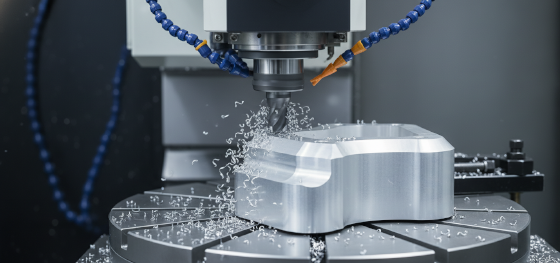
In a CNC milling center, the part is the silent partner. It is securely clamped to the machine bed or held in a precision vice, remaining stationary relative to the machine’s primary axes. The "action" comes from the spindle, which rotates a multi-point cutting tool at speeds ranging from a few hundred to over 24,000 RPM. As the tool moves in X, Y, and Z directions (and sometimes A and B axes in our 5-axis centers), it "nibbles" away material to reveal the part’s geometry. This is the fundamental mechanic of cnc milling vs cnc turning for complex, non-cylindrical parts.
Milling is essentially a high-frequency impact process. Each flute of the end mill strikes the material, creates a chip, and then rotates out of the cut to cool down before striking again. This intermittent cutting action is excellent for managing heat, but it introduces a specific surface texture—the scallop or tool mark. At Jucheng Precision, we leverage the versatility of milling for parts with "prismatic" features: flat faces, deep pockets, slots, and complex 3D contoured surfaces like impellers. Because the tool can approach the part from virtually any angle, milling is the undisputed king of geometric freedom. It is the architect's choice for components that look like blocks, housings, or irregular structural frames. If your part has pockets inside of pockets, or complex holes that are not on a central axis, it belongs on one of our high-speed machining centers.
Turning Logic: The Precision of the Rotating Workpiece
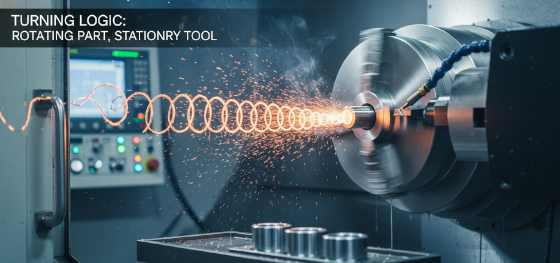
CNC turning flips the script. Here, the material is the protagonist, rotating at high velocity while the cutting tool remains relatively fixed in a turret. The tool—usually a single-point carbide insert—is pushed into the spinning workpiece to peel away layers of metal in a continuous, smooth motion. This continuity is the defining characteristic of cnc milling vs cnc turning when it comes to cylindrical accuracy. Because the cut is never interrupted, turning can achieve circularity and concentricity that a milling machine simply cannot match.
The physics of turning are optimized for symmetry. When we machine a long shaft, a precision bolt, or a tapered bushing at Jucheng Precision, the lathe’s ability to maintain a perfectly centered rotation ensures that the part remains true over its entire length. Turning also excels at creating high-quality external and internal threads. Because the tool moves in a linear path while the part spins at a coordinated speed, the thread pitch is perfectly consistent. The continuous chip produced in turning also allows for incredible surface finishes (Ra 0.8 or better) without the need for secondary grinding. If your part features a central axis of symmetry—if it is essentially a "round" object—turning is almost always the most efficient and precise path to completion. It is the specialist’s choice for everything from tiny medical probes to massive industrial axles.
Geometric Strengths: Prismatic vs. Cylindrical Dominance

The decision matrix for cnc milling vs cnc turning is primarily driven by the part’s CAD geometry. At Jucheng Precision, our engineers perform a "Geometric Audit" on every design. If the part is "Prismatic"—meaning it is defined by flat planes, 90-degree corners, and internal cavities—milling is the native language. Milling centers can handle large plates and blocks that would be physically impossible to spin safely on a lathe. They provide the reach and the multi-axis movement needed to carve into the "hidden" areas of a part, such as internal cooling channels or complex mounting brackets.
Turning, conversely, owns the "Cylindrical" world. If a part can be rotated on an axis, it should be turned. The speed of material removal on a lathe for round features is often three to four times faster than a mill attempting to interpolate the same circle. Beyond speed, there is the issue of "Runout." On a lathe, the bore and the outer diameter are cut in the same setup, ensuring they are perfectly concentric. On a mill, achieving that same level of concentricity requires expensive fixtures and complex probing cycles. We use this geometric divide to optimize your project’s budget. If we can find a way to turn a feature instead of milling it, we pass those time savings directly to you. Understanding where the square world ends and the round world begins is the first step in a professional cnc machining process plan.
The Hybrid Evolution: Mill-Turn and Multi-Tasking
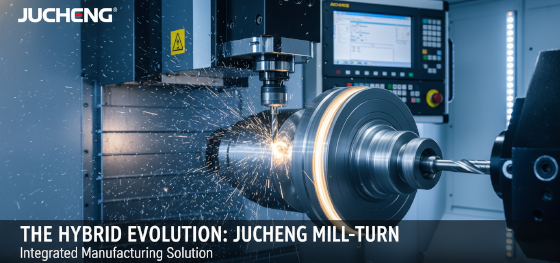
Modern manufacturing is rapidly erasing the traditional borders of cnc milling vs cnc turning. The rise of "Mill-Turn" or Multi-Tasking centers has created a hybrid category that offers the best of both worlds. These machines are essentially high-precision lathes equipped with "Live Tooling"—miniature milling spindles mounted on the turret. This allows Jucheng Precision to perform complex milling operations (like drilling off-center holes, milling flats, or engraving logos) while the part is still held in the turning chuck.
The value of a hybrid cnc machining process cannot be overstated. In traditional manufacturing, a complex part might move from a lathe to a mill, then back to a lathe for secondary finishing. Every time a part is moved and re-clamped, a "tolerance stack-up" occurs. The alignment of the second operation is never as perfect as the first. Our Mill-Turn centers eliminate this risk by completing the entire part in a single setup. "Done-in-One" is our goal for high-precision components. By combining the rotational speed of turning with the geometric flexibility of milling, we achieve a level of feature-to-feature accuracy that is world-class. This hybrid evolution is why JUCHENG is the preferred partner for complex medical devices and high-performance automotive connectors where the geometries are too "round" for a mill but too "complex" for a standard lathe.
JUCHENG’s Selection Logic: Unbiased Process Planning
The final hallmark of a professional manufacturing partner is the ability to choose the process that favors the client’s ROI over the shop’s convenience. At Jucheng Precision, we possess an extensive fleet of both 5-axis machining centers and precision CNC lathes. This means we have no bias. We don't try to force a turned part onto a mill because it's the only machine we have available. Our engineers look at your blueprints and select the path of least resistance—the process that delivers the tightest tolerances for the lowest per-part cost.
We use a simple but rigorous decision framework:
• If the part is 80% cylindrical and 20% milled -> We use a Mill-Turn Lathe.
• If the part has large flat surfaces or deep 3D cavities -> We use a 5-Axis Machining Center.
• If the part is a simple pin or shaft in high volumes -> We use a Swiss CNC Lathe.
• If the part is a complex manifold block -> We use a high-speed Vertical Mill.
By diversifying our technology, JUCHENG ensures that your cnc machining process is optimized for survival in a competitive global market. We don't just cut metal; we engineer the motion that brings your product to life. Whether you need a thousand simple washers or a single complex aerospace manifold, our team is here to guide you through the rotational divide and deliver perfection. Contact Jucheng Precision today for a comprehensive DFM review and experience the clarity that expert process planning can bring to your next precision project.

