


Every physical part begins its life as an idea. A ghost. A digital soul living in a CAD file. But how does this soul get a body? How does it travel from the clean, perfect world of your screen to the hard, physical reality of our factory floor?
This is the story of that journey. It is a look inside the complete cnc machining process. It is more than a list of steps. It is a carefully choreographed dance of software, steel, and human skill.
Let's follow one part, a complex aluminum heatsink, on its journey to becoming real.
Act I: The Mind of the Machine
Act II: The Setup - A Ritual of Precision
Act III: The Dance of Steel
Act IV: The Final Touches
The Final Judgment: The CMM Room
Act I: The Mind of the Machine
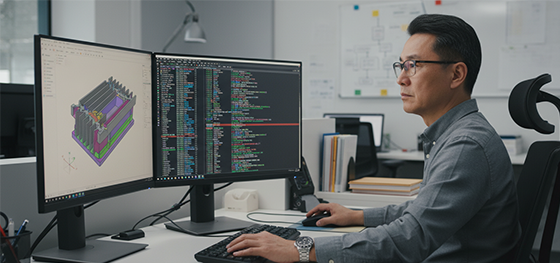
The journey does not start at the machine. It starts in the quiet office of a CAM programmer. This is where your part's digital soul is given its instructions.
A CNC machine cannot understand a 3D model. It only understands a language of coordinates and codes called G-code. The programmer's job is to use special CAM (Computer-Aided Manufacturing) software to translate your design into this language.
This is not an automatic process. It is a strategy game. For our heatsink, the programmer must decide which tool to use for the deep fins. What is the optimal speed to cut the aluminum without it getting too hot? Which surfaces to cut first? This is where experience is critical. A good strategy means a faster, more accurate part. A bad strategy can lead to a broken tool or a scrapped part.
Act II: The Setup - A Ritual of Precision
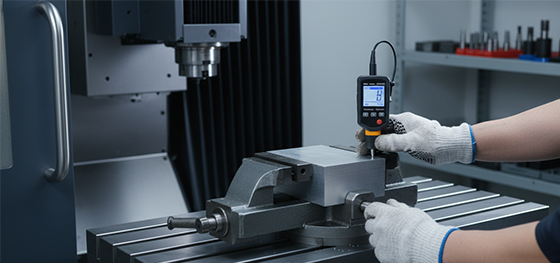
The G-code is ready. Now we move to the factory floor. But we still do not cut any metal. First comes the setup. This is a ritual of absolute precision.
A skilled machine operator takes a raw block of aluminum. They secure it tightly in a vise on the machine's table. Then, they must tell the machine exactly where this block is in 3D space.
Using delicate probes and edge finders, they touch off each face of the block. They find its exact center. This becomes the "work zero," the reference point for the entire machining operation.
They then load all the necessary cutting tools into the machine's tool changer. They precisely measure the length of each tool. A mistake of a fraction of a millimeter here will be a disaster later. This careful, unhurried setup is the foundation of the entire physical process.
Act III: The Dance of Steel

The setup is complete. The operator closes the door. They press the "Cycle Start" button. The dance begins.
The machine comes to life. The spindle spins to thousands of RPM. A flood of coolant begins to pour over the block. The first tool approaches the metal and makes its first cut.
For the next hour, it is a blur of controlled, violent motion. The machine executes the G-code flawlessly. It automatically changes tools. A large tool for roughing out big pockets of material. A small ball-end mill for creating a smooth, curved surface. A tiny drill for the mounting holes.
The raw block of aluminum slowly disappears. What emerges from the storm of coolant and chips is the recognizable shape of our heatsink. This is the core of the CNC Machining process.
Act IV: The Final Touches
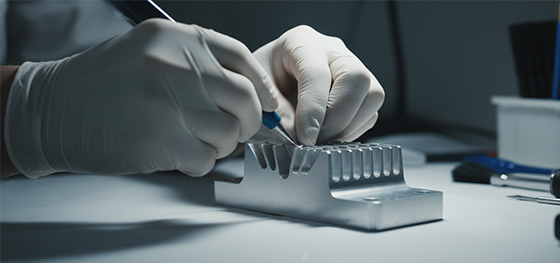
The machine stops. The part is almost finished. But it is not perfect yet. It has a "raw" feel.
The part is removed from the machine. It is covered in coolant and small chips. It is first thoroughly cleaned and dried.
Then, a skilled technician takes over. They inspect every edge under a bright light. The machining process can leave tiny, sharp slivers of metal called burrs. The technician uses special hand tools to carefully remove every single burr. This "deburring" process is critical for safety and for the final appearance of the part.
Our heatsink is now smooth, clean, and safe to handle. Its body is ready.
The Final Judgment: The CMM Room
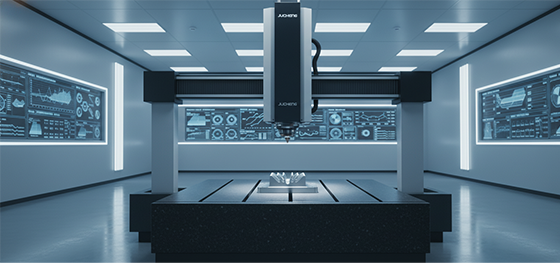
The part looks perfect. But is it? The final act of the journey takes place in a quiet, temperature-controlled room. The quality lab.
Here, the heatsink is placed on the granite table of a CMM (Coordinate Measuring Machine). A ruby-tipped probe, controlled by a computer, gracefully descends. It automatically touches hundreds of points on the part. It measures the diameter of every hole. The flatness of the base. The angle of the fins.
The machine compares these real-world measurements to your original CAD file. It generates a detailed report. Green numbers mean the feature is perfectly within tolerance. Red numbers mean a deviation.
Only after it has passed this final, objective judgment is the part truly finished. Its digital soul now has a physical body that has been verified to be a perfect match. The journey is complete.

