


Manufacturing hardened steel is a high-stakes confrontation with the limits of physics. When a material reaches a hardness of HRC 55 or above, it becomes an abrasive fortress that resists traditional cutting methods. In the modern cnc machining process, the final finishing of these materials is the ultimate test of facility capability. For decades, the industry relied exclusively on the slow, meticulous progress of the grinding wheel. However, advancements in tool coatings and machine rigidity have introduced a powerful challenger. This is the technical standoff of Hard Milling vs Grinding. It is a decision that balances the raw speed and 3D flexibility of the mill against the absolute geometric perfection and mirror-like finishes of the grinder.
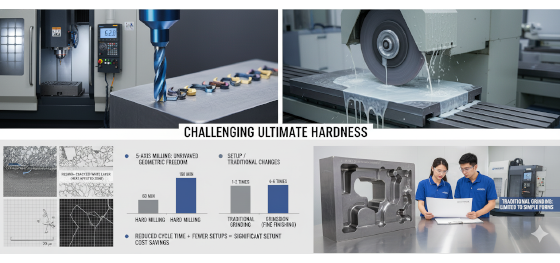
At Jucheng Precision, we don't view these as competing technologies, but as a integrated precision arsenal. We understand that for a complex injection mold or a high-performance aerospace spline, the choice isn't just about how the part looks—it is about managing the thermal impact on the metal's crystalline structure. Hard milling offers the ability to finish complex 3D contours in a single setup, while grinding remains the king of flatness and parallelism. This guide explores the thermodynamic differences, the surface integrity trade-offs, and why JUCHENG utilizes a hybrid approach to ensure your most stubborn alloy components are delivered with world-class accuracy and cost-efficiency.
Efficiency in hardened steel finishing is found in the optimization of material removal rates and surface fatigue life. You cannot simply "force" your way through quenched alloys; you must outsmart them. Whether you are looking to reduce lead times for custom tooling or achieve a sub-micron fit for a surgical instrument, understanding the variables of Hard Milling vs Grinding is essential. Let us examine the technical pillars of high-hardness refinement and see how they redefine the soul of your precision designs.
content:
Hard Milling Dynamics: The Physics of Thermal Removal
Grinding Perfection: The Legacy of Absolute Accuracy
Surface Integrity: Residual Stress vs. Thermal Damage
Geometric Freedom: Navigating 3D Cavities and Undercuts
Economic Realities: Balancing Cycle Time and Tooling Costs
JUCHENG’s Hybrid Standard: The Best of Both Worlds
Hard Milling Dynamics: The Physics of Thermal Removal
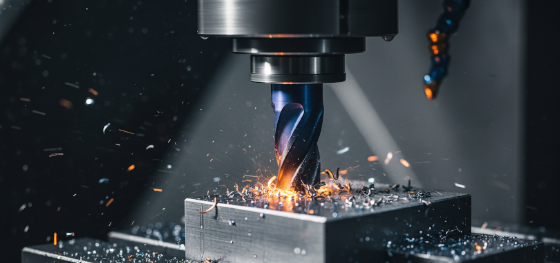
In the comparison of Hard Milling vs Grinding, hard milling is the modern disruptor. It is a process of high-velocity shearing. To cut material that is HRC 60, Jucheng Precision utilizes ultra-rigid CNC centers and specialized carbide or PCBN (Polycrystalline Cubic Boron Nitride) tooling. The physics of hard milling rely on the "Adiabatic Shear" principle. By running at extremely high spindle speeds and specific feed rates, we generate intense heat at the localized shear zone. However, because the tool is in contact for only a fraction of a second, the majority of this heat is transferred into the chip, which turns a characteristic dark blue or purple as it is ejected.
This "Dry Cut" strategy is essential. If you use coolant in hard milling, you risk thermal shock—cracking the expensive tool due to rapid heating and cooling. At Jucheng Precision, we use high-pressure air blasts to clear these hot chips. The primary benefit of hard milling is its versatility. We can use a ball-nose mill to finish a complex 3D mold cavity with a single machine setup. This eliminates the need for EDM (Electrical Discharge Machining) for many features, significantly reducing lead times. Hard milling is the champion of throughput. It allows us to transition from roughing to finishing on a hardened block without ever moving the part, preserving the alignment of features and delivering a surface finish that is often smooth enough for functional use without secondary operations.
Grinding Perfection: The Legacy of Absolute Accuracy
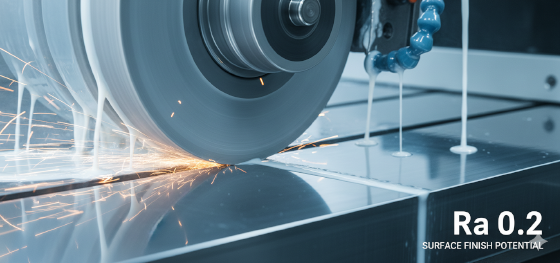
While milling has advanced, grinding remains the ultimate authority on dimensional perfection. In the Hard Milling vs Grinding hierarchy, grinding is a process of microscopic, multi-point abrasion. Instead of a single cutting edge, a grinding wheel features millions of tiny abrasive grains (aluminum oxide, silicon carbide, or diamond) that strike the surface simultaneously. This "gentle" material removal allows for a level of accuracy that a mill struggle to reach. When a design requires a flatness or parallelism tolerance of +/- 0.002mm, the grinder is the only logical choice.
The surface finish of grinding is also superior. While hard milling can reach an Ra 0.4 µm, a precision surface grinder at Jucheng Precision can easily achieve Ra 0.1 µm or better—a true mirror finish. This is essential for sliding surfaces in hydraulic valves and the mating faces of high-pressure seals where any microscopic ridge would cause a leak. Grinding also handles "interrupted cuts"—such as a shaft with a keyway—with more stability than a mill, as the mass of the grinding wheel resists the vibration of the entry and exit. We treat grinding as the final "Surgical Strike" of the cnc machining process. It is reserved for the features where "good enough" is a failure and only absolute zero-deviation is acceptable.
Surface Integrity: Residual Stress vs. Thermal Damage
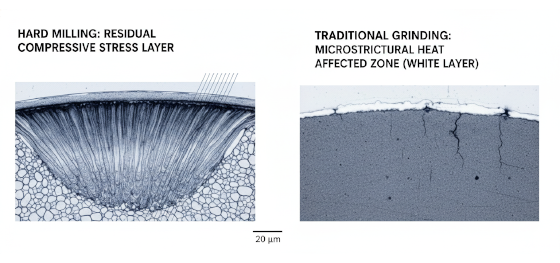
A surface that looks perfect can still be structurally damaged. This is the "Invisible Factor" in the Hard Milling vs Grinding debate. When you grind a hardened part, the friction of the abrasive wheel generates significant heat. If the coolant flow is not perfect or the wheel is "loaded" with debris, this heat can cause "Grinding Burn." This is a localized re-tempering of the metal that creates a brittle, white layer on the surface. Under high cyclic loads, this white layer can lead to surface cracking and premature failure of the component.
Hard milling offers a distinct advantage in surface integrity. Because the shearing action is so fast and the heat is carried away in the chip, the substrate remains cool. More importantly, hard milling induces a layer of compressive residual stress on the part’s surface. In the world of mechanical engineering, compressive stress is your best friend—it acts like an invisible shield that prevents cracks from starting. For aerospace splines and engine gears that must survive millions of high-torque cycles, the "peening" effect of hard milling can actually increase the part's fatigue life compared to a ground surface. At Jucheng Precision, we use microscopic analysis to audit the surface integrity of our hardened parts, ensuring that the finish we provide strengthens your design rather than weakening it.
Geometric Freedom: Navigating 3D Cavities and Undercuts
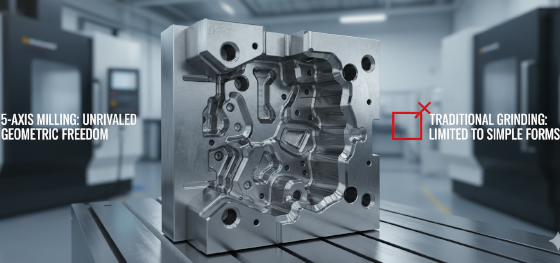
Geometry is often the final decider between Hard Milling vs Grinding. Grinding is geographically limited. It excels at "open" geometries: flat surfaces, cylindrical diameters, and simple tapers. But if your part features a complex 3D pocket, a deep internal radius, or an intricate logo engraved into a hardened die, a grinding wheel is physically too large to fit. In the past, these features had to be made using EDM, which is slow and expensive.
Jucheng Precision utilizes 5-axis hard milling to bypass these geometric bottlenecks. We can tilt the part and the tool to reach into deep corners and create complex organic shapes in hardened metal that a grinder could never touch. This geometric freedom allows engineers to design more efficient cooling channels in injection molds and more compact structural nodes in aerospace hardware. By using small-diameter carbide tools (down to 0.5mm) in our high-speed mills, we can carve details into HRC 62 tool steel with the fluidity of a 3-axis prototype mill in aluminum. This capability is what enables JUCHENG to deliver "High-Complexity, High-Hardness" parts that most shops simply find impossible.
Economic Realities: Balancing Cycle Time and Tooling Costs
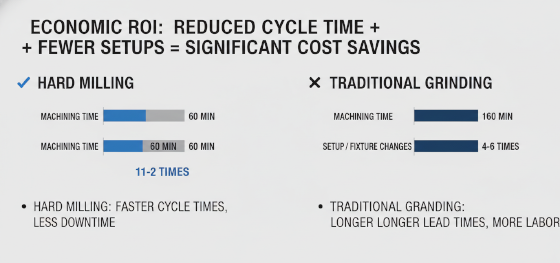
From an ROI perspective, the Hard Milling vs Grinding choice is a balance of machine time and consumable cost. Grinding is slow. It takes many small passes to reach a dimension, and the setup time for a precision grinder is significant. However, grinding wheels are relatively inexpensive and can be "dressed" to restore their shape thousands of times. For simple flat plates or shafts in high volumes, grinding often wins on the per-part price.
Hard milling is fast. It can remove material up to 5 times faster than grinding. But the "fuel" for this speed is expensive. High-end TiSiN-coated carbide end mills designed for HRC 60 steel can cost hundreds of dollars and may only last for 30 minutes of actual cutting time. At Jucheng Precision, we perform a "Cycle vs. Tool" analysis for every quote. If we can save four hours of machine time by using one $200 tool, the hard milling path is the clear winner for our client’s budget. We optimize our tool paths to utilize the full length of the cutter, maximizing tool life and ensuring that the "Speed Premium" of hard milling translates into actual savings for your project.
JUCHENG’s Hybrid Standard: The Best of Both Worlds
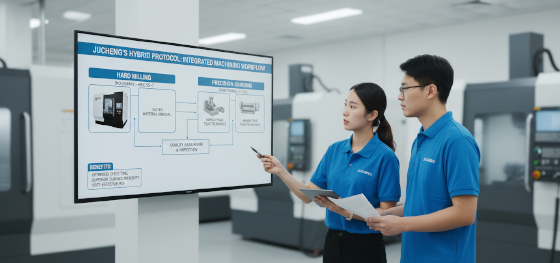
The most successful hardened steel components are not made with one process—they are made with a technical harmony. At Jucheng Precision, we operate a hybrid cnc machining process that exploits the strengths of both worlds. We often utilize hard milling for the "Heavy Lifting"—roughing out the hardened geometry and finishing the complex 3D surfaces where speed and reach are vital. We then move the part to a precision grinder for the "Final Kiss"—removing the last 0.01mm from critical mating faces to ensure absolute flatness and a mirror finish.
This integrated approach eliminates the accountability gaps that occur when a part moves between different vendors. We provide full material traceability and CMM verification for every stage of the process. When you receive a component from JUCHENG, it is a finished engineered masterpiece, verified for both surface integrity and dimensional perfection. Whether you are building an innovative medical device or a high-performance industrial mold, let our expertise in Hard Milling vs Grinding armor your engineering. Contact Jucheng Precision today for a comprehensive DFM review and see how our dual-finishing protocols can clarify and secure your next hardened steel challenge.

