


Size is often the most deceptive variable in a manufacturing facility. To the casual observer, a machine that moves quickly over a large area seems more capable than a smaller, slower box. However, in the world of high-precision engineering, the choice of equipment is a fundamental trade-off between scale and rigidity. This is the heart of the cnc router vs mill debate. One is a high-speed distance runner designed to cover vast sheets of material; the other is a heavy-duty powerlifter built to carve through the toughest alloys with micron-level accuracy.
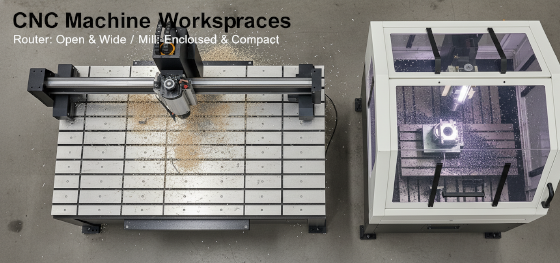
At Jucheng Precision, we integrate both technologies into our cnc machining process to provide a holistic manufacturing solution. We understand that selecting the wrong machine platform doesn't just waste time—it ruins the part's integrity. If you attempt to mill a massive aerospace plate on a compact machining center, your cycle times skyrocket. If you try to hold aerospace tolerances on a standard gantry router, the part will vibrate out of spec. This guide explores the structural physics, material boundaries, and economic realities of these two essential machine tools, helping you understand where your design fits on the production floor.
Choosing the right machine tool is the first step toward project success. It is a decision that impacts every downstream operation, from surface finish to final assembly. Let us move beyond the surface-level similarities to examine the technical pillars that separate the router from the mill.
Gantry vs. C-Frame: Structural Engineering Logic
Material Compatibility: Soft Polymers to Hard Alloys
Accuracy Thresholds: Microns vs. Millimeters
Spindle Dynamics: High RPM vs. High Torque
Technical Comparison Table: Router vs. Mill
JUCHENG’s Integrated Approach: Scaling for Success
Gantry vs. C-Frame: Structural Engineering Logic
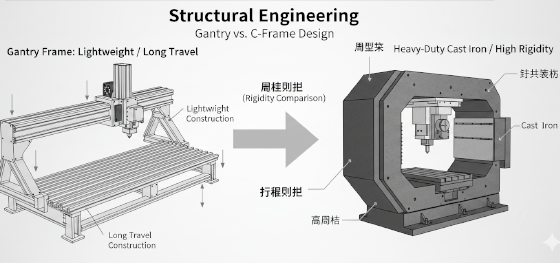
The primary difference in the cnc router vs mill comparison begins with the skeleton of the machine. A CNC Router is almost always built on a Gantry system. In this architecture, a bridge moves across the workbed, carrying the spindle along the X and Y axes. This design is optimized for a massive work envelope. It allows us to process six-meter long aluminum extrusions or four-by-eight-foot plastic sheets. However, because the bridge is often a lightweight steel or aluminum extrusion itself, it lacks the raw mass required to dampen heavy cutting vibrations. The router is built for speed and reach, not for fighting back against high cutting forces.
The CNC Mill utilizes a C-Frame or Bridge architecture, where a stationary column holds the spindle and the part moves beneath it on a heavy, cast-iron table. At Jucheng Precision, our milling centers weigh several tons, with massive internal ribbing designed specifically to absorb the kinetic energy of a tool carving into steel. This rigidity is the "secret sauce" of the mill. It allows the machine to maintain its position within microns even when a large-diameter cutter is taking a heavy bite. While the mill is limited in travel—rarely exceeding two meters in a standard setup—its ability to maintain structural stillness under load makes it the only logical choice for high-precision 3D parts. The router "skims" the surface of large sheets, while the mill "plows" through the bulk of solid blocks.
Material Compatibility: Soft Polymers to Hard Alloys
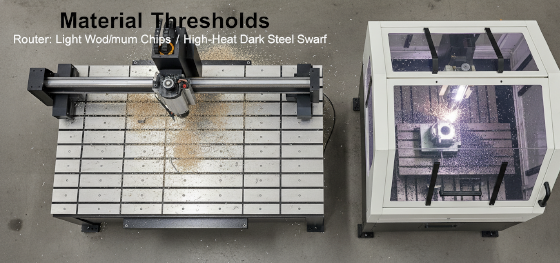
Materials dictate the machine selection in the cnc router vs mill hierarchy. Because of its lighter structural build, a router is primarily intended for "soft" materials. We utilize our CNC routers for thin-gauge aluminum sheets, plastics like Acrylic and Delrin, and medium-density wood or foam. In these materials, the cutting forces are low, and the high-speed movements of the gantry can be fully exploited to reduce cycle times. Attempting to cut stainless steel or titanium on a router is an exercise in frustration; the lack of rigidity leads to tool chatter, which snaps carbide bits instantly and leaves a surface finish like a gravel road.
The CNC Mill is the master of the "Hard Material" world. It possesses the torque and the dampening required to process tool steel, titanium, and heat-resistant superalloys. Because the cnc machining process in hard metals generates massive thermal loads and physical pressure, the mill’s heavy cast components prevent the material from "pushing back" and knocking the machine out of alignment. Jucheng Precision uses our high-rigidity mills for complex structural nodes and engine components where the material's yield strength is a constant threat to precision. If your part is made of metal thicker than 6mm and requires complex internal features, the mill is the engineering standard.
Accuracy Thresholds: Microns vs. Millimeters
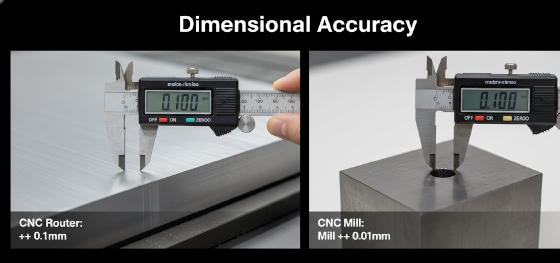
Precision is a matter of degree. In large-scale sheet fabrication, a tolerance of +/- 0.1mm (0.004 inches) is considered exceptional. This is the domain where the CNC Router thrives. Because the gantry must move over large distances, factors like rack-and-pinion wear or bridge flex prevent it from achieving extreme accuracy. It is the perfect tool for enclosures, signs, and structural panels where the fitment is relatively loose.
When your design involves +/- 0.01mm (0.0004 inches) tolerances, the conversation moves exclusively to the mill. In the cnc router vs mill battle for precision, the mill’s use of high-resolution linear scales and massive ground ball screws gives it a level of resolution a router simply cannot match. At Jucheng Precision, we use our mills for bearing seats, press-fit assemblies, and optical housings where even a single micron of deviation can lead to system failure. We verify these tolerances using our in-house CMM, ensuring that the machine's rigidity has been translated into a verified physical reality. Choosing a router for a high-precision bore is an expensive mistake; choosing a mill for a large aesthetic panel is a waste of machine time. We guide our clients to the machine that satisfies the tolerance without inflating the price.
Spindle Dynamics: High RPM vs. High Torque
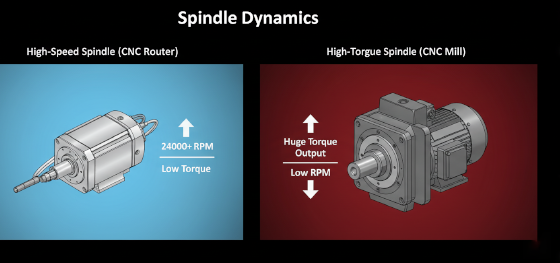
The "heart" of any CNC machine is the spindle, and the difference here is profound. A CNC Router typically uses a high-speed spindle, often reaching 18,000 to 30,000 RPM. These spindles are designed for "low-torque, high-velocity" material removal. They utilize smaller collets (ER-style) and are meant to nibble away at soft materials very quickly. This high RPM is essential for achieving a clean edge finish on plastics without melting them, as it allows the tool to take thousands of tiny bites every second.
A CNC Mill uses a "low-speed, high-torque" spindle, generally topping out at 8,000 to 12,000 RPM (though high-speed options exist). These spindles utilize robust taper systems like BT40 or CAT40, which provide a massive mechanical lock between the machine and the tool. This allows Jucheng Precision to take "heavy cuts" in hard alloys—removing large amounts of steel in a single pass. A router spindle would stall instantly under these loads. By understanding the dynamics of the spindle, we can match the cutter to the material's resistance, ensuring that the cnc machining process is both efficient and safe. We use the router's speed for surface aesthetics and the mill's torque for structural creation.
Technical Comparison Table: Router vs. Mill
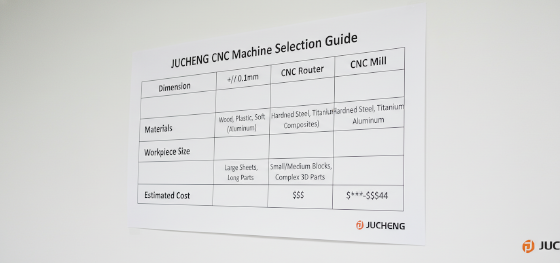
To simplify your manufacturing strategy, Jucheng Precision has developed a definitive comparison matrix. We use this logic internally to assign parts to the correct department, ensuring maximum ROI for our clients.
| Feature | CNC Router | CNC Mill |
|---|---|---|
| Architecture | Gantry (Moving Bridge) | C-Frame (Moving Table) |
| Primary Materials | Plastics, Aluminum Sheet, Wood | Steel, Titanium, Brass, Solid Blocks |
| Accuracy | +/- 0.1mm (Standard) | +/- 0.005mm (Precision) |
| Work Volume | Very Large (Up to 4m+) | Limited (Usually under 2m) |
| Z-Axis Clearance | Shallow (Usually under 300mm) | Deep (Up to 1m+) |
JUCHENG’s Integrated Approach: Scaling for Success
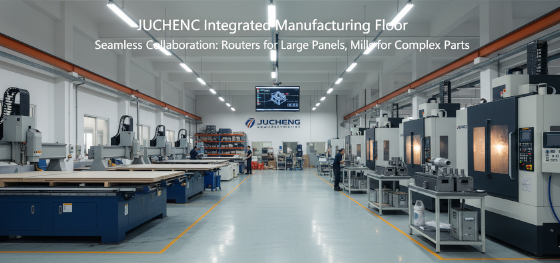
The modern supply chain is about versatility. At Jucheng Precision, we eliminate the need for you to choose between two different vendors. We operate as an integrated hub where routers and mills work in harmony. For a single product, we might use a CNC router to cut the large aluminum exterior panels and a 5-axis mill to manufacture the intricate internal locking mechanisms. This unified cnc machining process ensures that the tolerances of the small parts match the scale of the large ones perfectly.
Our engineers don't just "hit go" on a machine; they act as process planners. We look at your CAD drawings and identify where a router can save you money and where a mill must be used to preserve quality. We maintain over 150 CNC machines, providing us with the capacity to handle high-volume sheet work and ultra-low-volume hard-metal prototypes simultaneously. When you receive a shipment from JUCHENG, you are getting the benefit of optimized machine selection—ensuring your parts are as light as a router can make them and as precise as a mill can guarantee. Contact Jucheng Precision today for a comprehensive DFM review and see how our integrated machining protocols can clarify your next manufacturing challenge.

