


A hole is never just a hole in the world of precision manufacturing. It is a functional interface that defines the soul of a mechanical assembly. If you are designing a part where a shaft must glide with zero friction or a bearing must press-fit with micron-level certainty, the deceptive simplicity of a circular aperture becomes your greatest technical challenge. Most designers start by asking for a hole, but an experienced machinist at Jucheng Precision starts by asking about the tolerance. This fundamental question leads us directly to the technical crossroads of drilling vs boring vs reaming.
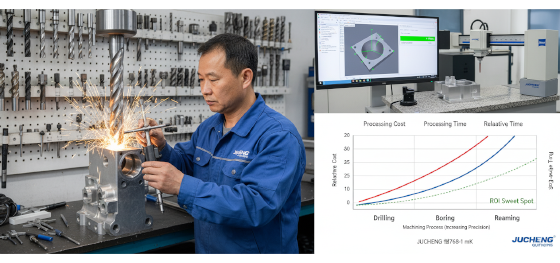
In the broader scope of the cnc machining process, creating an internal diameter is a multi-stage evolution. You cannot leap directly to a mirror-finished H7 bore without following a disciplined path of material removal. Each step in this trilogy—drilling, boring, and reaming—serves a specific structural purpose: the first creates space, the second defines geometry, and the third locks in the dimension. This guide explores the mechanical nuances of these three pillars, helping you understand when to accept the economy of a drill and when to demand the surgical precision of a reamer.
Efficiency in production is found in the balance of these operations. Over-engineering a hole leads to wasted budget, while under-engineering leads to catastrophic assembly failure. Let us examine the technical foundations of hole-making and how JUCHENG translates these processes into perfect mechanical fits.
Drilling: The Violent Birth of an Aperture
Boring: Correcting the Geometric Path
Reaming: The Surgical Finish for Tight Fits
The Accuracy Paradox: Balancing Precision and ROI
JUCHENG’s Metrology: Verification via CMM
Drilling: The Violent Birth of an Aperture
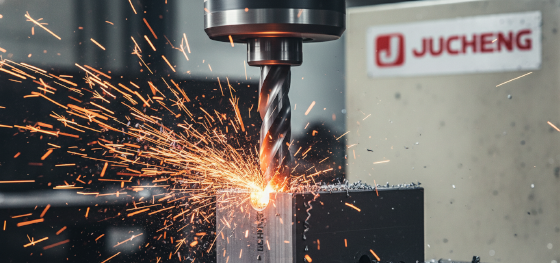
In the sequence of drilling vs boring vs reaming, drilling is always the first move. It is a high-energy, high-force operation designed for one thing: rapid material removal. A standard twist drill features two cutting edges that converge at a point. As the spindle drives this tool into the metal, it creates a hole from solid stock. However, drilling is inherently imprecise. Because the drill bit is long and relatively flexible, it is susceptible to "walking" or wandering as it enters the material. The resulting hole is rarely perfectly straight and often slightly oversized due to the vibration of the cutting flutes.
Furthermore, the surface finish of a drilled hole is rough, typically ranging from Ra 3.2 to 6.3 µm. This is acceptable for a clearance hole for a bolt, but it is a disaster for a bearing seat. The exit of a drilled hole often features a heavy burr because the tool "pops" through the final layer of metal. At Jucheng Precision, we use high-performance carbide drills with through-spindle coolant to minimize these issues, but we never rely on a drill for a precision fit. We view drilling as the "roughing" phase—it creates the vacancy that we will later refine. If your part only requires a simple hole with a +/- 0.2mm tolerance, drilling is the most cost-effective path. But if the physics of your assembly demand more, the drill is just the beginning of the journey.
Boring: Correcting the Geometric Path
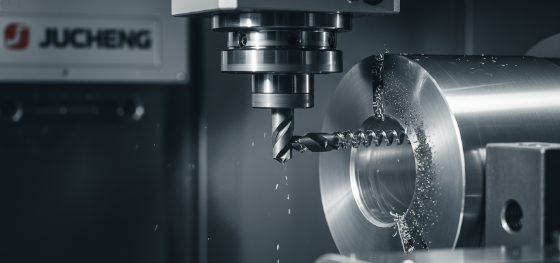
If drilling is the blunt instrument, boring is the corrective lens. In the drilling vs boring vs reaming hierarchy, boring is the process used to enlarge an existing hole while correcting its geometric center. Unlike a drill, which follows its own point, a boring bar is a single-point cutting tool that behaves like an internal lathe. Because the tool is offset from the spindle center, it carves a path that is perfectly concentric with the machine's axis of rotation. If a pre-drilled hole has wandered by 0.1mm, a boring operation will bring it back to the true position.
The primary value of boring is geometric truth. It ensures the hole is perfectly round and perfectly straight. This is vital for long internal bores in the cnc machining process, where any taper would cause a shaft to bind. At Jucheng Precision, we utilize digital boring heads that can be adjusted in increments of 0.002mm. This allow us to hit precise diameters that standard drills simply cannot achieve. Boring also improves the surface finish significantly over drilling, reaching an Ra 1.6 µm range. It is the mandatory step for any part that features a heavy press-fit or a complex internal step that must be perfectly aligned with an outer diameter. We treat boring as the bridge between raw creation and surgical refinement, ensuring that the "location" of your hole is as accurate as its size.
Reaming: The Surgical Finish for Tight Fits
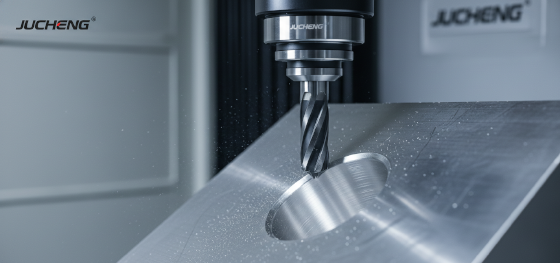
The final tier of the drilling vs boring vs reaming trilogy is reaming. If boring defines the position, reaming defines the perfection. A reamer is a multi-edged finishing tool designed to remove a very small amount of material—typically between 0.1mm and 0.3mm from the diameter. Because it has multiple straight or helical flutes, it provides a highly stable cutting action that produces an incredibly smooth surface finish, often Ra 0.8 µm or better. This is the process JUCHENG uses to achieve H7 or H8 tolerances, where the allowable margin of error is thinner than a human hair.
However, reaming has a critical limitation: it cannot correct the position of a hole. A reamer will follow the path of the existing bore. This is why the sequence is so important. If you ream a hole that was poorly drilled without boring it first, you will end up with a smooth, perfectly sized hole that is in the wrong place. At Jucheng Precision, we combine these technologies into a seamless workflow. We drill to create the void, bore to ensure the location and straightness, and finally ream to lock in the final, mirror-finished diameter. This three-stage protocol is how we deliver medical-grade components that require an exact sliding fit. Reaming is the surgical strike of the machining world—it is fast, predictable, and delivers the consistent sizing needed for high-volume precision assembly.
The Accuracy Paradox: Balancing Precision and ROI
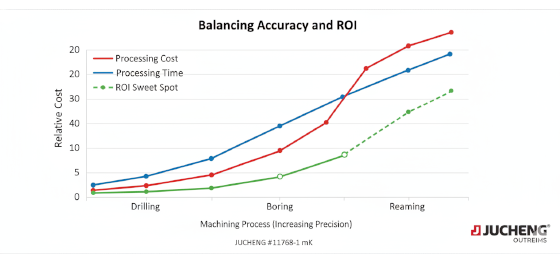
Choosing between drilling vs boring vs reaming is ultimately an economic decision based on the physics of your design. Every additional step in the hole-making process adds cycle time and tooling cost. A drilled hole is the cheapest; a reamed hole is the most expensive. The "Accuracy Paradox" in manufacturing is that 90% of a part's cost can be driven by the final 10% of its tolerance requirements.
During our DFM (Design for Manufacturing) reviews, JUCHENG engineers look for opportunities to optimize this balance. If a part is a simple structural bracket, we suggest staying with drilling to save you money. But if the part is a high-speed rotating housing, we mandate the boring and reaming sequence to ensure safety and performance. We also utilize modern "Interpolation Milling" as a flexible alternative to boring for large diameters, using our high-speed 5-axis machines to spiral a mill into a hole with extreme precision. This technical flexibility allows us to offer the most cost-effective path to your desired quality. By understanding the diminishing returns of precision, we help you invest your budget where it actually impacts the function of your product.
JUCHENG’s Metrology: Verification via CMM
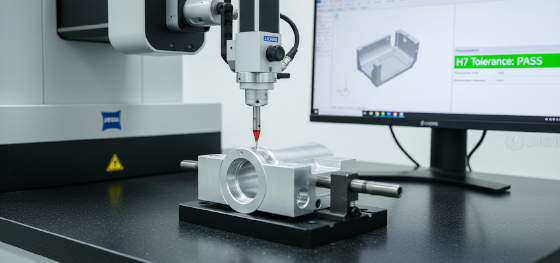
The final hallmark of a professional cnc machining process is the ability to prove that the hole meets the print. You cannot verify an H7 tolerance with a visual check. At Jucheng Precision, every precision bore we manufacture undergoes a rigorous inspection cycle. We utilize digitized inner-diameter micrometers for real-time shop floor checks, and for final validation, we use our Zeiss and Hexagon Coordinate Measuring Machines (CMM).
Our CMM probes take hundreds of points inside a hole to generate a 3D map of its circularity, cylindricity, and position. We provide our clients with detailed inspection reports that guarantee every drilling vs boring vs reaming operation was executed to perfection. This transparency is vital for medical devices and aerospace assemblies where a single out-of-spec hole could lead to system failure. When you partner with JUCHENG, you aren't just buying a part; you are buying the engineering certainty that your components will assemble flawlessly every time. Don't leave your critical fits to a shop that only knows how to drill. Trust the specialists who understand the entire precision hierarchy. Contact Jucheng Precision today for a technical review of your next precision project.

