


The final bottleneck in any high-volume CNC shop is not the spindle speed or the tool changer; it is the human hand. While a 5-axis machine can carve a thousand identical components with micron-level accuracy, the subsequent task of removing sharp edges and smoothing tool marks often falls to manual labor. Hand-deburring is inherently inconsistent, incredibly slow, and prone to human error. To bridge the gap between high-speed machining and market-ready products, engineers rely on the automated power of vibratory finishing. It is a mass-finishing process that treats a thousand parts with the same technical rigor as a single prototype, turning a raw machined surface into a polished, compliant component through the science of harmonic motion.

At Jucheng Precision, we integrate CNC machining surface treatment into our end-to-end production ecosystem. We understand that for complex medical housings, automotive fasteners, and aerospace brackets, every edge must be "broken" to a specific radius, and every surface must be prepared for its final coating. Vibratory finishing uses a bath of abrasive media and specialized compounds to achieve a homogeneous finish across every square millimeter of a part. This guide explores the sophisticated mechanics of the vibrating tub, the critical selection of media shapes, and the economic strategies JUCHENG employs to deliver high-volume precision with zero defects.
Successful mass finishing is a balance of amplitude and chemistry. It is the art of making metal flow against stone. Whether you are looking to remove heavy burrs or achieve a high-luster pre-plate finish, understanding the variables of the vibratory cycle is essential for project success. Let us dive into the technical pillars of this automated refinement and see how it redefines the surface of your most demanding designs.
Harmonic Mechanics: The Physics of the Vibrating Mass
The Media Matrix: Matching Abrasives to Substrates
Precision Edge Breaking: Consistent Radiusing
Surface Texture Transformation: Preparing for Post-Processing
The Economic Edge: Scaling Quality for High Volumes
Harmonic Mechanics: The Physics of the Vibrating Mass
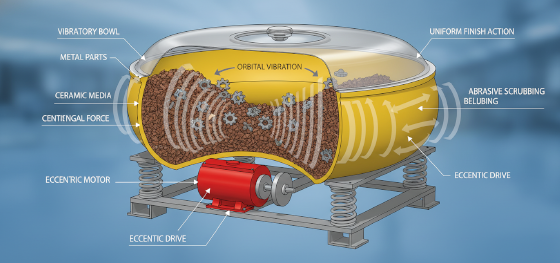
To understand vibratory finishing, one must move beyond the image of a simple "shaker." The process is an exercise in 3D toroidal movement. A vibratory bowl or tub is mounted on a series of heavy-duty springs, with an eccentric-weight motor attached to the base. As the motor spins, it generates a centrifugal force that creates a complex, circular, and vertical vibration in the container. This movement causes the entire mass of parts, abrasive media, and liquid compound to roll in a "donut-shaped" path.
The technical brilliance of this movement lies in the relative speed. The media and the parts move at slightly different velocities within the tub. This differential creates a constant, gentle "scrubbing" action. Thousands of abrasive particles are pressing against the machined part simultaneously, entering internal pockets and flowing over exterior edges. Unlike tumbling, which relies on the force of gravity as parts fall over each other, vibratory systems keep the parts suspended in the media mass. This minimizes the risk of parts striking one another and causing "nicks" or "dings." At Jucheng Precision, we calibrate the frequency and amplitude of the vibration to match the part's weight and fragility. We can create a violent scrub for heavy steel forgings or a delicate whisper for thin-walled medical enclosures. This mechanical control is what allows us to deliver a perfectly uniform finish on every square millimeter of a complex CNC component, a feat that is physically impossible to replicate with a manual deburring tool.
The Media Matrix: Matching Abrasives to Substrates
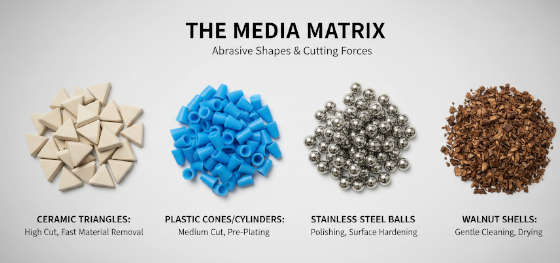
The media is the "cutting tool" of the finishing world. At Jucheng Precision, we maintain an extensive library of abrasive shapes and materials, because the choice of media determines the soul of the finish. Ceramic Media is the industrial workhorse. It is heavy, aggressive, and designed for fast material removal and heavy deburring on steel, stainless steel, and cast iron. It is ideal for "breaking" large machining burrs and creating a uniform matte finish.
Plastic Media is lighter and more cushioned. We utilize it for softer alloys like aluminum, brass, or copper where a ceramic media might be too aggressive and leave small impact marks. Plastic media is excellent for pre-anodizing preparation, delivering a smooth, satin-like surface that absorbs color uniformly. Beyond the material, the shape of the media is a critical engineering specification. Triangles can reach into 90-degree corners; spheres are best for round internal bores; cones provide a balance of both. We even utilize organic media like corn cob or walnut shells for drying and light polishing of delicate luxury components. By matching the abrasive matrix to your part’s specific substrate and geometry, JUCHENG ensures that the finishing process enhances the design rather than erasing its precision. We manage the "wear rate" of our media meticulously, because as media breaks down and rounds off, its cutting performance changes. We constantly cycle our inventory to ensure that the thousandth part receives the same abrasive energy as the first.
Precision Edge Breaking: Consistent Radiusing
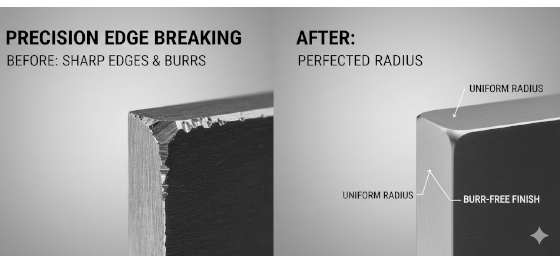
In the medical and aerospace sectors, an edge isn't just "sharp" or "blunt"—it is a measured radius. A raw CNC edge can be dangerous to handle and prone to stress cracking. However, over-deburring can ruin a critical mating surface or change the fit of a fastener. Vibratory finishing provides a level of control over edge radiusing that hand tools cannot match. Because the abrasive media flows evenly over the entire part, the edges—which protrude most into the media flow—receive the most consistent energy.
At Jucheng Precision, we use timed cycles to achieve specific edge radii. We can precisely control the process to deliver a "soft touch" edge of 0.05mm or a heavy, rounded radius of 0.5mm. This consistency is essential for parts that must undergo automated assembly. If one part has a sharp edge and the next is heavily rounded, the assembly robots will fail. Our vibratory protocols eliminate this variability. Furthermore, the process is self-limiting to an extent; as the edges become rounder, the media has less "purchase" on them, which prevents the parts from being over-processed. This "intelligent" material removal is why JUCHENG is the trusted partner for complex manifolds and internal machine components where every edge must be safe to the touch but dimensionally perfect.
Surface Texture Transformation: Preparing for Post-Processing
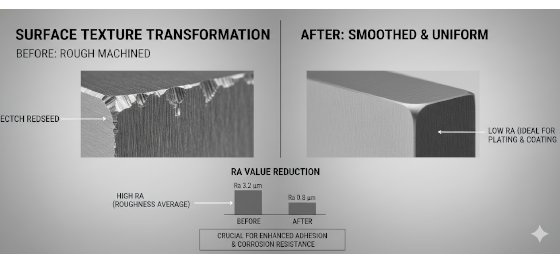
A great finish is only as good as its foundation. In CNC machining surface treatment, vibratory finishing serves as the ultimate pre-treatment step. It doesn't just remove burrs; it transforms the "lay" of the surface. Machining tool marks are directional—they are a series of parallel ridges. If you plate or paint directly over these ridges, they will often show through the final coating as a textured defect. Vibratory finishing replaces this directional grain with a random, isotropic matte texture.
This "isotropic" surface is highly receptive to secondary finishes. When a part is vibratory finished before anodizing, the resulting color is deeper and more uniform because the light reflects in a diffused manner. For powder coating, the microscopic texture created by the media increases the surface area, providing more "teeth" for the polymer to grab onto, which significantly improves adhesion. Jucheng Precision engineers often recommend a two-stage finishing cycle: a ceramic vibratory run for heavy deburring, followed by a fine plastic vibratory run for surface smoothing. This layered approach allows us to hit $Ra$ values as low as 0.8 µm across thousands of parts simultaneously. We don't just "shake" your parts; we prepare their molecular skin for a lifetime of service.
The Economic Edge: Scaling Quality for High Volumes

The true value of vibratory finishing is found in the economics of scale. If a manual technician takes 5 minutes to deburr one complex part, a batch of 1,000 parts represents 83 hours of labor. This creates a massive bottleneck that can kill the lead time of a project. A single vibratory bowl can process those same 1,000 parts in 45 minutes with virtually zero labor cost after the initial setup. This efficiency is why Jucheng Precision can offer competitive pricing on large production runs without sacrificing a single micron of quality.
Beyond the speed, there is the cost of quality. Human operators get tired; their "touch" changes at the end of an 8-hour shift. A vibratory machine does not have a "bad day." It delivers the exact same energy to the last part of the batch as it did to the first. This repeatability reduces the need for expensive and time-consuming 100% inspections. JUCHENG’s quality assurance team uses statistical process control (SPC) to monitor our finishing batches, providing our clients with the confidence that their entire shipment is compliant. Whether you are developing a new consumer product or scaling up a critical industrial assembly, our vibratory finishing expertise ensures that your parts are finished, verified, and ready to work. Don't leave your final impression to a manual file. Trust the specialists who treat batch consistency as an engineering discipline. Contact Jucheng Precision today for a technical review of your next high-volume CNC project.

