


Designing custom venting grilles, speaker covers, or decorative architectural facades requires balancing raw material yield against overall processing speeds. Evaluating the total cost of perforated sheet metal represents the most critical step in custom sheet metal fabrication, directly determining whether your hardware project remains highly profitable or exceeds its targeted budget. This specialized forming process relies on creating high-density hole patterns to establish modular airflow passages or aesthetic screening.

Suffer from unexpected machine runtime charges and bloated tooling bills on your custom grille runs? When drawings are modeled without analyzing the physical differences between laser profiling and mechanical punching, it forces fabricators to run machines longer, driving up manufacturing overhead. Proactively optimizing your hole geometries and selecting standard punch patterns is the best way to secure your product margins.
Let's explore why laser cutting thousands of tiny holes is financially impractical, analyze why mechanical turret punching represents the most cost-effective alternative, and review the cost differences between standard patterns and custom tooling.
The High Cost of Laser Cutting Thousands of Holes
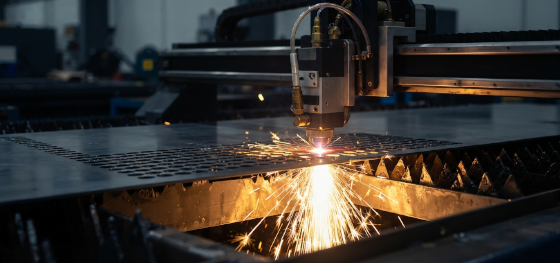
Why is laser cutting highly expensive for high-density perforated patterns?
Laser cutting must physically trace the perimeter of every single hole and execute thousands of high-temperature pierces, exponentially driving up machine runtime and nitrogen gas consumption.
While laser cutting provides outstanding geometric flexibility with zero upfront tooling charges, utilizing a laser to slice out thousands of tiny, identical circular holes is an extreme cost leak. To cut a single hole, the laser head must position itself, execute a high-pressure pierce, trace the boundary, and retract. For a panel with 5,000 holes, this represents 5,000 individual pierces.
This slow, continuous tracing process exponentially increases the total machine runtime, resulting in high processing fees. Additionally, running multi-kilowatt fiber lasers on high-density arrays consumes massive amounts of high-pressure nitrogen assist gas to prevent edge oxidation. This high thermal energy also concentrates in a small area, which can warp thin-gauge panels and require expensive, manual straightening, driving up your final bill.
Why CNC Punching is the Cost-Effective Solution for Perforations

How does mechanical CNC punching slash your overall processing bill for perforated panels?
CNC punching utilizes mechanical force to shear out standard shapes in a single millisecond stroke, and can punch dozens of holes simultaneously using multi-pin cluster dies.
To minimize machine runtime, our finishing department executes high-density perforations using advanced CNC punching systems. A turret punch press does not trace perimeters; it drives a hardened steel punch through the sheet in a single mechanical stroke. Utilizing specialized cluster dies (which feature 10 to 40 punch pins in a single holder) allows us to stamp out dozens of holes simultaneously.
This mechanical automation drastically reduces the processing cycle time compared to laser cutting. For a production batch of several hundred perforated sheets, CNC punching operates at least ten times faster than laser profiling. This extreme speed drops the hourly machine processing fee to mere pennies, making it the most cost-effective method for high-density venting panels.
Standard Hole Patterns vs. Custom Perforation Designs
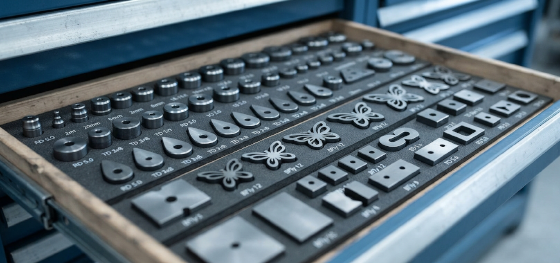
What is the cost difference between utilizing standard in-stock punches and fabricating custom-shaped dies?
Standard patterns utilize our vast in-house inventory of round and square punches with zero mold charges, while custom shapes require expensive custom tooling and long lead times.
Evaluating the raw cost of perforated sheet metal requires analyzing your selected hole geometries. Professional sheet metal shops maintain an extensive inventory of standard punch and die sets. Designing your vents to use standard, in-stock sizes (such as 3mm round holes on a 5mm staggered pitch) completely bypasses any custom mold-making requirements, allowing us to program and run your parts immediately.
Conversely, specifying custom geometric shapes, irregular slots, or brand logos requires custom-machined punch dies. This custom tool fabrication introduces high NRE fees and requires a complex tooling setup that extends your lead times by weeks. This custom tooling is highly impractical for low-volume prototyping and short runs, and should only be specified when production volumes are high enough to amortize the setup costs. Here is a direct comparison of the two approaches:
| Tooling Metric | Standard Punch Tooling | Custom Machined Dies (NRE) |
|---|---|---|
| Upfront Setup Cost | Zero (Universally compatible inventory) | High (Typically 800 to 2,500 USD) |
| Tooling Lead Time | Instant (Pre-loaded carousels) | 2 to 4 weeks (Requires EDM and CNC grinding) |
| Forming Flexibility | Standard round, square, and hexagonal slots | Complex artistic branding, organic curved slots |
| Best Production Volume | 1 to 5,000 units (Highly cost-effective) | 10,000+ units (Amortizes initial NRE fees) |
Get a Quote for Your Perforated Panels from Jucheng Precision

How does Jucheng Precision minimize the overall price of custom perforated panels?
We operate high-power fiber lasers, high-capacity turret presses, and automated powder coating lines, bypassing fragmented supplier markups.
Why pay premium prices for scattered processing? At Jucheng Precision, we manage cutting, bending, and finishing under one roof, keeping your overall sheet metal fabrication cost remarkably low. Our advanced press brakes and high-speed turret presses execute complex, multi-bend sequences in a single setup, ensuring that your parts are cut, formed, and finished with extreme consistency.
We process a wide range of materials, including lightweight aluminum, high-yield stainless steel, and easily formable carbon steel during high-precision sheet metal fabrication cycles. Our technical department provides a 24-hour free DFM analysis to check your CAD models, checking tolerances and material limits before production. Supported by our no MOQ policy and rapid delivery guarantee, we manage your project from initial flat pattern cutting to final, high-durability packaging and assembly.
FAQ: Critical Questions About Cost of Perforated Sheet Metal
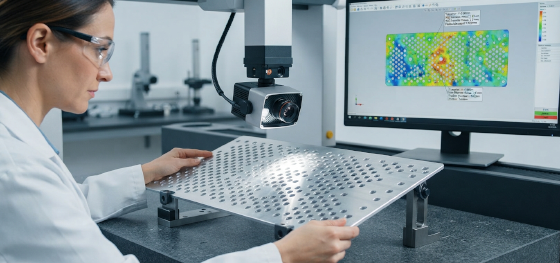
Our engineering team has compiled professional solutions to the most common quality and cost challenges faced during perforation runs:
How does the open area percentage affect the final cost of perforated sheet metal?
The open area percentage represents the total empty space divided by the total panel area. While a high open area (e.g., 60%) provides excellent airflow, it requires stamping out more metal, which increases the total punch count and drives up processing fees. We recommend maintaining an open area of 40% to 50% to optimize both airflow and mechanical punching speeds.Does Jucheng Precision charge extra tooling fees for standard perforated patterns?
Absolutely not. Jucheng Precision maintains an extensive in-house library of standard, high-grade round, square, and slotted punch dies. If your designs utilize standard industrial dimensions, we can process your custom venting panels immediately, allowing you to bypass any custom tooling or NRE mold expenses completely.Why does laser cutting perforated steel require high-pressure nitrogen instead of oxygen?
Oxygen assist gas reacts with the steel, causing extreme edge burning and a thick, dark oxide scale on the thousands of cut edges. Utilizing high-pressure nitrogen assist gas cools the cut zone and completely blows away the molten zinc, delivering clean, bright edges that are free from burning and ready for immediate secondary assembly.How does Jucheng Precision prevent panel warpage on custom perforated sheet metal orders?
Stamping thousands of holes concentrates immense shear stresses in the sheet, causing it to warp or curl. To prevent this, our quality control team runs all perforated sheets through multi-roller leveling machines after punching. These rollers apply controlled, alternating bending forces to relieve the internal shear stresses, ensuring the finished grilles remain completely flat.

