


Robotic units-per-hour (UPH) is a physical hostage to the law of conservation of momentum. In the high-velocity environment of 2026 automation, the End-of-Arm Tooling (EOAT) functions as the "Last Meter" of efficiency. If the gripper or manifold is over-engineered and carries unnecessary mass, the entire system pays a thermodynamic and kinetic tax. Every gram located at the end of a six-axis arm exponentially increases the "Moment of Inertia," forcing motors to slow down their acceleration curves and increasing the wear on expensive harmonic drive gearboxes. Navigating this requirement for extreme mass reduction without sacrificing structural modulus requires a comprehensive Lightweight EOAT materials guide. Jucheng Precision operates as a high-fidelity manufacturing sanctuary in the Shenzhen precision manufacturing hub, providing the material science depth needed to bridge the gap between "heavy standard tools" and "agile bionic effectors." Within the broader framework of custom robotic end-of-arm tooling, we ensure your robot maintains its sub-micron repeatability by engineering a tool that is as light as the laws of physics permit.
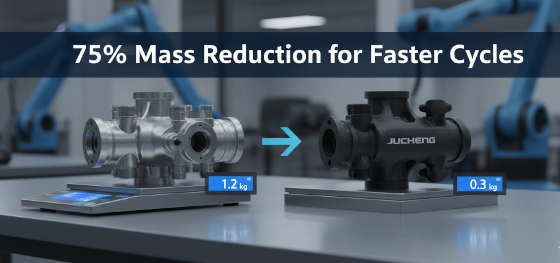
Establishing a high-yield autonomous line in 2026 demands the absolute rejection of "single-material" procurement. Amateurs often default to 6061 aluminum for every bracket, unaware that the specific flexural modulus of PEEK or the anisotropic strength of Carbon-Fiber polymers can offer superior performance for niche handling tasks. Jucheng Precision eliminates these "Mechanical Drags" by providing an integrated multi-process ecosystem of 5-axis CNC machining and industrial 3D printing. Whether you are developing a surgical effector requiring biocompatible rigidity or a warehouse sorter needing high-speed acceleration, our Lightweight EOAT materials guide serves as the mandatory technical foundation for your supply chain. We turn "Bill of Materials" chaos into "Kinematic Sovereignty," delivering T1 samples that maximize your allowable payload from the first shot to the ten-thousandth.
Why specify Aluminum 6061 or 7075 for robotic effectors?
Can POM and PEEK replace metal for high-precision EOAT?
Why is Carbon-Fiber Reinforced Polymer the 2026 champion?
The JUCHENG Angle: How do we optimize material selection for kinematics?
Frequently Asked Questions: Lightweight EOAT Materials
Why specify Aluminum 6061 or 7075 for robotic effectors?
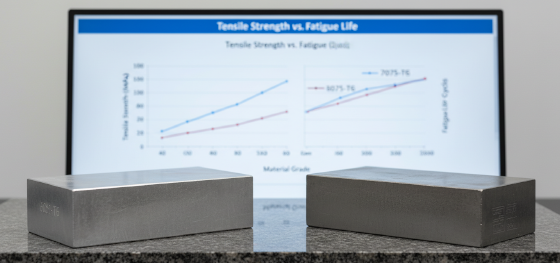
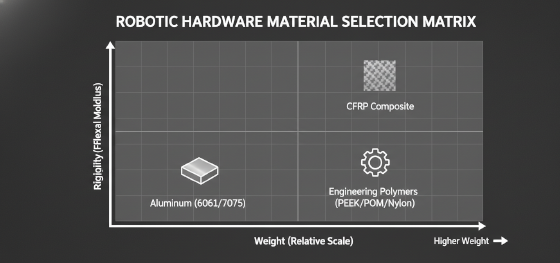
Metallurgical tradition remains the benchmark for structural EOAT reliability. For most industrial robotic grippers, aluminum is the "Golden Mean" of the periodic table. Jucheng Precision engineers utilize Aluminum 6061-T6 for general-purpose frames due to its excellent machinability and predictable thermal expansion. However, when the robot must handle high-torque cycles or carry payloads exceeding 20kg, we pivot to Aerospace-Grade 7075-T6. This alloy offers a yield strength (500+ MPa) that rivals many carbon steels but at 33% of the mass. A professional Lightweight EOAT materials guide must highlight that 7075 provides the fatigue resistance necessary for 24/7 assembly lines where a linkage failure could halt a million-dollar facility. We utilize 5-axis CNC machining to carve these alloys into hollowed-out, rib-reinforced structures, ensuring your "Hands" are rigid enough for machine tending but light enough for high-speed directional changes.
Can POM and PEEK replace metal for high-precision EOAT?
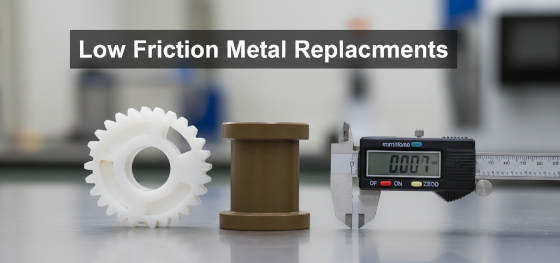
Molecular slickness and high flexural modulus make engineering plastics the primary saboteurs of metal-heavy designs. pom injection molding (Delrin/Acetal) is the material of choice for low-friction sliding mechanisms and precision gears within an EOAT assembly. POM possesses a naturally low coefficient of friction and zero moisture-induced swelling, ensuring tight-tolerance joints don't bind in high-humidity environments. For extreme medical or high-heat industrial tasks, we upgrade to peek injection molding. PEEK offers a structural modulus that mirrors titanium but with a significant density reduction. It survives continuous 250°C temperatures and repeated chemical sterilization, making it the hero for robotic surgical grippers. At Jucheng Precision, we use these super-polymers to "Cure the Mass Crisis," delivering non-metallic effectors that are chemically inert and dimensionally sovereign, documented for sub-micron accuracy.
Why is Carbon-Fiber Reinforced Polymer the 2026 champion?

Strength-to-mass ratios reach their absolute limit with composite additives. In 2026, the apex of the Lightweight EOAT materials guide is Carbon-Fiber Reinforced Polymer (CFRP), specifically via Multi Jet Fusion (MJF) 3D printing. By infusing a Polyamide matrix with 30% carbon fiber, we create grippers that possess a specific stiffness higher than cast aluminum. This technology allows for "Generative Design" where the material is placed only along the lines of mechanical stress, resulting in hollow, bone-like architectures. Jucheng Precision utilizes Carbon-PA to manufacture oversized vacuum manifolds and end-effectors that would be nightmare-inducingly heavy in metal. This additive strategy eliminates the "Tooling Debt" of large parts and slashes the robot's power consumption by nearly 40%. We turn "composite concepts" into "certified robotic anatomy," ensuring your hardware survives millions of pick cycles without a single molecular tear.
The JUCHENG Angle: How do we optimize material selection for kinematics?
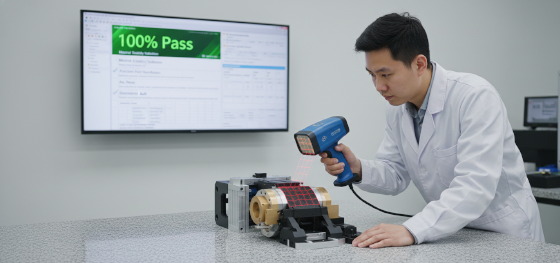
Engineering excellence at Jucheng Precision is built on the foundation of a material-agnostic mandate. We don't believe in "one-material-fits-all" hardware. Our facility, housing over 150 CNC machines and industrial 3D printing farms, acts as your manufacturing navigator. We don't just "cut and shoot"; we perform a comprehensive "Kinematic Audit" on your CAD assembly. If we identify a part where 3D printed Nylon-CF can replace aluminum to save 500 grams, we suggest it before a single block of metal is rough-milled. We provide full material lot traceability and CMM inspection reports for every batch, ensuring your project meets the strict requirements of the medical and automotive industries. Stop gambling your robot's UPH on heavy, unoptimized effectors. Leverage our decade of high-performance replication mastery to validate rapidly and launch profitably. contact our technical team today for a free DFM review.
Frequently Asked Questions: Lightweight EOAT Materials
Question: What is the absolute lightest material for a high-speed robotic gripper?
Answer: For 2026, Carbon-Fiber Reinforced Nylon (PA12-CF) produced via MJF 3D printing is the champion of mass reduction, offering a density of ~1.04 g/cm³ while maintaining high structural stiffness.
Question: Can JUCHENG help switch a heavy steel gripper to a lightweight aluminum version?
Answer: Yes. We analyze your torque requirements and utilize Aluminum 7075-T6 to provide nearly identical strength while reducing the component's mass by nearly 65%, which directly increases your robot's allowable payload.
Question: Does the choice in our Lightweight EOAT materials guide affect the robot's positioning accuracy?
Answer: Absolutely. Lighter effectors reduce the dynamic vibration (oscillation) at the end of the arm, allowing the robot to settle faster at its target coordinate, which improves the "Settling Time" and overall accuracy of the cell.
Question: How durable are plastics like PEEK compared to aluminum for 24/7 operation?
Answer: PEEK offers spectacular wear and fatigue resistance. In many high-cycle applications, a PEEK component will actually outlast aluminum because it does not suffer from the same "Work-Hardening" and cracking risks under repetitive strain.

