


Grip reliability remains the final filter for high-velocity industrial automation. In the hyper-agile manufacturing landscape of 2026, a machine-tending robot is only as efficient as the "handshake" between its jaws and the workpiece. If the contact surface is rigid metal, it risks marring expensive components or losing its grip under high acceleration. Traditional workarounds—such as manually gluing rubber pads or foam strips to CNC-machined jaws—introduce a dangerous point of failure: adhesive degradation. In oily or high-humidity warehouse conditions, these pads invariably peel, causing the robot to drop parts and stall the entire assembly line. Navigating this requirement for indestructible, high-friction contact requires the strategic deployment of Overmolded gripper fingers. Jucheng Precision operates as a high-fidelity multi-material sanctuary in the Shenzhen precision manufacturing hub, providing the thermodynamic depth to fuse disparate material durometers into a single, monolithic asset. Within the broader framework of custom robotic end-of-arm tooling, we bridge the gap between "rigid structural bones" and "compliant haptic skins," ensuring your automation systems scale with absolute mechanical sovereignty.
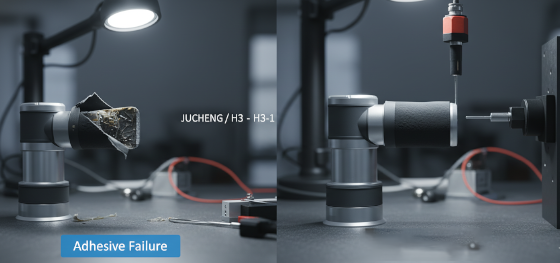
Establishing a resilient autonomous supply chain demands the absolute rejection of "Post-Process" gluing. Amateurs often spend forty percent of their maintenance budget re-attaching failed rubber pads to robot grippers, unaware that Overmolded gripper fingers can survive millions of cycles without a single molecular tear. Jucheng Precision eliminates these "Maintenance Nightmares" by utilizing advanced chemical cross-linking protocols. We don't just "cover" your robotic fingers; we engineer a permanent molecular bond that possesses the mechanical soul of an integrated factory-line component. Whether you are developing a 500-unit pilot run for a retail sorter or a heavy-duty effector for an automotive plant, our facility provides the material science and finishing rigor required for 2026 market entry. This guide deconstructs the necessity of dual-material synergy, the physics of sequential injection, and why JUCHENG’s "Interlock Protocol" is the mandatory foundation for anyone developing Overmolded gripper fingers for global fulfillment.
Mechanical Synergy: Uniting Structural Modulus with High Friction
Thermal Fusion: The Sequential Injection and Bonding Process
Geometric Insurance: Designing Interlocks to Prevent Delamination
The JUCHENG Angle: Delivering Monolithic Multi-Material Assemblies
FAQ
Mechanical Synergy: Uniting Structural Modulus with High Friction
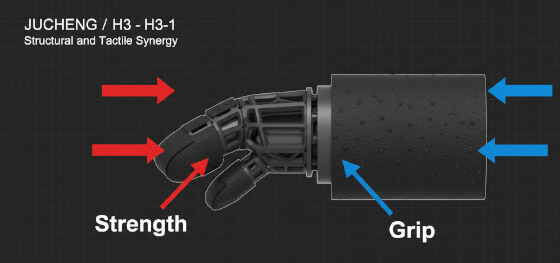
Tactile authority is a byproduct of material contrast. The fundamental advantage of Overmolded gripper fingers is the ability to resolve the conflict between "Inertial Stiffness" and "Surface Compliance." A successful gripper finger requires a high-modulus core—often made of 7075 Aluminum or Glass-Filled Nylon—to resist the bending forces of a 10kg payload. However, this rigid core lacks the "Squish Factor" needed to conform to irregular part surfaces. Jucheng Precision solves this by molding a soft Shore 40A to 60A TPE or TPU skin over the rigid skeleton. This soft layer increases the "Contact Patch" area, allowing the robot to secure the part using 40% less clamping torque. By reducing the required force, we allow engineers to downsize the actuators in the robotic hand, directly increasing the robot's allowable payload and reducing energy consumption. We turn "violent clamping" into "precision securement," protecting your product's finish while maximizing the arm's velocity.
Thermal Fusion: The Sequential Injection and Bonding Process
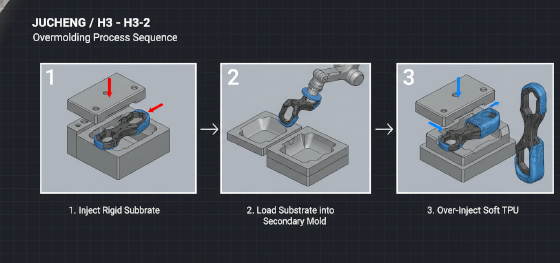
Molecular fusion dictates the success of a multi-material robotic part. Unlike simple assembly, Overmolded gripper fingers are created through a dual-stage thermodynamic cycle. At Jucheng Precision, we typically execute this via a "Pick-and-Place" overmolding protocol for low-to-mid volume runs. We first injection mold the rigid substrate or "bone" in Tool A. While the surface is still chemically active, the part is manually or robotically transferred to Tool B. The secondary material—a molten elastomer—is then injected at high pressure (up to 15,000 psi). This pressurized melt front "wets" the surface of the rigid core, causing a localized re-melt of the polymer chains. As the two resins cool together, they form a covalent bond at the interface. We turn "separate pieces" into a "monolithic assembly," ensuring your custom robotic end-of-arm tooling possesses the structural permanence required for years of 24/7 industrial abuse without delamination.
Geometric Insurance: Designing Interlocks to Prevent Delamination
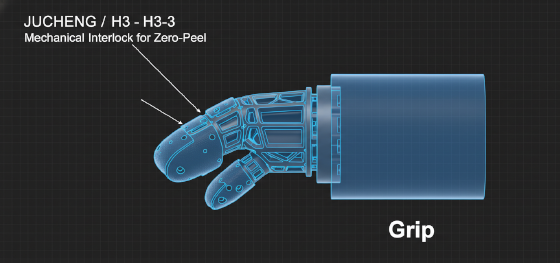
Chemical adhesion is the goal, but mechanical interlocking is the safety net. In the uncompromising world of high-torque robotics, the sheer stress on Overmolded gripper fingers during a rapid directional change can exceed the limits of molecular bonding. If the elastomer skin is only attached to a smooth flat surface, it will eventually roll and peel at the corners. Jucheng Precision eliminates this "Peel Crisis" through "Geometric Anchoring." During our mandatory DFM review, we instruct designers to integrate "Dovetail Grooves," "Through-Holes," and "Undercut Radii" into the rigid core. During the second shot, the liquid rubber flows *into* these features and solidifies, creating a physical "Rivet Effect." This mechanical trap ensures that even if the part is exposed to aggressive cleaning solvents that weaken the chemical bond, the fingertip remains physically shackled to the frame. We turn "aesthetic skins" into "indestructible structural armors," documented for survival in high-mass industrial environments.
The JUCHENG Angle: Delivering Monolithic Multi-Material Assemblies
Manufacturing excellence at Jucheng Precision is built on the foundation of single-source accountability. We don't believe you should manage one vendor for your CNC linkages and another for your overmolding. JUCHENG houses elite 5-axis CNC mold shops and multi-shot injection bays under one ISO 9001 certified roof. We don't just "mold rubber"; we engineer the entire haptic lifecycle. We provide full material lot traceability and destructive "Peel-Strength" reports for every Overmolded gripper fingers batch, ensuring your project meets the strict standards of the automotive and medical industries. Stop gambling your robot's UPH on uncertified vendors who use glue. Leverage our decade of high-performance replication mastery to validate rapidly and launch with an uncompromising grip. Contact our technical team today for a free DFM review and see how we can turn your digital robotic intent into a structurally sovereign physical reality.
FAQ
Q: Which materials are best for Overmolded gripper fingers?
A: For the rigid core, we recommend 7075-T6 Aluminum or High-Impact PC/ABS. For the soft skin, Shore 40A to 60A TPU or Silicone offers the best balance of friction and tear resistance.
Q: Can JUCHENG overmold rubber onto a CNC machined metal finger?
A: Yes. We utilize specialized heat-activated chemical primers and aggressive mechanical interlocks to permanently bond liquid elastomers directly onto 5-axis machined aluminum or steel linkages.
Q: How do you prevent "Flash" on the rigid part of the finger?
A: We design a "Step-Joint" shut-off in the tool steel, which pinches the rigid core with extreme precision to prevent the low-viscosity overmold resin from leaking onto clean surfaces.
Q: What is the lead time for a prototype batch of Overmolded gripper fingers?
A: Utilizing our rapid aluminum tooling strategy, Jucheng Precision can deliver your first set of 20 high-fidelity overmolded fingers in as fast as 12 to 15 business days.

