


Molecular indifference to saltwater represents the ultimate strategic advantage in maritime autonomy. In the hyper-hostile environment of subsea exploration and offshore energy maintenance, the transition from a digital CAD intent to a physical underwater robot is a battle against the chemistry of the ocean. While stainless steel and titanium provide the strength to survive the abyss, they introduce the heavy penalties of magnetic interference, galvanic corrosion, and negative buoyancy. Navigating this requirement for lightweight, chemically inert, and structurally sovereign hardware requires the strategic deployment of Delrin and PEEK underwater robot parts. Jucheng Precision operates as a high-fidelity polymer sanctuary in the Shenzhen precision manufacturing hub, providing the 5-axis CNC depth needed to transform high-performance resins into pressure-rated assets. We don't just "cut plastic"; we engineer non-conductive mechanical foundations that ensures your ROV or AUV maintains its dimensional integrity and sensor focus through thousands of dive cycles.
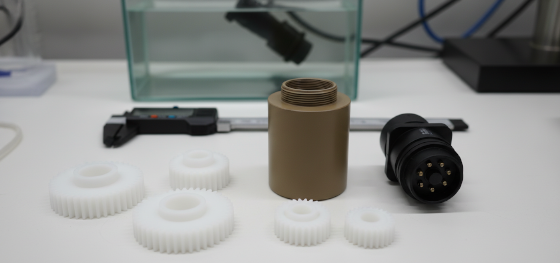
Establishing a resilient deep-sea supply chain in 2026 demands the absolute rejection of "commodity-grade" polymer logic. Amateurs often treat Delrin and PEEK underwater robot parts like general-purpose industrial components, unaware that the thermal expansion of polymers during high-speed CNC milling can cause critical bearing seats to drift out of tolerance by dozens of microns. Jucheng Precision eliminates these "Mechanical Failures" by enforcing a strict "Thermal Stabilization" protocol for all advanced engineering plastics. We utilize specialized sharp-geometry tooling and controlled coolant cycles to prevent the material from "melting" or "smearing" at the tool tip. Whether you are developing a shallow-water glider using Delrin (POM) for its low friction or an ultra-deep sea sensor pod using PEEK for its titanium-like strength, our facility provides the material science and metrological rigor required for global market entry. This guide deconstructs the necessity of neutral buoyancy, the physics of zero-swelling polymers, and why JUCHENG’s "Plastic Precision" protocol is the mandatory foundation for anyone developing Delrin and PEEK underwater robot parts for the global abyss.
Why plastics rule subsea: Corrosion, insulation, and buoyancy
Delrin (POM): Zero-swelling precision for shallow water frames
PEEK: High-stiffness armor for deep-water sensor housings
JUCHENG Protocol: Managing thermal drift in polymer CNC
FAQ
Why plastics rule subsea: Corrosion, insulation, and buoyancy

Corrosion immunity dictates the long-term ROI of maritime robotics. In the standoff between alloys and polymers, plastics possess an "Atomic Advantage": they do not conduct the ions necessary for electrolytic rust. When an engineer specifies Delrin and PEEK underwater robot parts, they are effectively eliminating the risk of "Galvanic Corrosion" that occurs when stainless steel screws meet aluminum frames. Beyond chemical defense, polymers offer "Bouyancy Sovereignty." Most engineering plastics have a density near 1.3 g/cm³, compared to 2.7 for aluminum and 8.0 for steel. This lower mass reduces the need for expensive syntactic foam, allowing for smaller, more agile ROVs with higher payload capacities. We don't just "reduce weight"; we optimize the displaced volume of the robot, ensuring your autonomous explorers maximize their mission endurance in the most abusive oceanic environments.
Delrin (POM): Zero-swelling precision for shallow water frames
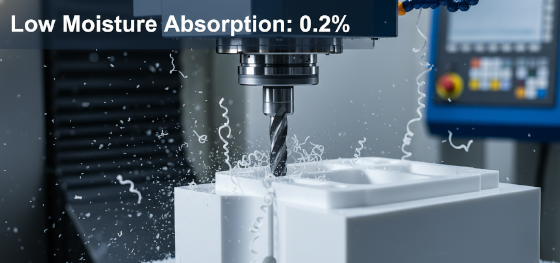
Dimensional sovereignty in a liquid environment is a byproduct of low moisture absorption. While Nylon is a popular industrial plastic, its high "thirst" for water (up to 8% absorption) makes it a dangerous choice for subsea hardware; it will swell and bind precision gears within days. Delrin and PEEK underwater robot parts utilize Polyoxymethylene (POM) for shallow-to-mid-depth frames and sliding mechanisms because its moisture absorption is effectively zero (approx. 0.2%). This ensuring that a CNC-machined bearing seat or a planetary gear set maintains its sub-micron backlash profile regardless of humidity or depth. Jucheng Precision technicians utilize specialized "Cool-Cutting" toolpaths to prevent the POM from reaching its melting point during the CNC cycle, ensuring the material’s crystalline structure remains intact for maximum fatigue resistance in active ROV thrusters and articulating arms.
PEEK: High-stiffness armor for deep-water sensor housings

Mechanical strength at 6,000 meters requires the absolute modulus of PEEK. In the world of Delrin and PEEK underwater robot parts, PEEK (Polyetheretherketone) is the undisputed hero for deep-sea pressure vessels and sensor housings where metal would interfere with acoustic or electromagnetic signals. PEEK possesses a tensile strength (upwards of 100 MPa) that rivals titanium but at half the mass. Jucheng Precision engineers utilize PEEK for high-stakes ROV battery pods and LiDAR viewports because it resists "Cold Flow" under the extreme, constant pressure of the abyss. Furthermore, PEEK is chemically indifferent to hydraulic fluids and marine oils, making it the mandatory foundation for autonomous systems operating in offshore oil and gas fields. We turn "raw polymer billets" into "indestructible abyssal armor," providing the documented proof of structural survival your naval and commercial clients demand.
JUCHENG Protocol: Managing thermal drift in polymer CNC
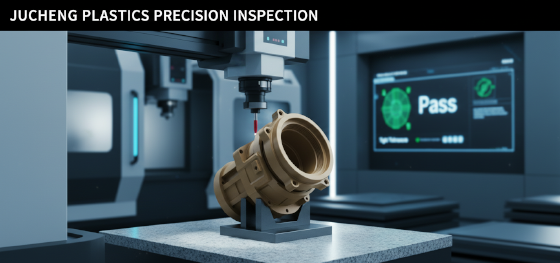
Manufacturing excellence at Jucheng Precision is built on the foundation of the metrological audit for non-metallic alloys. We recognize that Delrin and PEEK underwater robot parts exhibit significantly higher coefficients of thermal expansion than steel. A part that is "on-size" in our climate-controlled 5-axis CNC bay could drift by 0.05mm if it heats up during shipping. Our facility implements a mandatory "Annealing and Stabilization" protocol for every PEEK project. We bake the machined components in digital convection ovens to relieve internal residual stresses, ensuring the part reaches a state of permanent geometric equilibrium before it hits the water. We provide full material lot traceability and dimensional inspection reports for every batch, ensuring your project meets the strict requirements of the maritime and defense industries. Stop gambling your subsea mission onvendors who treat plastics like hobbyist materials. Leverage our decade of high-performance replication mastery to validate rapidly and scale profitably. Contact our technical team today for a free DFM review.
FAQ
Q: Why is PEEK used instead of titanium for some ROV sensor housings?
A: PEEK is non-magnetic and non-metallic. For sensors that rely on radio frequencies or magnetic fields to map the seafloor, a metal housing acts as a shield that blocks the data. PEEK provides the strength of metal with absolute signal transparency.
Q: Does Delrin swell after being submerged for months?
A: No. Unlike Nylon, Delrin has a moisture absorption rate of less than 0.25%, meaning its dimensional drift in saltwater is negligible. This makes it ideal for underwater robot joints and gears that must maintain tight tolerances.
Q: Can JUCHENG help with buoyancy calculations for plastic parts?
A: Yes. During our complimentary DFM review, our engineers utilize mass-properties simulation in CAD to identify how Delrin and PEEK underwater robot parts will impact your ROV's overall center of buoyancy and weight.
Q: Is 3D printing PEEK as strong as CNC machining it?
A: No. While 3D printed PEEK is revolutionary for geometry, it contains internal micro-porosity that acts as a failure point under high hydrostatic pressure. For deep-sea hardware, 5-axis CNC machining from a solid, forged PEEK billet is the only way to guarantee 100% molecular density.

