


Your new product needs a metal housing. You have a limited budget. You get your first quote for Die Casting, and you see two numbers. A very large number for the "tooling." And a surprisingly small number for the "part price."

How do you make sense of this? Is the high upfront cost worth it? When does it become smarter than CNC machining?
Understanding the die cast cost is not just accounting. It is a strategic calculation. It is about understanding the powerful economic model of mass production. This guide will break down that model for you.
content:
Dissecting the Tooling Cost
Unpacking Your Part Price
Calculating Your Breakeven Point
Investing Smarter with a Partner
Dissecting the Tooling Cost
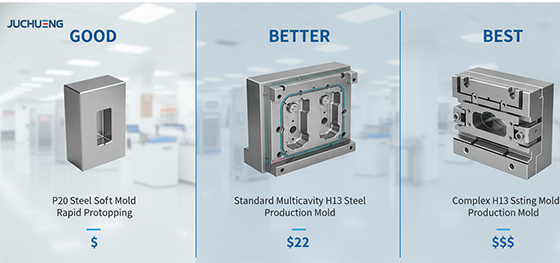
The biggest number on any die casting quote is the Non-Recurring Expense (NRE), or the tooling. This is the one-time cost to create the die. This die is a masterpiece of precision engineering, and its cost is driven by several factors.
First is complexity. A die for a simple, flat part is relatively cheap. A die for a complex part with many undercuts (requiring moving sliders) and intricate features will be much more expensive. More complexity means more steel to machine and more skilled labor.
Second is the die material. For very high volumes (100,000+ parts), the die must be made from hardened tool steel like H13. This is very expensive and slow to machine, but it can last for a very long time.
Third is the number of cavities. A single-cavity die makes one part per cycle. A multi-cavity die might make 4 or 8 parts per cycle. A multi-cavity die is much more expensive to build, but it dramatically lowers the part price later on by increasing production efficiency.
Unpacking Your Part Price
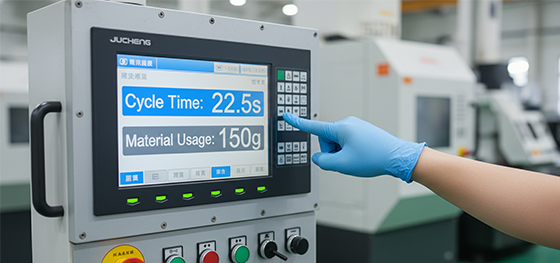
Once the die is paid for, the price per part becomes incredibly low. This price is driven by two simple factors: material and time.
The first is the cost of the raw metal. The part price includes the weight of the aluminum or zinc needed to make your part. An expensive alloy or a heavy part will have a higher material cost.
The second, and most important, factor is machine time. The part price is directly related to how long it takes to run one cycle. This "cycle time" is a combination of the injection, cooling, and ejection time. A part with very thick walls will need a very long cooling time, which increases the cycle time and the cost.
A good manufacturer works to get this cycle time as low as possible through smart die design and an efficient process. This is how you get a part price of just a few dollars, or even cents.
Calculating Your Breakeven Point
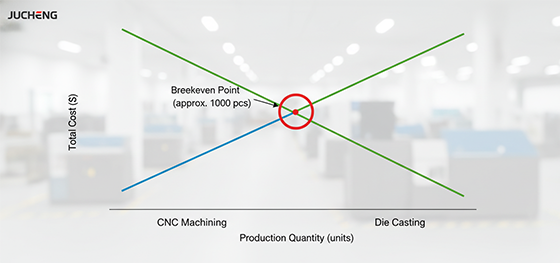
So, when does it make sense to pay the high upfront tooling cost? This is a "breakeven" calculation.
Imagine you need 2,000 units of a complex aluminum housing. To CNC machine each part might cost $50. The total cost would be 2,000 x $50 = $100,000. There is no tooling cost.
For die casting, the tooling might cost $20,000, and the part price might be $10. The total cost for 2,000 units would be $20,000 + (2,000 x $10) = $40,000. In this case, die casting is the much cheaper option.
But if you only needed 200 units, CNC machining would cost $10,000. Die casting would cost $20,000 + (200 x $10) = $22,000. Here, CNC is the smarter choice.
Somewhere between 200 and 2,000 units is the "breakeven point" where the total cost lines cross. Finding this point is the key to making a smart manufacturing decision.
Investing Smarter with a Partner

For startups and companies doing low-volume production, that high upfront tooling cost can be a major barrier. This is where choosing the right partner is critical.
A good partner does not just offer one expensive, high-volume tooling option. At JUCHENG, we specialize in low-volume manufacturing solutions. This is our killer advantage.
We can create simpler, lower-cost "prototype tooling" or "soft tooling" from pre-hardened P20 steel. These dies are not designed to last for a million cycles. But they are perfect for producing a few hundred to a few thousand parts.
This "bridge tooling" approach gets you to market fast. It allows you to test your product with real production parts, without the massive financial risk of a full production die. It is the smartest way to manage your die cast cost.
Understanding the cost is about understanding your options. We work with you as a partner. We analyze your project volume and your budget. We help you make the smartest investment to get your product off the ground.
```

