


What is a tolerance on an engineering drawing? It is more than just a number. It is a promise. It is the promise that a bearing will fit. It is the promise that two parts will assemble seamlessly. It is the promise that your product will work.
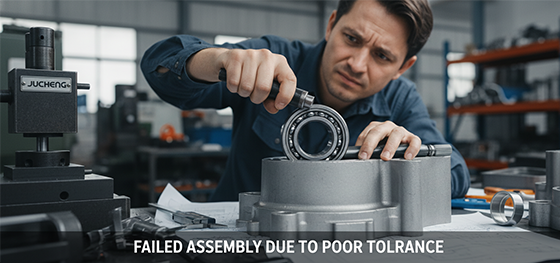
In the world of Die Casting, keeping this promise is a complex challenge. The process is fast and efficient, but it has its natural limits.
Understanding the two worlds of Die casting tolerances—what can be achieved in the mold versus what must be achieved after—is the key to a successful project. This guide will explain how a true manufacturing partner makes and keeps that promise of precision.
content:
Understanding 'As-Cast' Tolerances
The Limitations of Casting Alone
Bridging the Gap with Post-Machining
Our Promise: Data-Driven Verification
Understanding 'As-Cast' Tolerances
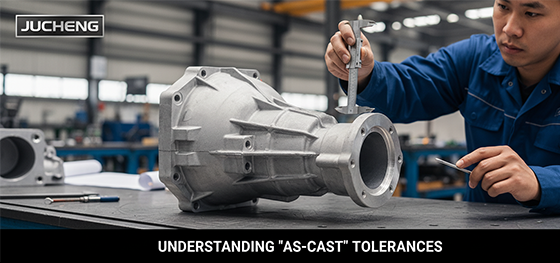
The first level of precision is the "as-cast" tolerance. This refers to the dimensional accuracy of the part as it comes directly out of the die, with no secondary operations.
For most non-critical features, this is often good enough. Modern die casting is a very precise process. It can achieve tolerances that are much tighter than other casting methods like sand casting. These standards are often defined by industry bodies, such as ISO 8062.
A typical as-cast tolerance for a well-controlled aluminum die casting might be around ±0.1mm to ±0.3mm, depending on the size and complexity of the feature. This is perfectly acceptable for the overall shape of an enclosure or the location of a non-critical rib.
The Limitations of Casting Alone
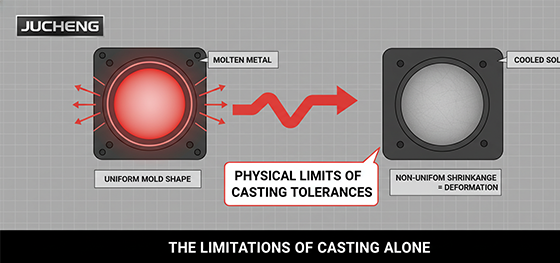
But why can't the as-cast part be perfect? The limitation is physics.
The die casting process involves molten metal solidifying in a steel die. As the metal cools from hundreds of degrees, it shrinks. This shrinkage is not perfectly uniform. Different sections of the part cool at slightly different rates, which can cause minor warping or distortion.
The die itself also wears down over thousands of cycles of extreme heating and cooling. This can lead to very slight changes in the part dimensions over a long production run.
Because of these variables, it is simply not possible to hold a tolerance of, for example, ±0.01mm on a hole diameter through casting alone. For features that require this level of extreme precision, you need a different strategy.
Bridging the Gap with Post-Machining

This is where a true one-stop manufacturing partner shows their value. This is the JUCHENG advantage. We do not see casting and machining as separate worlds. We see them as a team.
Our strategy is simple and powerful. We use die casting for what it does best: creating a complex overall shape quickly and cost-effectively. Then, we use CNC machining for what it does best: creating features with ultimate precision.
For a gearbox housing, we will die cast the main body. The overall shape will have a standard as-cast tolerance. But we will intentionally cast the critical bearing bores slightly undersized.
Then, we take the cast part and put it on one of our advanced 5-axis CNC machines. The machine then performs a secondary "post-machining" operation. It will precisely mill the bearing bores to their final, exact diameter, achieving a tolerance that casting alone could never hold. This hybrid approach gives you the best of both worlds: the cost-effectiveness of casting and the precision of machining.
Our Promise: Data-Driven Verification

Making a promise of precision is easy. Keeping it requires a commitment to quality and data.
At JUCHENG, our quality department is the final guardian of that promise. After a part has been cast and post-machined, it goes for a full inspection.
We use our high-precision CMM (Coordinate Measuring Machines) to verify every critical dimension. The machine's probe automatically measures your part and compares the data directly to your original CAD file.
We can then provide you with a full dimensional inspection report. This document is your objective proof. It is our guarantee that the Die casting tolerances we promised on paper have been achieved in metal. This is the confidence and peace of mind that comes from working with a true, vertically integrated manufacturing partner.

