


Cinema technology has found a second home on the manufacturing floor. In the expansive catalog of the 3D printing process, most technologies focus on moving a print head or a laser point across a workspace. Digital Light Processing, or dlp 3d printing, discards the concept of a "path" in favor of a "flash." Instead of tracing the outline of a part with a laser, it project a high-definition image of an entire layer onto a vat of liquid photopolymer resin. This shift from point-by-point scanning to full-layer exposure is not just a technical curiosity; it is a fundamental leap in production speed for micro-precision components.
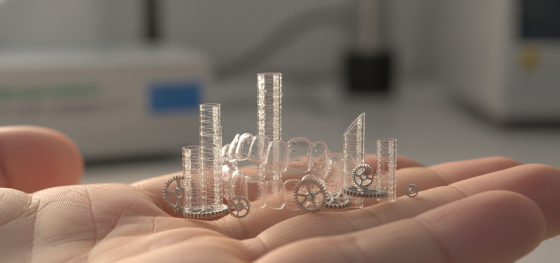
At Jucheng Precision, we view additive manufacturing through the lens of industrial pragmatism. While dlp 3d printing offers unparalleled speed for tiny, high-detail parts, it is often limited by the fixed resolution of the projector’s pixel grid. For engineers in the dental, microfluidic, and jewelry sectors, this technology provides the ability to print dozens of intricate parts simultaneously without increasing the cycle time. This guide explores the projector-based mechanics of DLP, the physics of the voxel, and why JUCHENG integrates these insights to help you choose between micro-scale DLP and our massive, industrial-tier SLA systems for your most ambitious prototypes.
Efficiency in micro-manufacturing is found in the management of pixels. You aren't just building a part; you are coordinating light at the micron level. Whether you are developing a tiny medical valve or a precision jewelry master, understanding the flash logic is essential. Let us examine the technical pillars of DLP technology and see how it redefines the speed of high-detail CNC-adjacent design.
Projector vs. Laser: The Layer Flash Logic
Speed Advantage: High-Throughput for Small Batches
Resolution and Voxels: Engineering the Pixel
Micro-Precision Applications: Dental and Medical
Strategic Selection: When to Choose JUCHENG Industrial SLA
Projector vs. Laser: The Layer Flash Logic
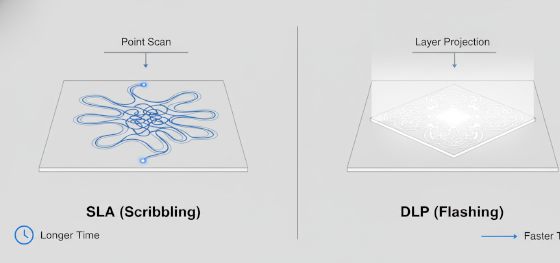
The fundamental divide between dlp 3d printing and standard SLA is the light source. In an SLA machine, a single laser point moves across the resin like a pencil drawing on paper. It must physically travel the entire distance of the part's cross-section. DLP replaces this scanning laser with a digital light projector, much like the one used in a cinema or boardroom. This projector is composed of hundreds of thousands—often millions—of micro-mirrors on a digital micromirror device (DMD) chip. Each mirror represents a single pixel. When a layer is ready to be cured, the entire image of that layer is projected through an optical lens onto the bottom of the resin tank.
This "flash" logic means that the entire surface area of the layer is solidified simultaneously. It doesn't matter if you are printing one small ring or fifty identical rings; the machine takes the same amount of time to cure the layer. This is a radical departure from the traditional 3D printing process where complexity and quantity are the primary drivers of time. However, this projection method introduces a unique geometric constraint: the pixel. Because the light is projected in a grid, the edges of a DLP part are composed of microscopic rectangles called "Voxels" (3D pixels). While modern DLP machines use advanced anti-aliasing to smooth these edges, the underlying grid resolution remains a factor that JUCHENG engineers carefully manage when selecting the optimal process for your micro-features.
Speed Advantage: High-Throughput for Small Batches
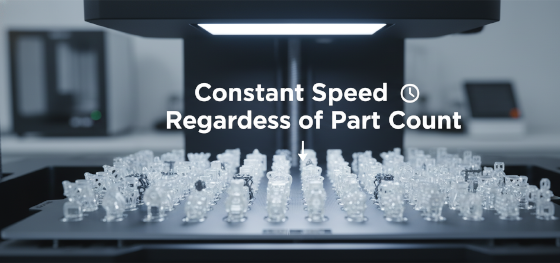
Speed is the ultimate weapon of DLP technology. In a commercial environment where "Time to Market" defines the winner, the ability to produce dozens of small parts in a matter of hours is invaluable. Because the cure time per layer is fixed—typically between 1 and 5 seconds depending on the resin—DLP thrives in "Batch Prototyping." If an engineer needs to test 20 different variations of a micro-fluidic connector, we can load all 20 designs onto a single build plate. On an SLA machine, the laser would have to trace each part, leading to a long night of printing. On a DLP machine, all 20 versions rise out of the resin at the exact same rate.
At Jucheng Precision, we utilize this high-throughput capability for our clients in the consumer electronics sector. It allows for rapid A/B testing of tactile buttons, small fasteners, and intricate decorative elements. The constant Z-axis speed also leads to more predictable production schedules. We can calculate the exact minute a batch will be finished because the horizontal complexity of the parts has zero impact on the clock. This predictability is essential for agile hardware development, ensuring that the iterative cycle of "Design-Print-Test" remains as tight as possible. For parts smaller than a few inches, the speed of DLP is the ultimate efficiency hack in the additive world.
Resolution and Voxels: Engineering the Pixel
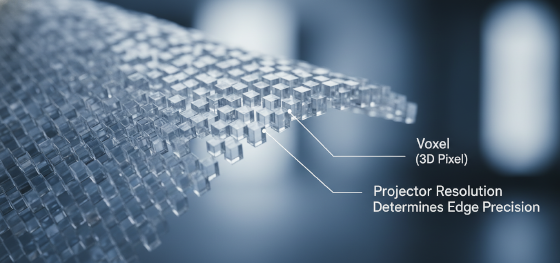
Precision in DLP is governed by the relationship between the projector’s resolution and the size of the build envelope. Most industrial DLP projectors have a fixed pixel count (e.g., 4K or 3840 x 2160 pixels). If you use that projector to cover a large build plate, each pixel becomes larger, and the resolution drops. If you concentrate that same light onto a tiny area, the pixels become incredibly small—often reaching 35 to 50 microns. This is the "Voxel Physics" of dlp 3d printing. It allows for the resolution of features that are nearly impossible to achieve with a 100-micron laser spot on a standard SLA machine.
JUCHENG technicians pay close attention to this pixel-to-part ratio. For parts requiring extreme microscopic detail—like the fine textures on a premium audio device or the internal channels of a lab-on-a-chip—we utilize high-density DLP setups with small build envelopes. This ensures that the sharpest internal corners and the smoothest curves are maintained. However, the trade-off is the "Stair-Step" effect on vertical surfaces. Because the part is built from discrete 3D blocks (voxels), a vertical wall might show a very fine grid pattern. We mitigate this through proprietary post-processing, including specialized light-sanding and UV-vapor treatments that melt the voxel boundaries into a cohesive, smooth surface. This technical rigor ensures that your micro-parts don't just measure right; they look and feel like production-grade plastic.
Micro-Precision Applications: Dental and Medical
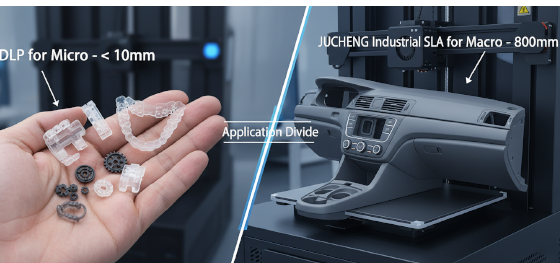
Where does DLP technology truly earn its keep? The industry that has been most radically transformed by DLP is the dental sector. Producing custom aligners, surgical guides, and crown models requires a unique blend of high accuracy and massive volume. Because every patient's anatomy is different, every part is a custom prototype. DLP’s ability to batch-produce these custom shapes in hours has revolutionized the digital dentistry workflow. We utilize specialized biocompatible resins in our DLP systems that are certified for short-term mucosal contact, allowing dentists to verify the fit of a bridge or an implant guide with absolute confidence.
In the broader medical and electronics sectors, DLP is the preferred choice for micro-components. We produce high-precision connectors for high-frequency telecommunications equipment, where the internal lattice structures must be perfect to prevent signal interference. The ability of DLP to resolve internal cavities as small as 150 microns makes it a vital tool for the microfluidics industry. Whether you are building a diagnostic chip or a miniature hearing aid housing, DLP provides the resolution needed to pack functionality into smaller and smaller spaces. At Jucheng Precision, we combine this micro-accuracy with our ISO 13485 quality protocols, ensuring that your tiny medical innovations are delivered with a full audit trail of safety and compliance.
Strategic Selection: When to Choose JUCHENG Industrial SLA
Despite the impressive speed and resolution of DLP, it is not always the best tool for the job. In the 3D printing process, scale is a critical decider. Because a DLP part is a projection, it is difficult to maintain sub-micron accuracy over a large area. As you increase the size of the part, the pixels grow, and the light becomes less uniform at the edges of the tank. This is where JUCHENG’s core expertise in industrial-grade SLA (Stereolithography) takes the lead.
While DLP is excellent for tiny, intricate parts, JUCHENG’s industrial SLA machines are the superior choice for high-detail prototypes larger than a few inches. Our large-format SLA centers can print monolithic parts up to 800mm with a laser-point accuracy that a projected grid simply cannot match over that distance. If you are building a full-sized automotive dashboard, a large medical diagnostic housing, or a complex aerospace structural frame, industrial SLA remains the more cost-effective and dimensionally stable path. We help our clients perform this "Scale vs. Detail" audit during our DFM review. We don't just "push go" on the machine you ask for; we suggest the technology that delivers the tightest tolerances for your specific volume and geometry. When your design moves past the micro-world and into the macro-world, JUCHENG’s 5-axis peek cnc machining and large-format SLA protocols clarify and elevate your most ambitious projects. Contact our engineering team today for a free technical consultation and let us help you choose the right light-cured solution for your next breakthrough.

