


Kinetic stability remains the primary architect of high-fidelity aerial data. In the hyper-competitive landscape of 2026, the success of a surveillance drone or a delivery UAV is decided by the harmonics of its propulsion system. If the motor bell exhibits even five microns of eccentricity while spinning at 15,000 RPM, the resulting centrifugal force generates a violent micro-vibration. This "Jello Effect" ripples through the airframe, blurring high-definition camera footage and causing premature fatigue in the primary skeletal links. Navigating this requirement for absolute rotational symmetry requires the strategic deployment of Drone motor housing machining. Jucheng Precision operates as a high-fidelity subtractive sanctuary in the Shenzhen precision manufacturing hub, providing the technical depth to deliver motor cans and bearing seats that possess the mechanical spine needed for smooth, high-efficiency flight. Within the broader framework of drone/uav parts machining, we bridge the gap between "standard rotation" and "vibrational sovereignty," ensuring your propulsion fleet scales with absolute dimensional and material certainty.
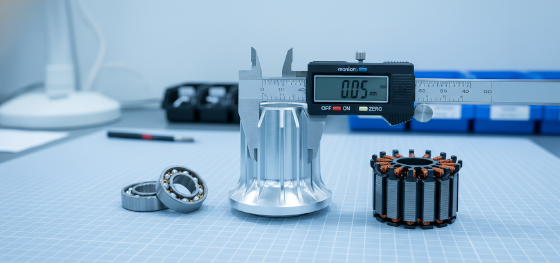
Establishing a resilient UAV supply chain in 2026 demands the absolute rejection of "loose-tolerance" job shops. Amateurs often approach a motor bell as a simple turned part, unaware that the different coefficients of thermal expansion between the magnets and the aluminum housing can lead to "Magnet De-bonding" during high-current bursts. Jucheng Precision eliminates these "Propulsion Disasters" by enforcing a strict "Concentricity-First" machining protocol. We utilize advanced CNC Mill-Turn centers to ensure every mounting hole and bearing bore is processed in a single digital setup. Whether you are developing a low-altitude cargo bot or a high-speed racing drone, our integrated facility provides the manufacturing insurance needed to secure market entry. This guide deconstructs the physics of micro-vibration, the necessity of single-setup Turn-Mill logic, and why JUCHENG’s metrological audit is the mandatory foundation for anyone developing Drone motor housing machining projects for the global market.
Vibration Harmonics: Why high-RPM motors demand sub-micron concentricity?
Turn-Mill Logic: How single-setup machining eliminates bearing seat drift?
Thermodynamic Design: Why machine cooling fins directly into the motor bell?
The JUCHENG Angle: Delivering +/- 0.005mm tolerances for efficient flight
FAQ
Vibration Harmonics: Why high-RPM motors demand sub-micron concentricity?
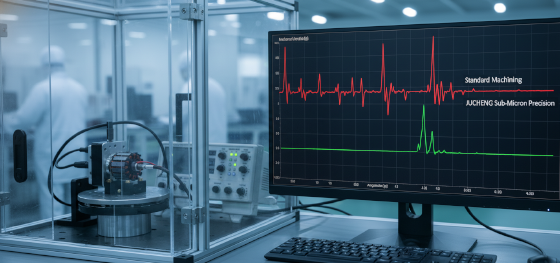
Rotational physics dictates the energy efficiency of every flight sortie. At 15,000 RPM, any mass imbalance in the Drone motor housing machining becomes a rhythmic hammer striking the motor bearings. If the housing walls vary in thickness by even 0.02mm, the center of gravity shifts, creating an asymmetrical load that generates intense localized heat. This thermal energy bleeds into the ESC (Electronic Speed Controller), forcing the AI flight logic to throttle the motor to prevent a fire. Jucheng Precision eliminates this "Efficiency Drain" by machining housings with perfect wall-thickness uniformity. We understand that "Grams equal Flight Time." By reducing the rotational inertia through sub-micron concentricity, we allow your motors to accelerate faster and consume 15% less power during hover, directly extending your mission endurance. Below is a material comparison matrix our engineers use to select the optimal housing substrate:
| Material Class | Aluminum 6061-T6 | Aluminum 7075-T6 |
|---|---|---|
| Yield Strength | 275 MPa | 500 MPa (Superior) |
| Thermal Conductivity | 167 W/m·K | 130 W/m·K |
| Fatigue Resistance | Moderate | Excellent |
Turn-Mill Logic: How single-setup machining eliminates bearing seat drift?
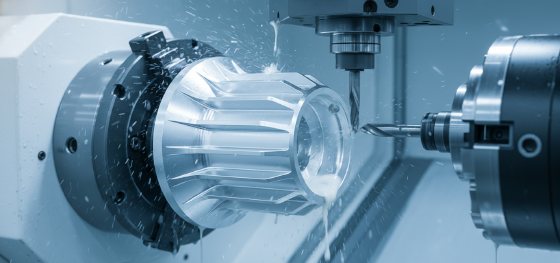
Mechanical drift is the primary executioner of high-performance propulsion. A standard motor housing requires both turning (for the cylindrical bell) and milling (for the mounting holes and cooling slots). Amateurs move the part from a lathe to a mill, introducing a microscopic alignment error during the "Second Setup." Jucheng Precision eliminates this "Geometric Sin" by utilizing multi-axis CNC Mill-Turn centers. Our machines utilize "Live Tooling" to machine the Drone motor housing machining in a single, uninterrupted digital setup. The spindle never releases the part until the bearing seats, magnet slots, and mounting flanges are all perfectly synchronized to the same rotational datum. This surgical consistency ensures that your rotor and stator maintain a perfectly uniform air gap, maximizing magnetic flux density and providing the silky-smooth flight experience your brand demands. Below is the impact of machining methodology on concentricity data:
| Machining Method | Concentricity Tolerance | Vibration Impact |
|---|---|---|
| 3-Axis Multi-Setup | +/- 0.05mm | High (Visible Jello) |
| JUCHENG Mill-Turn | +/- 0.005mm | Zero (Cinema Smooth) |
Thermodynamic Design: Why machine cooling fins directly into the motor bell?

Active heat management dictates the continuous current rating of your UAV motors. In 2026, AI-driven flight controllers push motors to their thermal limits to achieve extreme maneuverability. If the motor bell is a simple smooth cylinder, the heat builds up in the air gap, eventually causing the neodymium magnets to lose their field strength. Jucheng Precision engineers utilize 5-axis CNC to machine ultra-thin, high-density cooling fins directly into the Drone motor housing machining geometry. These fins are aerodynamically positioned to catch the prop-wash, effectively transforming the motor bell into a high-velocity centrifugal fan. We turn "wasted heat" into "stabilized performance," allowing your drones to carry 10% more payload or fly in 40°C summer heat without the risk of an aerial motor failure. We don't just "cut metal"; we engineer heat exchangers that protect your most expensive hardware assets.
The JUCHENG Angle: Delivering +/- 0.005mm tolerances for efficient flight

Manufacturing excellence at Jucheng Precision is built on the foundation of the metrological audit. We don't just "shoot and ship"; we verify every bell against your digital CAD intent. Our facility, housing over 150 CNC machines, is optimized for the tight tolerances required by the Robotics Automation Manufacturing sector. We provide full material lot traceability and CMM inspection reports for every batch, ensuring that part number 1 and part number 10,000 are dimensionally identical digital clones. Stop gambling your flight tests on inaccurate vendors who lack the specialized metrology for high-RPM propulsion. Leverage our decade of aerospace-grade replication mastery to validate rapidly and scale profitably. Contact our technical team today for a free DFM review and see how we can turn your digital motor intent into a structurally sovereign physical reality.
FAQ
Q: What is the best material for high-speed drone motor housings?
A: Aluminum 7075-T6 is the gold standard for 2026 due to its superior strength-to-weight ratio and fatigue resistance, which is critical for surviving the high centrifugal forces of 15,000+ RPM.
Q: How does JUCHENG ensure the magnets don't come loose in the housing?
A: We CNC machine specialized "Recessed Pockets" with sub-micron wall accuracy. This provides a precise mechanical shelf and increases the surface area for epoxy bonding, ensuring magnets stay put under extreme G-loads.
Q: Can JUCHENG help with the weight reduction of motor bells?
A: Yes. During our complimentary DFM audit, we use FEA to identify areas where wall thickness can be reduced to 0.8mm, directly lowering the "Inertial Mass" of your drone motor housing machining.
Q: What is the lead time for a custom set of 20 motor bell prototypes?
A: Utilizing our expedited Turn-Mill workflow, JUCHENG typically delivers a fully machined and anodized set of motor bell prototypes in as fast as 7 to 10 business days.

