


Kinetic impact remains the final judge of autonomous hardware integrity. In the hyper-accelerated landscape of the 2026 low-altitude economy, the transition from lightweight hobbyist drones to 100kg-plus commercial UAVs represents a violent leap in mechanical load cases. For engineers, the primary adversary is not the landing algorithm—it is the physical "Thermal and Shock Fatigue" inherent in the touchdown cycle. If the landing gear struts flex or fracture during a hard descent or an emergency auto-rotation, the $50,000 LiDAR and camera payload is instantly destroyed, leading to total program loss. Navigating this requirement for extreme energy absorption and sub-micron joint stability requires the strategic deployment of UAV landing gear manufacturing. Jucheng Precision operates as a high-fidelity metallurgical sanctuary in the Shenzhen precision manufacturing hub, providing the exotic subtractive depth needed to conquer the most challenging aerospace alloys. Within the broader framework of drone/uav parts machining, we bridge the gap between "concept landing" and "industrial-grade survival," ensuring your fleet maintains its structural sovereignty through thousands of operational sorties.
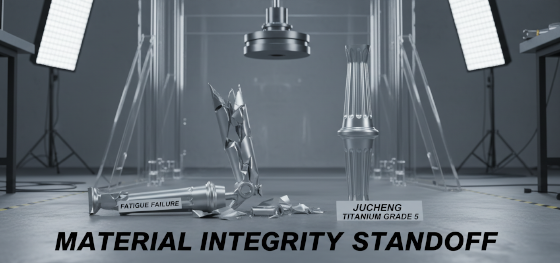
Establishing a resilient aerial supply chain in 2026 demands the absolute rejection of "Office-Grade" material logic. Amateurs often default to 6061 aluminum or standard carbon fiber for landing assemblies, unaware that the repetitive stress of hard landings will work-harden these materials into a brittle state within months. Jucheng Precision eliminates these "Field Disasters" by enforcing a strict "High-Strength-to-Weight" material protocol. We utilize 5-axis CNC machining to carve landing struts from Titanium Grade 5 (Ti-6Al-4V), a material that offers the tensile strength of hardened steel at nearly half the mass. Whether you are developing a retractable electric gear set for a delivery bot or a fixed bionic strut for an agricultural sprayer, our integrated facility provides the material science and metrological rigor required for global market entry. This guide deconstructs the necessity of titanium selection, the thermodynamics of high-pressure machining, and why JUCHENG’s "Shock-Ready Protocol" is the mandatory foundation for anyone developing UAV landing gear manufacturing projects.
Surviving Touchdown: The Physics of High-Impact Landing Forces
Titanium Grade 5: Why ignore aluminum for heavy commercial drones?
Thermal Warfare: Mastering the gummy nature of Titanium Grade 5
The JUCHENG Angle: High-pressure coolant systems and carbide precision
FAQ
Surviving Touchdown: The Physics of High-Impact Landing Forces
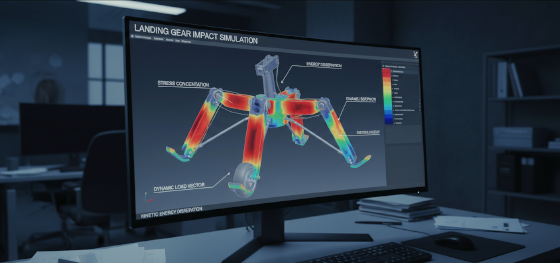
Mechanical leverage in the vertical axis dictates the lifespan of the entire drone airframe. In the world of UAV landing gear manufacturing, the strut acts as a massive mechanical fuse. During a hard landing, the kinetic energy of the falling robot must be converted into elastic deformation or dissipated through the suspension system. If the landing gear is too rigid, the shockwave travels directly into the motor mounts and sensor housings, causing microscopic stress fractures in the humanoid robot parts often used in articulated drone effectors. Jucheng Precision engineers utilize Finite Element Analysis (FEA) to identify the "Fracture Path" in your designs. We don't just "cut parts"; we optimize the geometry to ensure the material yield point is never exceeded during a 3-meter-per-second vertical descent. By engineering controlled flex into the titanium struts, we provide a structural buffer that protects your most expensive internal logic and optical arrays from the violence of the ground.
Titanium Grade 5: Why ignore aluminum for heavy commercial drones?
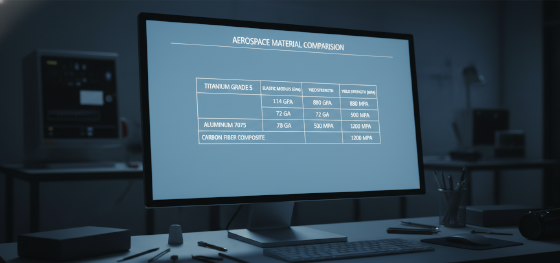
Molecular density versus yield strength represents the primary trade-off in aerospace hardware. While Aluminum 7075-T6 is a spectacular material for airframes, its fatigue limit makes it a dangerous choice for the constant "hammering" of landing cycles. UAV landing gear manufacturing for the 2026 industrial sector almost exclusively relies on Titanium Grade 5 (Ti-6Al-4V). Titanium possesses a unique "Infinite Fatigue Life" below its stress threshold, meaning a properly designed titanium leg can strike the ground a million times without accumulating micro-fractures. Furthermore, titanium has a relatively low Young’s Modulus compared to steel, making it significantly more "springy." This inherent elasticity allows the landing gear to act as a natural leaf spring, absorbing energy that would otherwise destroy a rigid aluminum assembly. To assist in your material selection, Jucheng Precision provides the following technical matrix:
| Property | Aluminum 7075-T6 | Titanium Grade 5 (Ti-6Al-4V) |
|---|---|---|
| Yield Strength | 500 MPa | 880+ MPa (Superior) |
| Elastic Modulus | 72 GPa | 114 GPa (Perfect Balance) |
| Fatigue Limit | Low (Finite) | High (Infinite below limit) |
| Machining Ease | Excellent | Difficult (High Heat) |
Thermal Warfare: Mastering the gummy nature of Titanium Grade 5
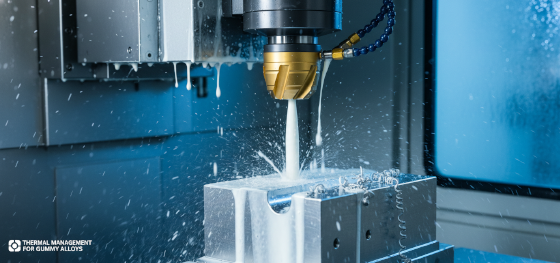
Thermodynamic insulation dictates the difficulty of machining landing gear links. Titanium is notoriously "gummy"—it has a low thermal conductivity that prevents heat from escaping into the chips or the metal block. Instead, 80% of the cutting heat is concentrated at the very tip of the CNC tool. If an amateur shop runs the spindle too fast, the tool will instantly weld to the landing strut, causing "Work-Hardening" that ruins the part. Jucheng Precision eliminates this "Machining Trap" by utilizing specialized positive-rake carbide tooling with polished flutes. We take shallow, high-velocity cuts that remove the metal before the heat can settle into the polymer chains or grain boundaries. This "Cold-Cut" philosophy ensures your mounting flanges and bores are machined with sub-micron accuracy, providing the tight-tolerance interfaces needed for retractable landing mechanisms to operate without binding.
The JUCHENG Angle: High-pressure coolant systems and carbide precision
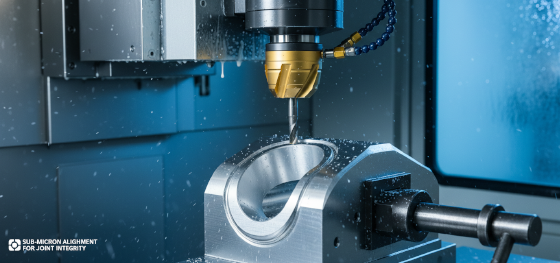
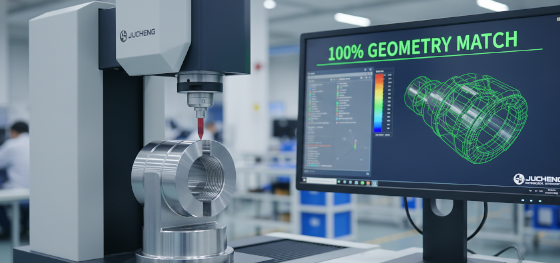
Manufacturing excellence at Jucheng Precision is built on the foundation of specialized aerospace equipment. We don't just "cut metal"; we manage a thermodynamic crisis. Our facility, housing over 150 CNC machines including 5-axis Haas and Mazak centers, utilizes 1,000 PSI Through-Spindle Coolant (TSC) systems for all UAV landing gear manufacturing projects. This high-pressure hydraulic jet shatters the "Vapor Barrier" at the tool tip, instantly quenching the cutting zone and violently flushing away the hot chips. This process is mandatory to achieve the Ra 0.4 µm surface finish required for fatigue-resistant aeronautical parts. We provide full material lot traceability and CMM inspection reports for every batch, ensuring your project meets the strict requirements of the 2026 low-altitude economy. Stop gambling your drone’s payload on inaccurate vendors who fear titanium. Leverage our decade of high-performance metallurgical mastery to validate rapidly and launch confidently.
FAQ
Q: Why is Titanium better than Aluminum for UAV landing gear manufacturing?
A: Titanium Grade 5 offers nearly double the strength of aluminum with a much higher fatigue limit, allowing it to survive thousands of hard landings without cracking or permanent deformation.
Q: Can JUCHENG handle retractable landing gear assemblies?
A: Yes. We CNC machine the high-precision housings, linkages, and gear-sets required for retractable systems, achieving the +/- 0.01mm tolerances needed for smooth, jam-free operation.
Q: Do you offer surface treatments for titanium landing gear?
A: JUCHENG provides specialized Tiodize (Type II Anodize) for titanium, which improves lubricity and wear resistance for moving joints and prevents the "Galling" common in aerospace interfaces.
Q: What is the lead time for a prototype set of titanium drone legs?
A: Utilizing our expedited aerospace workflow and in-house 5-axis machines, we can deliver a fully machined and tested set of titanium struts in as fast as 10 to 14 business days.

