


Payload efficiency remains the final judge of autonomous mission success. In the high-velocity landscape of 2026, the transition from hobbyist composite kits to industrial-grade airframes represents a violent leap in mechanical requirements. For UAV hardware engineers, the primary adversary is not the flight control code—it is the physical "Mass Debt" that drains battery life and limits the mission endurance of delivery and surveillance craft. If the primary airframe flexes under high-G maneuvers or vibrates due to insufficient joint stiffness, the sensor data becomes corrupted, and the motors must compensate through excessive current draw. Navigating this demand for extreme strength-to-weight ratios requires the strategic deployment of Lightweight drone frame machining. Jucheng Precision operates as a high-fidelity subtractive sanctuary in the Shenzhen precision manufacturing hub, providing the 5-axis CNC depth needed to transform raw billets into bionic skeletons. Within the broader framework of drone/uav parts machining, we bridge the gap between "prototype flight" and "certified airworthiness," ensuring your fleet maintains its sub-micron repeatability through the most aggressive mobility audits.
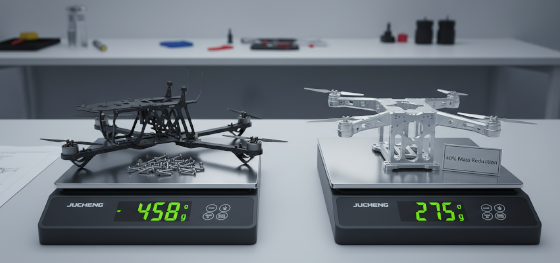
Establishing a resilient aerial supply chain in 2026 demands the absolute rejection of "assembled-only" frames. Amateurs spend forty percent of their R&D cycle managing dozens of separate brackets, screws, and spacers, unaware that every fastener adds a "Weight Tax" and a potential failure point under vibration. Jucheng Precision eliminates this "Structural Bloat" by providing an integrated ecosystem of 5-axis CNC machining and high-speed milling. Whether you are developing a low-altitude delivery bot or a high-end cinema drone, our facility provides the material science and metrological rigor required for market entry. This guide deconstructs the necessity of 7075-T6 selection, the physics of 1mm thin-wall stability, and why JUCHENG’s "Monolithic Protocol" is the mandatory foundation for anyone developing Lightweight drone frame machining projects for global deployment.
Rigidity for SWaP Success: Why frame stiffness dictates flight stability?
Alloy Standoff: Choosing between Aluminum 7075 and Magnesium AZ31B
Thin-Wall Physics: Mastering sub-1mm bionic structures without warping
Monolithic Construction: Eliminating fasteners to slash takeoff weight
JUCHENG Protocol: Zero-Backlash Metrology and CMM Verification
FAQ
Rigidity for SWaP Success: Why frame stiffness dictates flight stability?
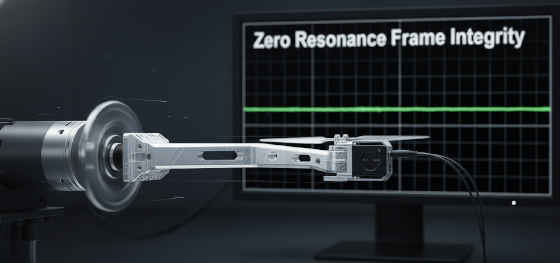
Mechanical resonance represents the primary saboteur of autonomous sensor data. In the world of Lightweight drone frame machining, the term SWaP (Size, Weight, and Power) is the governing law of physics. A frame that is light but "floppy" will suffer from harmonic oscillations as the brushless motors spin at 10,000 RPM. These micro-vibrations travel through the airframe and reach the IMU and LiDAR sensors, creating digital "noise" that forces the flight controller to make unnecessary corrections. Jucheng Precision eliminates this "Kinetic Noise" by engineering high-modulus skeletal structures. We utilize 5-axis CNC to machine non-linear internal ribs that follow the stress vectors identified in your FEA reports. By maximizing the flexural modulus of the frame linkages, we ensure your sensors provide a stable point-cloud, effectively increasing your robot's navigational accuracy and reducing motor overheating. We turn "flexible linkages" into "rigid conduits of movement," armoring your UAV against the aerodynamic chaos of high-altitude flight.
Alloy Standoff: Choosing between Aluminum 7075 and Magnesium AZ31B
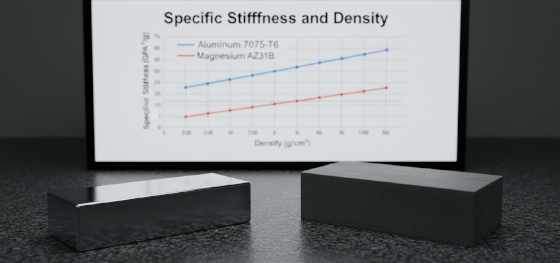
Molecular density dictates the ultimate range of your autonomous fleet. Selecting the correct substrate for Lightweight drone frame machining is a balance between "Fatigue Strength" and "Density Reduction." Jucheng Precision primarily utilizes two elite alloys. Aluminum 7075-T6 is the undisputed champion for structural spars and heavy-payload arms due to its yield strength (500+ MPa), which mirrors many steels at 33% of the mass. However, for 2026 projects pushing the limits of endurance, we pivot to Magnesium AZ31B. Magnesium is a staggering 33% lighter than aluminum and possesses superior vibration-damping properties. We navigate the "Flammability and Corrosion" risks of magnesium through specialized wet-machining protocols and immediate PEO (Plasma Electrolytic Oxidation) coatings. By matching the alloy to your specific mission profile, we deliver airframes that are as light as a composite shell but with the indestructible mechanical soul of a precision-machined asset.
Thin-Wall Physics: Mastering sub-1mm bionic structures without warping
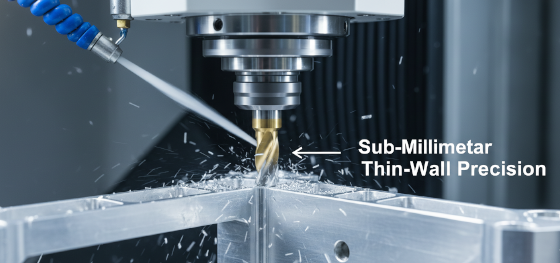
Subtractive perfection reaches its physical limit at the 0.8mm barrier. To achieve the "Bionic" geometries required for modern UAVs, engineers design hollow internal bays with walls as thin as paper. Lightweight drone frame machining at Jucheng Precision is a surgical exercise in "Thermal and Mechanical Balance." Standard machining creates "Spindle Chatter" that causes these thin aluminum or magnesium skins to vibrate and warp during the cut. We utilize high-speed spindles (up to 30,000 RPM) combined with custom vacuum work-holding fixtures that support the delicate walls throughout the cycle. By taking "Peel Milling" passes—removing only microns of material at a time—we ensure zero geometric drift. This capability allows you to integrate battery compartments and electronic mounts directly into the structural skin, maximizing the internal "Cube Space" while maintaining a rigid, warp-free exterior that survives the most aggressive flight audits.
Monolithic Construction: Eliminating fasteners to slash takeoff weight
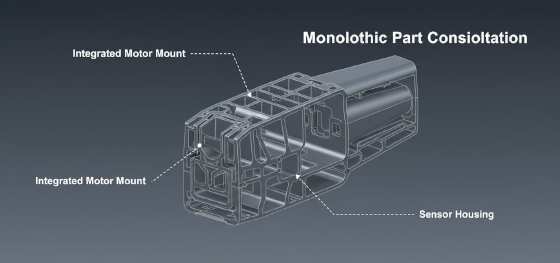
Manufacturing velocity is won through the elimination of the "Fastener Penalty." A traditional drone frame composed of carbon fiber plates and aluminum standoffs can require over 100 individual steel bolts. These bolts add "Parasitic Mass" that contributes zero to the structural modulus. Jucheng Precision advocates for the "Monolithic Mandate." By utilizing our 5-axis CNC fleet, we machine the entire central torso or main spar assembly from a single solid block. This integrated approach to Lightweight drone frame machining eliminates the weight of fasteners and the risk of bolts vibrating loose during a mission. Monolithic parts provide a unified stress path, significantly increasing the fatigue life of the airframe compared to assembled versions. We turn "jointed kits" into "single-piece airframes," delivering a structurally sovereign physical reality that is ready for immediate flight integration.
JUCHENG Protocol: Zero-Backlash Metrology and CMM Verification
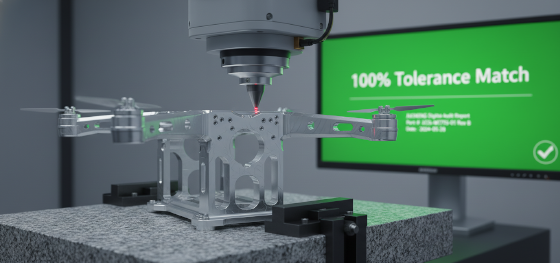
Engineering excellence at Jucheng Precision is built on the foundation of metrological certainty. We don't just "mold and machine"; we verify every motion center against your digital intent. Our facility, housing over 150 machines, is optimized for the tight tolerances required by the aerospace sector. For every drone/uav parts machining batch, we provide full material lot traceability and CMM dimensional inspection reports, ensuring that part number 1 and part number 1,000 are identical digital clones. Stop gambling your flight tests on inaccuratevendors who lack the specialized metrology for aeronautical hardware. Leverage our decade of high-performance replication mastery to validate rapidly and scale profitably. Contact our technical team today for a free DFM review and see how we can turn your digital UAV intent into a structurally sovereign physical reality.
FAQ
Q: What is the lightest material for Lightweight drone frame machining?
A: Magnesium AZ31B is currently the lightest structural metal, offering a 33% weight saving over aluminum 6061 while providing excellent vibration damping.
Q: Can JUCHENG machine internal channels for wiring inside the frame?
A: Yes. We utilize 5-axis deep-hole drilling and undercut milling to create hidden internal cable-routing paths, protecting your electronics and improving aerodynamics.
Q: How do you prevent corrosion on magnesium drone frames?
A: We implement a mandatory chemical conversion coating or Micro-Arc Oxidation (MAO) immediately after machining to provide an inert barrier against humidity and salt spray.
Q: What is the lead time for a monolithic 7075 aluminum frame?
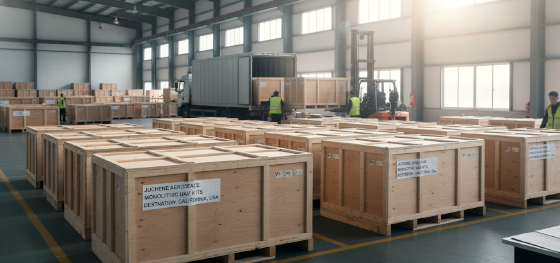
A: Utilizing our expedited aerospace workflow, JUCHENG can deliver a fully machined and anodized drone frame in as fast as 10 to 14 business days.

