


Aerodynamic efficiency dictates the commercial ceiling of unmanned flight technology. In the hyper-agile landscape of 2026, the transition from internal skeletal structures to the final outer skin represents a violent leap in cosmetic and aerodynamic requirements. For hardware innovators, the primary adversary is not the propulsion logic—it is the "Tooling Ransom" associated with large-format curved fairings and canopies. If your team requires twenty high-fidelity units for wind tunnel validation or an investor roadshow, spending fifty thousand dollars on a multi-cavity steel injection mold is a strategy for capital exhaustion. Navigating this requirement for retail-ready aesthetics and geometric stability requires the strategic deployment of UAV prototype vacuum casting. Jucheng Precision operates as a high-fidelity replication sanctuary in the Shenzhen precision manufacturing hub, providing the technical depth to deliver polyurethane shells that possess the mechanical spine and aesthetic soul of a mass-produced product. Within the broader framework of drone/uav parts machining, we bridge the gap between "rough 3D prints" and "market-ready sovereignty," ensuring your aerodynamic fleet scales with absolute material and dimensional certainty.
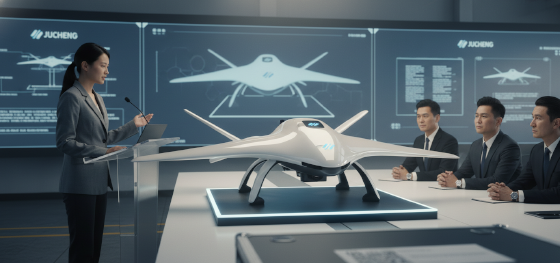
Establishing a resilient aerial supply chain in 2026 demands the rejection of "experimental-grade" additive surfaces. Amateurs often attempt to sand 3D-printed fairings for wind tunnel tests, unaware that the inherent surface porosity and layering create microscopic turbulence that ruins drag coefficient data. Jucheng Precision eliminates these "Aesthetic and Technical Failures" by utilizing advanced silicone tooling protocols. We don't just "mold shapes"; we replicate the exact surface energy and VDI texture of a CNC-machined master pattern. Whether you are developing an autonomous cargo drone requiring a ruggedized shell or a micro-UAV needing a crystal-clear lens, our facility provides the material science and finishing rigor required for global market entry. This guide deconstructs the necessity of 10-day rapid tooling, the physics of wind-tunnel ready surfaces, and why JUCHENG’s "Showroom Protocol" is the mandatory foundation for anyone developing UAV prototype vacuum casting projects for high-stakes demos.
Solving the Tooling Dilemma: Why avoid $50,000 injection molds?
The Silicone Solution: Delivering high-fidelity urethane parts in 10 days
Wind Tunnel Ready: Achieving glass-smooth surface finishes
The JUCHENG Angle: Retail-ready UAV shells with automotive finishes
FAQ
Solving the Tooling Dilemma: Why avoid $50,000 injection molds?
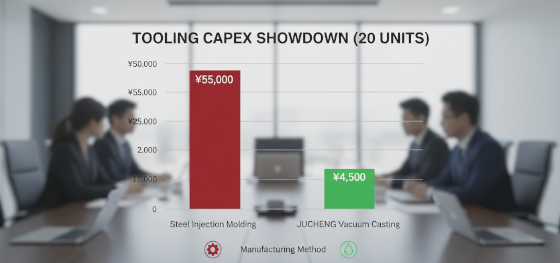
Financial suicide occurs when an engineer applies high-volume manufacturing logic to an iterative prototype phase. In the world of UAV prototype vacuum casting, the quantity required for a fleet of beta-testing drones usually ranges from 10 to 50 units. At this volume, high-pressure injection molding is financially impossible; the multi-ton steel tools required to resist injection forces can easily breach the $50,000 threshold. If your design team discovers an aerodynamic flaw during the first flight, that $50k tool becomes a permanent sunk cost. Jucheng Precision eliminates this "CapEx Anchor" by utilizing low-pressure silicone tooling. We turn an eighty-thousand-dollar debt into a four-thousand-dollar tactical expense. This economic pivot allows you to preserve your venture capital for software optimization and motor procurement, ensuring your brand stays lean and responsive to the rapid hardware changes of the autonomous era.
The Silicone Solution: Delivering high-fidelity urethane parts in 10 days
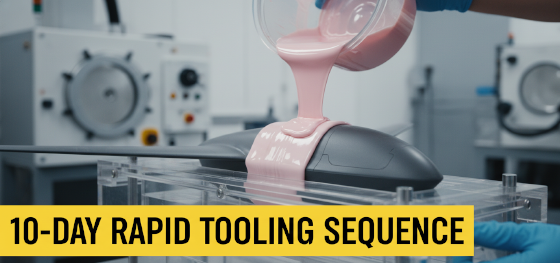
Mechanical agility is achieved through the management of atmospheric pressure rather than hydraulic force. UAV prototype vacuum casting utilizes Room Temperature Vulcanizing (RTV) silicone to replicate a CNC-machined "Golden Master." Jucheng Precision technicians mix specialized two-part polyurethane resins—formulated to mimic the flexural modulus of ABS or Polycarbonate—inside a deep-vacuum chamber. This total evacuation of air ensures that every thin aerodynamic rib and mounting lip is filled with 100% dense polymer, free of microscopic voids. We can deliver a batch of 20 identical fairings in just 10 business days. This velocity is vital for securing market interest; you can have physical hardware in the hands of your sales team while your competitors are still waiting for their first DFM review from a high-volume tool shop. We turn "digital intents" into "tangible flight assets" in record time.
Wind Tunnel Ready: Achieving glass-smooth surface finishes
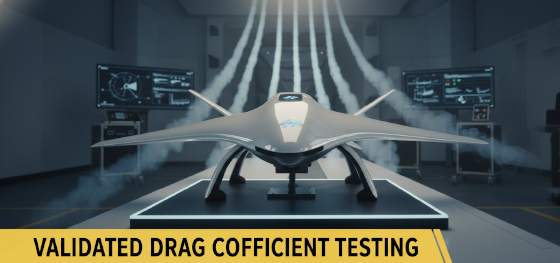
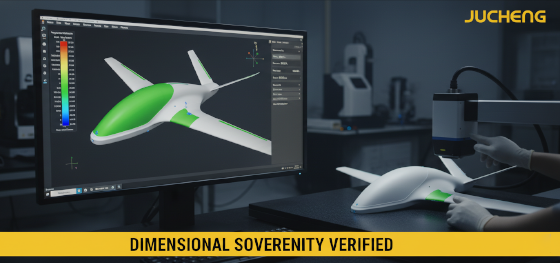
Surface topography dictates the validity of your aerodynamic data. For UAV prototype vacuum casting projects intended for wind tunnel trials, any surface roughness (Ra) above 0.8 µm will trigger premature flow separation, resulting in false drag coefficients. Jucheng Precision eliminates this "Data Corruption" through surgical master-pattern finishing. We utilize 5-axis CNC machines to cut the initial geometry, followed by hundreds of hours of progressive hand-polishing and buffing to achieve an SPI A-1 mirror finish on the master. The liquid silicone tool captures this mirror finish with 99.9% fidelity. When the polyurethane resin is cast, the resulting part possesses a glass-smooth surface energy that allows air molecules to glide over the canopy with zero parasitic drag. We provide the structural and cosmetic truth required to ensure your flight range simulations match your physical flight results.
The JUCHENG Angle: Retail-ready UAV shells with automotive finishes
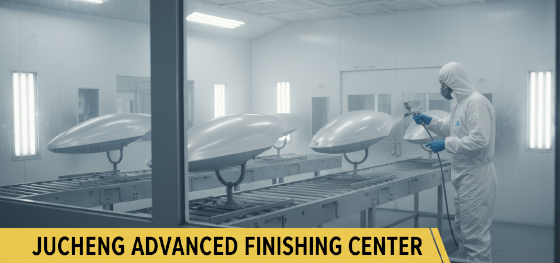
Visual authority is won in the finishing cleanroom. A UAV prototype vacuum casting run at Jucheng Precision concludes in our integrated painting department. We recognize that for investor demos and marketing photography, the "First Impression" is everything. We apply automotive-grade 2K coatings and UV-resistant clear coats that provide extreme color depth and scratch resistance. Our facility integrates large-format silk-screening for brand logos and precision laser-etching for backlit sensor indicators. We turn "grey plastic mockups" into "retail-ready hardware," ensuring your prototypes look as advanced as the intelligence driving them. We provide the manufacturing insurance needed to secure project funding and market interest, delivering the visual soul your hardware requires for a successful 2026 launch.
FAQ
Q: Can UAV prototype vacuum casting simulate carbon fiber aesthetics?
A: Yes. Jucheng Precision can utilize specialized high-gloss black resins and secondary "carbon-weave" hydro-dipping or painting techniques to provide the look of high-end composites on a prototype budget.
Q: What is the largest aerodynamic canopy JUCHENG can cast?
A: Our oversized vacuum chambers in Shenzhen can handle parts up to 2 meters in length, specifically designed for large-format delivery drones and industrial surveillance airframes.
Q: How durable are the materials used in UAV prototype vacuum casting?
A: We utilize industrial-grade polyurethane simulants that mirror the impact strength and HDT (Heat Deflection Temperature) of production ABS and PC, making them suitable for real-world flight testing and crash-resistance audits.
Q: Can JUCHENG handle the 3D printed drone parts master pattern creation?
A: Absolutely. Our integrated facility can 3D print your master using high-resolution SLA, polish it to a mirror finish, and then use it to create the silicone mold for your UAV prototype vacuum casting run.

